A 14 Year Boy Old Buried Alive: Are Children Truly Safe After Speaking Up?
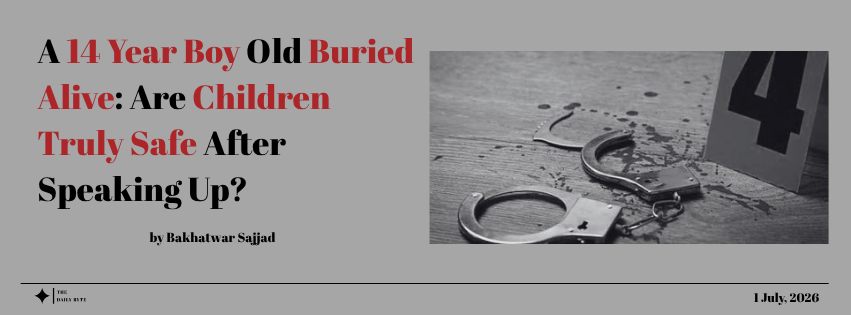
The recent Sargodha case, in which a 14 year old boy was allegedly buried alive after disclosing sexual abuse, has once again raised serious concerns about child protection in Pakistan. While police continue to investigate the case, it raises an important question: Are we doing enough to protect children after they speak up?
Mohammad Danish,
also known as Ghulam Rasool, a 14 year old resident of Mauza Mari (Mari
Lak village) on the outskirts of Sargodha, left his home on the evening of June 25 at around 4:30 pm to attend a Majlis of 9th Muharram but did not return home.
When he failed to return that night, his mother alerted the police, and the
family searched for him throughout the night but could not find him.
The next morning, on June 26, at around 11 am, the boy's parents and a neighbour continued searching in the
nearby agricultural fields. While searching, they heard faint cries and
whimpering coming from the ground. As they moved closer, they noticed one of
the boy's legs protruding from the soil. They immediately dug through the soil
and rescued him alive. Rescue 1122 shifted him to the District Headquarters
(DHQ) Hospital in Sargodha, where doctors later confirmed that his condition was
stable and that he was out of danger. After regaining consciousness, the victim
recorded his statement before the police.
According to police, the crime
involved three brothers belonging to an influential local family:
- Qamar Abbas
(main suspect)
- Amjad
- Mohammad Waris
Police said that around 20 days
before the incident, the victim was allegedly sexually assaulted by Qamar
Abbas, who also allegedly threatened him with serious consequences if he
disclosed the abuse. According to the investigation, the victim later informed
Amjad, the suspect's elder brother, about the alleged assault.
Police further alleged that after
learning the abuse had been disclosed, the suspects intercepted the boy,
questioned him, abducted him, severely beat him, and took him to a deserted
agricultural field, where they allegedly buried
him alive.
On June 26, an FIR was registered at Jhal Chakkian Police Station on the complaint of the victim's
mother. The case was registered under the relevant sections of the Pakistan
Penal Code, including Section 34, Section
334 (attempted murder), and Section
376(3), relating to the sexual assault of a minor.
According to District Police Officer
(DPO) Mohammad Sohaib Ashraf, Amjad and Mohammad Waris were arrested shortly
after the incident, while the main suspect, Qamar Abbas, initially fled but was
later arrested. Police said all three suspects are now in police custody, and
the investigation is continuing from every angle. The victim's family has
demanded justice and called for strict legal action against those responsible.
This incident is not just another
criminal case. It once again highlights the serious concerns surrounding child
protection and the safety of victims who report abuse.
Speaking about abuse is never easy
for a child. Many children do not report abuse because of fear, shame, threats,
the lack of a trusted adult, or fear of being judged. Parents should create an
environment where their children feel comfortable talking about anything
without fear. At the same time, responsibility does not rest on parents alone.
Schools, communities, child protection authorities, and law enforcement
agencies all have an important role in making sure every child knows where to
seek help and feels safe enough to report abuse.
Pakistan continues to witness
hundreds of child abuse cases every year despite having child protection laws
and institutions. This raises another important question: If these laws and systems already exist, why do such incidents
continue to occur? Is the challenge the law itself, or its
implementation?
Every child deserves to feel safe enough to speak up without fearing the consequences. This case should not become just another headline that people forget after a few days. Speaking up should never put a child's life at greater risk. Every child who reports abuse deserves protection, justice, and the confidence that someone will stand by them.