Bus Crash That Killed 13 Sparks Protests in Iran
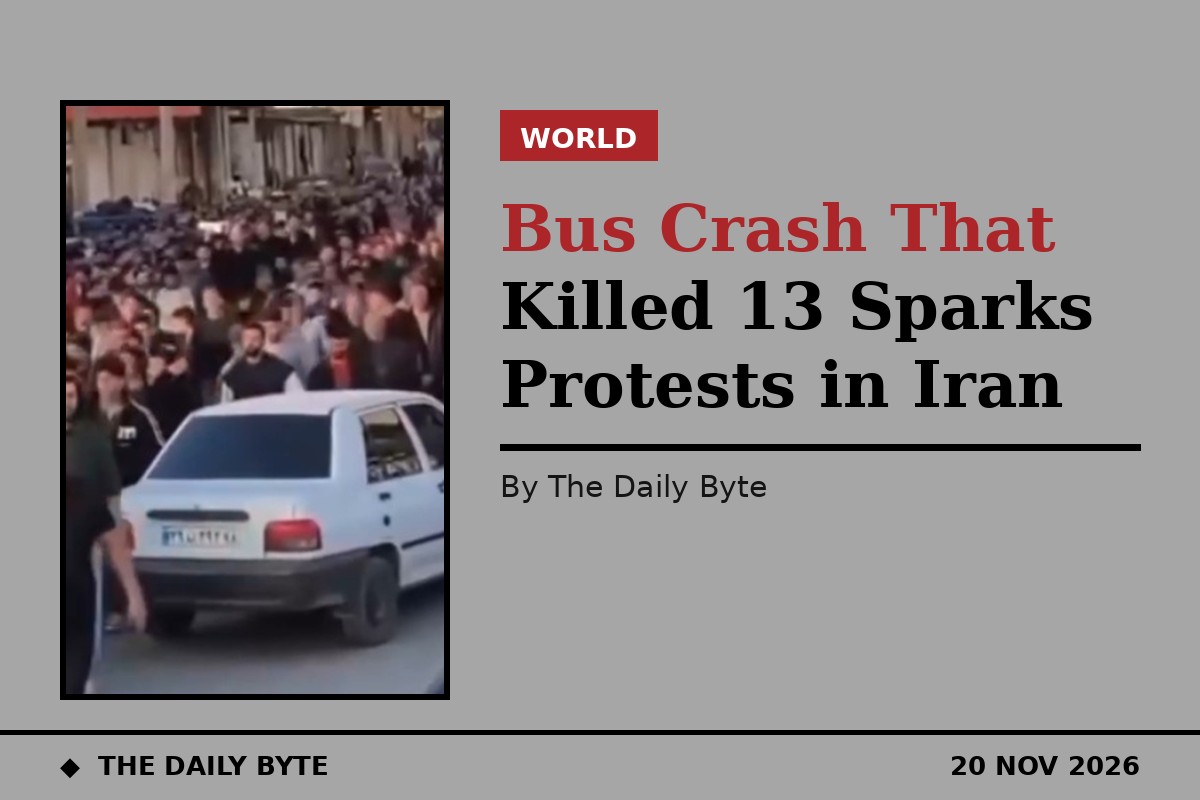
Hundreds of people protested in the western Iranian city of Abdanan on Tuesday after a bus crash killed 13 oil workers, in a rare public display of anti-government anger that grew from demands for accountability into calls for the overthrow of the Islamic Republic.
The unrest erupted in Abdanan, a city in Iran's Ilam province near the Iraqi border, where residents first gathered to demand answers over Saturday's fatal accident before turning their anger toward the country's leadership. A video verified by The Associated Press showed protesters chanting "Death to the dictator!"
The bus was carrying workers from the Dehloran gas processing project when it overturned on Saturday evening. Thirteen people were killed and more than a dozen injured, according to Iranian media reports.
From mourning to protest
The demonstration began in Abdanan's Vali-e Asr Square, where between 200 and 300 people initially gathered, according to Iran's Revolutionary Guard-affiliated Fars news agency, before the crowd grew to roughly 1,000. At first the slogans focused on the crash, with protesters chanting "Today is the day of mourning" and "Resign, resign", but they soon took on a political character.
Videos circulating on social media, obtained by Iran International and reported by other Persian-language media, showed demonstrators chanting "Long live the Shah" and "This is the final battle, Pahlavi will return", in support of the former monarchy that predated the 1979 Islamic Revolution. Other slogans included "Poverty, corruption, high prices, we will march until the overthrow".
Banners associated with the Ministry of Intelligence and the Basij paramilitary force were torn down during the demonstrations, according to footage reviewed by Euronews Persian, and a large section of Abdanan's bazaar closed in solidarity with the demonstrators and the victims' families.
The crash and the official response
Provincial traffic police identified driver negligence, irregularities involving the company's bus contract and inadequate road barriers as factors contributing to the accident, Euronews Persian reported. Prosecutors have announced legal proceedings against the company and provincial transportation officials, although responsibility has not been established in court.
Abdanan's prosecutor, Amrollah Misaie, said anyone seeking to exploit the crash to disrupt public order would be dealt with firmly, according to the judiciary-affiliated Mizan news agency, as quoted by AFP. The Abdanan Security Council threatened residents, urging them to stay calm and avoid participating in protests it described as unlawful.
Crackdown and arrests
Security forces moved to suppress the demonstrations. The Kurdistan Human Rights Network said officers fired tear gas and that internet access was cut to hinder communication among protesters. IranWire, citing the Kurdistan Press Agency, reported that special units were deployed across the city and that protesters faced tear gas and pellet fire.
At least seven people were arrested, including a 15-year-old boy, according to the Hengaw Organization for Human Rights. The organisation named four of those detained as Sina Darvishi, Saeed Abdollahi, Iraj Heydari and Mohsen Bavir, and said Bavir was released several hours after his arrest, while the whereabouts of the others remained undisclosed.
A town with a history of protest
Abdanan, a town of about 24,000 people, was one of the centres of the nationwide anti-government protests in January, and home to some of the most violent crackdowns by Iran's security forces. The United Nations special rapporteur on human rights in Iran, Mai Sato, told The Associated Press in Paris on Wednesday that repression has intensified in the 10 months since January.
Messages of solidarity with Abdanan's protesters were reported from residents in several other Iranian cities, including Bandar Abbas, Tabriz, Tehran, Mashhad, Rasht, Arak and Maragheh, though those reports do not independently establish that demonstrations took place in the other cities. The Organizing Council of Oil Contract Workers' Protests also issued a statement expressing solidarity, linking the demonstrations to broader economic grievances, including poverty, rising prices and corruption.
For now, the protest in Abdanan stands as a reminder of how quickly a local tragedy can become a political flashpoint in Iran, and of how little room the authorities are willing to leave for public anger to be expressed.
Sources: Associated Press; Fox News.


