Acquitted 'China Spy' Says He Was Security Services Fall Guy
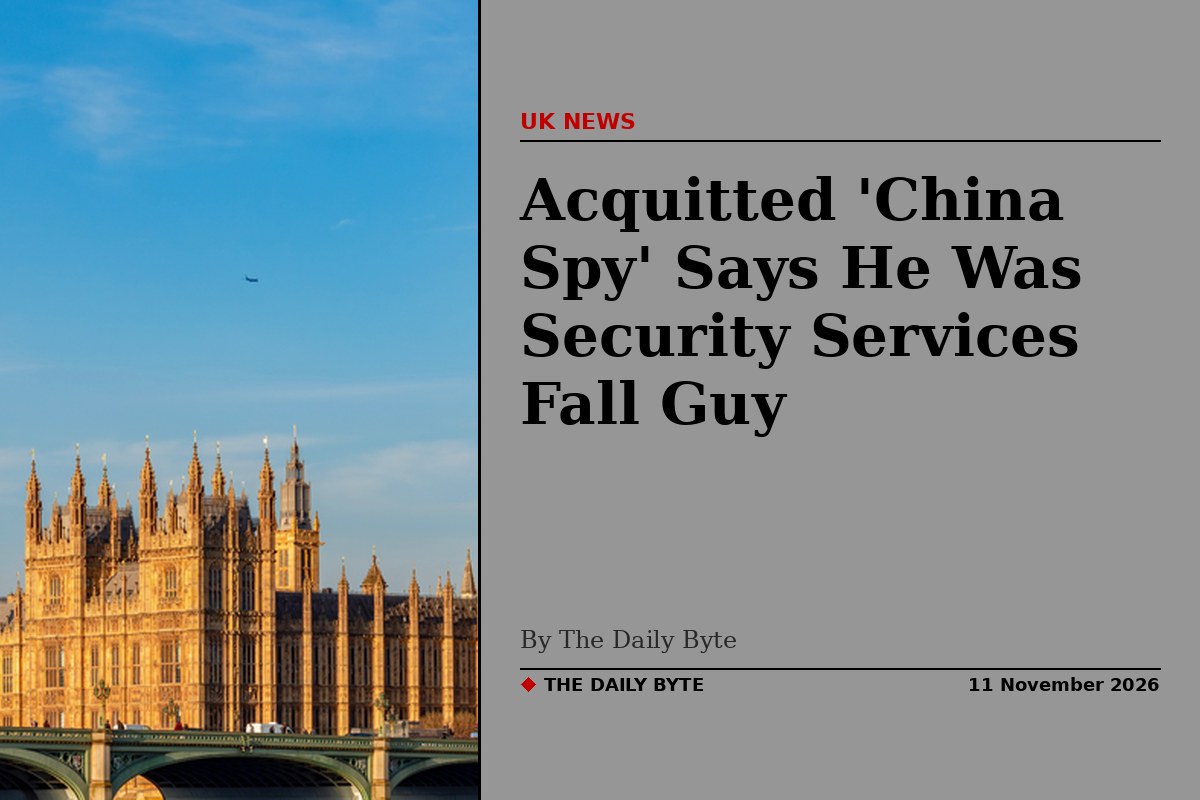
A British man acquitted of spying for China has told the BBC he was a "convenient fall guy" for UK police and security services who wanted to put espionage threats from foreign states "on the map".
Chris Cash, a former parliamentary researcher, has shared more than 6,000 messages with the BBC revealing how a Chinese official sought information about sensitive political matters in the UK, including the 2022 Conservative leadership battle to decide the next prime minister. In his first interview since his acquittal, Cash said he would "never do anything" to harm UK national security.
The messages show how Cash's friend in China, Chris Berry, dramatically described a "secret" meeting with a high-ranking Chinese official. Berry said he had been told that China was concerned about how a British MP it had sanctioned might be promoted to a cabinet role. The BBC reports that there is no evidence in the messages that Cash was paid by, or sympathetic to, the Chinese Communist Party.
The messages at the heart of the case
The allegations against the two men were based on 6,273 messages exchanged between them, the same messages Cash has now shared with the BBC. His solicitor has told the BBC they are genuine. They cover a period when Cash had joined the China Research Group (CRG), a group of China-sceptic Conservative MPs founded by Tom Tugendhat and Alicia Kearns, and when Berry was working in China for a company called Strong, where part of his work involved writing political and economic reports for clients.
According to court documents, Berry was said to have compiled 34 reports for a man linked to the Chinese state spy agency, relaying information passed on to him by Cash. Prosecutors had alleged that a senior Chinese official, identified as Cai Qi, a member of the standing committee of the Chinese Communist Party politburo, was the recipient of politically sensitive information from the pair.
The messages reviewed by the BBC show the two men discussing topics including sanctions on China, the technology company Huawei, human rights, Hong Kong, Taiwan and British foreign policy. Cash said he used the Signal app for almost all his contacts with people in China, saying he did so more for their protection, because discussing the government could land someone in trouble.
How the case collapsed
Cash returned to the UK in 2019 and later became director of the China Research Group. He used Berry as a reference during vetting for a parliamentary pass, which was approved. Cash did not have government security clearance, and there is no evidence he had access to classified documents.
Cash was woken by car doors being shut at quarter to six on a March morning in 2023, when officers arrived to arrest him. His laptop and phone were taken. Berry was arrested the same day. Both men were charged in April 2024 under the Official Secrets Act 1911, accused of gathering information between December 2021 and February 2023 that was intended to be useful to an enemy. Both denied the allegations.
In September 2025, the Crown Prosecution Service discontinued the proceedings, saying the evidence no longer met the threshold for trial, and not guilty verdicts were formally entered. The collapse sparked a political row over the government's failure to designate China as a "threat" under the law, and a cross-party parliamentary committee later described the prosecution as "shambolic", "beset by confusion" and suffering from "systemic failures".
Berry declined to comment on the BBC's latest story, but at the time of his acquittal he denied any wrongdoing and said he had been "unfairly subjected to a trial by media". He said he had provided reports to a Chinese company which he believed had clients seeking to develop trading links with the UK, and that those reports contained no classified information and relied on public sources.
Cash told the BBC that China had been considering dropping sanctions against Tom Tugendhat, one of the Conservative MPs in the China Research Group where Cash worked. Tugendhat was appointed security minister by Liz Truss, and Beijing lifted its sanctions on him in January 2026. Source: BBC News.