Actinogen Shares Crash 80% as Alzheimer's Drug Fails
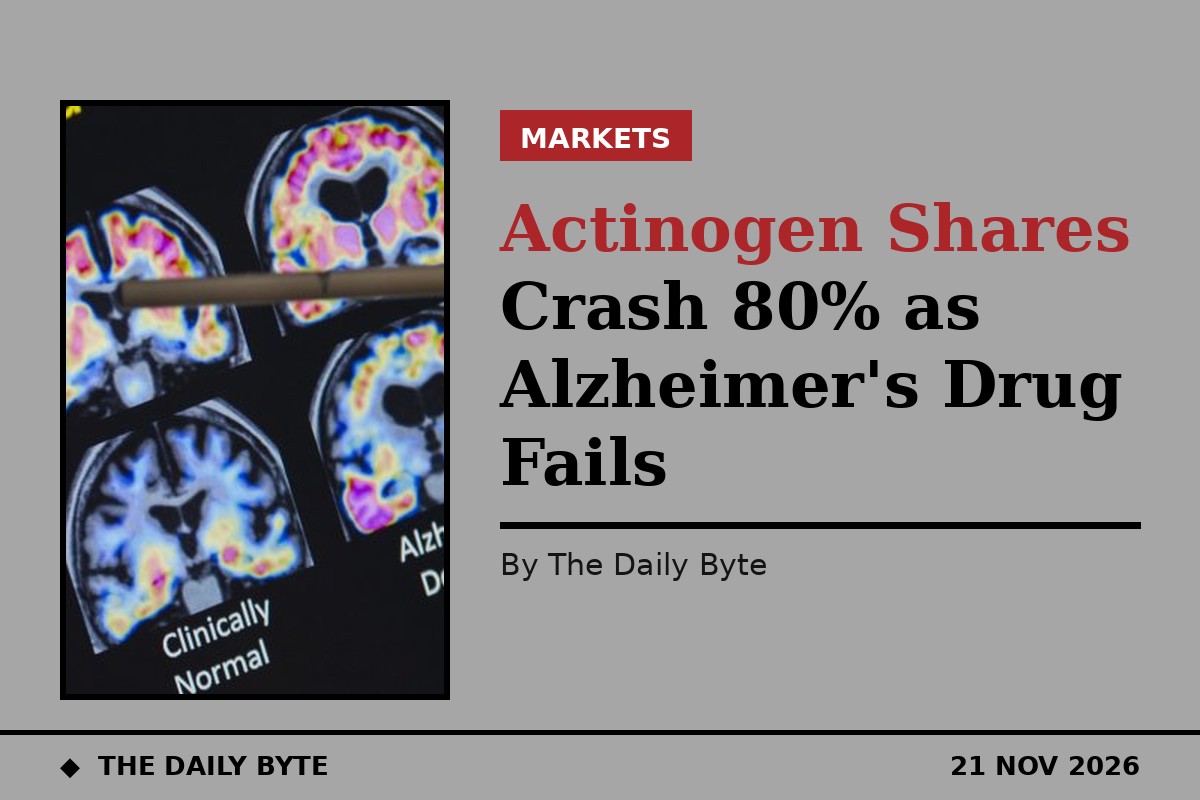
Shares in Australian biotechnology company Actinogen Medical crashed by more than 80 percent after its experimental Alzheimer's pill failed the main test in a pivotal trial, BioSpace reported. The company announced the topline results on Thursday 19 November, and investors sold the stock heavily on the news.
The drug, Xanamem, also known as emestedastat, is a once-daily pill designed to slow Alzheimer's disease by blocking an enzyme called 11-beta-HSD1, which controls cortisol levels in the brain. Actinogen tested it in the XanaMIA trial, a Phase 2b/3 study of 247 people with mild to moderate Alzheimer's disease in Australia and the United States. All of the participants also had raised levels of pTau181, a blood marker linked to the disease, and they received either 10 milligrams of Xanamem or a placebo for 36 weeks.
The trial missed its primary endpoint. On the Clinical Dementia Rating Scale-Sum of Boxes, an 18-point scale on which higher scores mean worse dementia, Xanamem beat placebo by only 0.10 points at week 36, a difference that was not statistically significant, with a p-value of 0.65. Actinogen also reported only small, non-significant trends in favour of the drug on secondary measures of thinking and daily living.
The older-patient result the company is highlighting
Actinogen is instead pointing to a prespecified subgroup of participants older than the median age of 75. In that group, 40 percent of patients given Xanamem showed no measurable worsening on the dementia scale, compared with 22 percent on placebo, a result that reached statistical significance at p equals 0.02. The company also described a 0.39-point advantage on the same scale at week 36, which it called about 30 percent slowing of the disease, and compared that rate with the 27 percent and 29 percent slowing reported for Biogen and Eisai's Leqembi and Eli Lilly's Kisunla in their late-stage trials.
That comparison needs care. Psychiatric Times, reporting the same results, noted that the 0.39-point gap in the older group did not itself reach statistical significance, with a p-value of 0.22, so the two measures in the subgroup were not fully concordant. It described the older-patient finding as hypothesis-generating, and noted that the release did not report subgroup sizes, confidence intervals, or adjustments for the many comparisons made. Whether the age-related effect is real remains unproven.
On safety, the news was better for the company. No serious adverse events were attributed to Xanamem over 36 weeks, which Actinogen said repeated the favourable safety profile seen in earlier, shorter dosing. The drug is not approved by the United States Food and Drug Administration or any other regulator.
What happens next for Xanamem
Actinogen said it plans further analyses and will present additional results at a future scientific meeting, while an open-label extension of the trial continues. Chief executive Steven Gourlay said the company would explore the trial data with potential partners and the US regulator over the coming months to decide the best development path for Xanamem in an older patient population.
The stakes are high for the small company. BioSpace reported that Xanamem is Actinogen's only publicly disclosed pipeline asset, although the drug is also being studied in major depressive disorder. After the fall, the company's stock was worth less than one US cent, BioSpace reported, leaving the older-patient signal as the main route the company can offer investors and partners.