ADB approves $300m for Sri Lanka water services
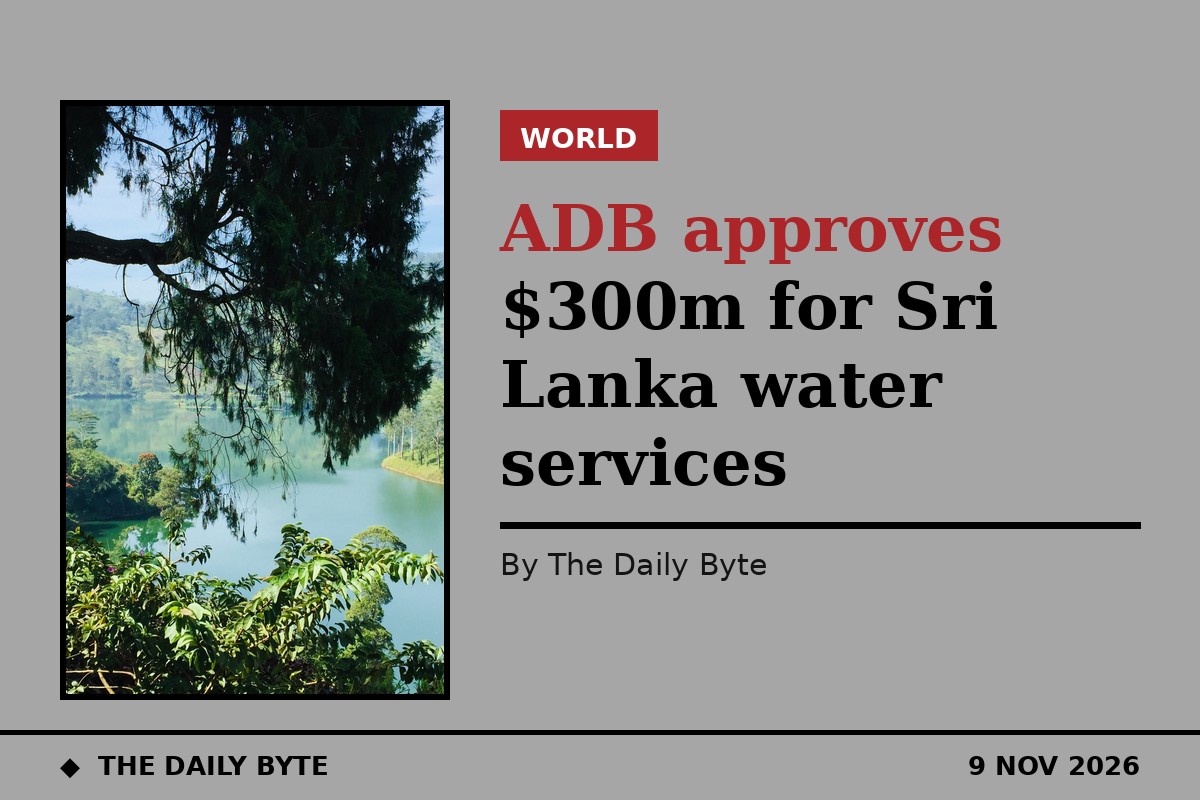
The Asian Development Bank has approved $300 million in financing to expand safe water supply and sanitation services across Sri Lanka, the bank announced on Monday, 9 November 2026. The package combines a $200 million infrastructure project with a $100 million programme of sector reforms.
"Access to safe, reliable, and sustainable water and sanitation services is essential for public health and economic growth," said Shannon Cowlin, the ADB's country director for Sri Lanka. She said the projects would support the government's efforts to strengthen water governance, improve service delivery and make the sector's institutions more resilient and financially sustainable.
What the $200 million project will build
The larger project, the Climate-Resilient Sustainable Water Supply and Sanitation Project, will improve access to reliable and safe water for more than 1.3 million people in Sri Lanka's Western and Southern provinces. It will also improve sewerage and sanitation services for almost 250,000 people in Jaffna, in the Northern Province.
The project will build new climate-resilient water treatment plants, transmission and distribution networks and storage reservoirs in Colombo and Lunugamwehera. In Jaffna it will develop wastewater treatment facilities, sewerage networks and pumping stations. The work is also intended to cut water losses, promote renewable energy use and strengthen the National Water Supply and Drainage Board, the state utility that runs most of the country's piped water.
Reforms behind the $100 million
The second part of the package is the $100 million second subprogram of the Water Supply and Sanitation Reform Program, the ADB's first policy-based lending programme in Sri Lanka's water sector. It builds on reforms introduced under the first subprogram and is designed to improve how water services are managed, financed and delivered.
The reforms cover two areas. The first strengthens resilience, inclusion and environmental sustainability through better water resources management, water safety, sanitation management and adaptation to natural hazards. The second improves governance and financial performance through changes to the National Water Resources Policy, tariff reforms, a resilience roadmap for the sector, stronger corporate performance management and a financial sustainability roadmap for the water board. The programme also aims to bring in more private sector financing for future investment.
Why the investment matters
Reliable piped water remains uneven across Sri Lanka, with many communities depending on wells, bowser deliveries or ageing networks that lose large volumes of treated water before it reaches taps. In Jaffna, where the water table is under strain and sanitation coverage is limited, the new sewerage works are among the most significant upgrades the peninsula has seen.
The financing is part of the ADB's broader support for Sri Lanka's reform agenda as the country continues its economic recovery. The bank, founded in 1966 and owned by 69 members, 50 of them from Asia and the Pacific, says the two projects together will deliver safer, more reliable and more resilient water and sanitation services for communities across the island.