Africa health leaders open CPHIA 2026 in Addis Ababa
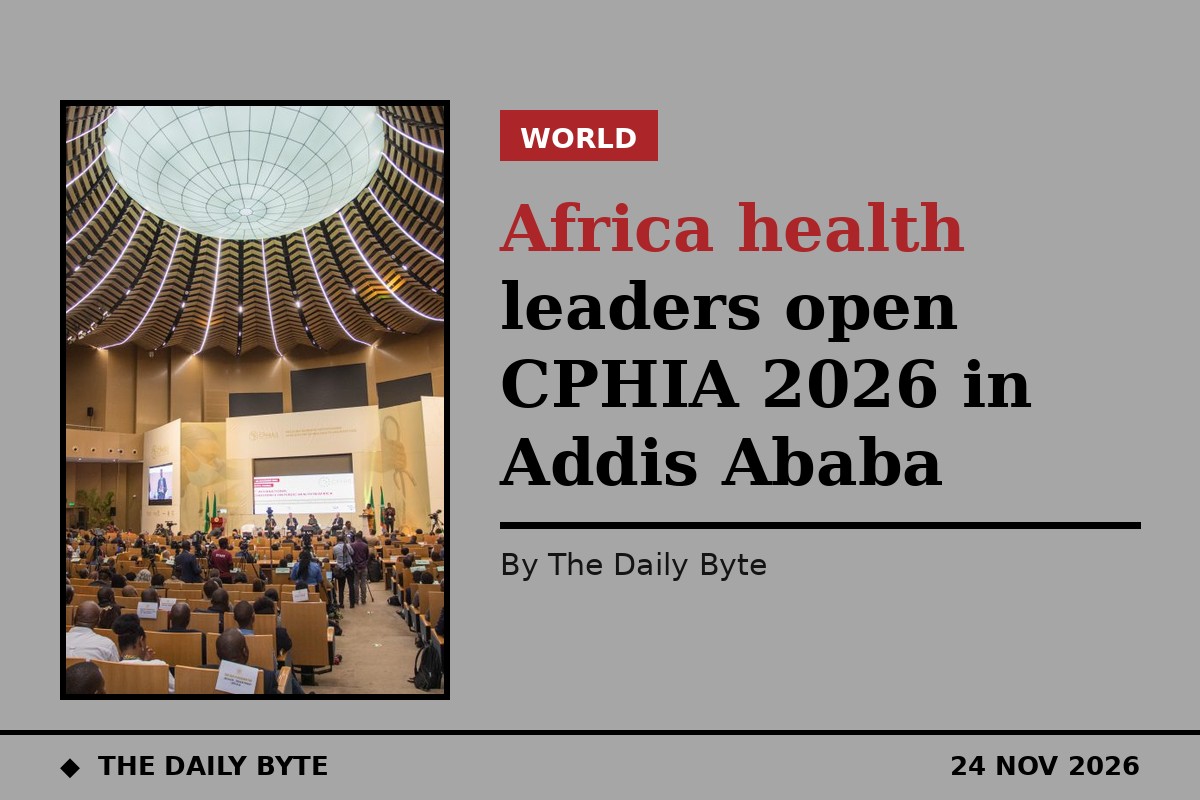
African leaders, health ministers and scientists have gathered in Addis Ababa for the fifth International Conference on Public Health in Africa, a five-day meeting aimed at cutting the continent's dependence on foreign health funding and imported medicines.
The conference, known as CPHIA 2026, opened on Monday, 23 November, at the Addis International Convention Center and runs until 27 November. It is co-hosted by the Africa Centres for Disease Control and Prevention (Africa CDC) and the Ethiopian government, and organisers expect more than 30,000 participants, in person and online, making it one of the largest public health gatherings ever held on the continent.
The theme sets out the ambition plainly: "Africa's Health Security and Sovereignty: Transformation from Health Dependency and Vulnerability to Ownership and Resilience." Behind that slogan is a practical problem. African health systems still rely heavily on external assistance and on medicines, vaccines and diagnostics made elsewhere, and governments are under growing pressure to fund more of their own health care as foreign aid shrinks and disease outbreaks keep coming.
Money, manufacturing and preparedness
Addis Standard reported that discussions will focus on innovative health financing, local manufacturing of vaccines, medicines and diagnostics, pandemic preparedness, digital health, artificial intelligence in primary care, climate-related health risks and reform of the global health architecture to give Africa a stronger voice in international decisions.
A central priority is reducing dependence on imported medical products. Africa has set a long-term ambition to manufacture 60 percent of its vaccine needs locally by 2040, and the conference is expected to push that agenda forward alongside pooled procurement and stronger regional supply chains.
The scale of the programme underlines how far the event has grown. Organisers expect more than 6,000 scientific abstract submissions, over 1,000 selected research presentations, more than 70 exhibitions and upwards of 177 side events across the five days. Opening-day activities included high-level political discussions and the launch of African Union champions' roadmaps on reproductive, maternal, newborn, child and adolescent health for 2026 to 2030, as well as talks on leadership and sustainable health financing. A ministerial dialogue involving candidates for the post of World Health Organization director-general is also on the agenda.
A platform that has grown fast
CPHIA is the flagship annual public health conference of Africa CDC and African Union member states. It was established in 2021, with the first edition held virtually, followed by gatherings in Kigali, Rwanda, in 2022, Lusaka, Zambia, in 2023 and Durban, South Africa, in 2025. Africa CDC describes it as the platform where political leaders, policymakers, researchers, innovators, civil society and young people define the continent's path toward stronger and more resilient health systems.
Holding the fifth edition in Addis Ababa carries symbolic weight. The city is home to both the African Union and Africa CDC, and Ethiopia's Prime Minister Abiy Ahmed joined participants at the opening. The choice also comes at a difficult moment: governments across Africa are being asked to spend more of their own money on health just as external assistance declines and public health emergencies, from Ebola to cholera, continue to test fragile systems.
Whether the week produces concrete commitments will be the real test. The conference's own framing points beyond speeches toward domestic resource mobilisation, local innovation and institutions that can stand on their own. For the delegates in Addis Ababa, the question is whether the sovereignty the theme promises can be turned into funded plans, factories and supply chains before the next crisis arrives.


