AI Demand Squeezes Car Chip Supply, Nexperia Warns
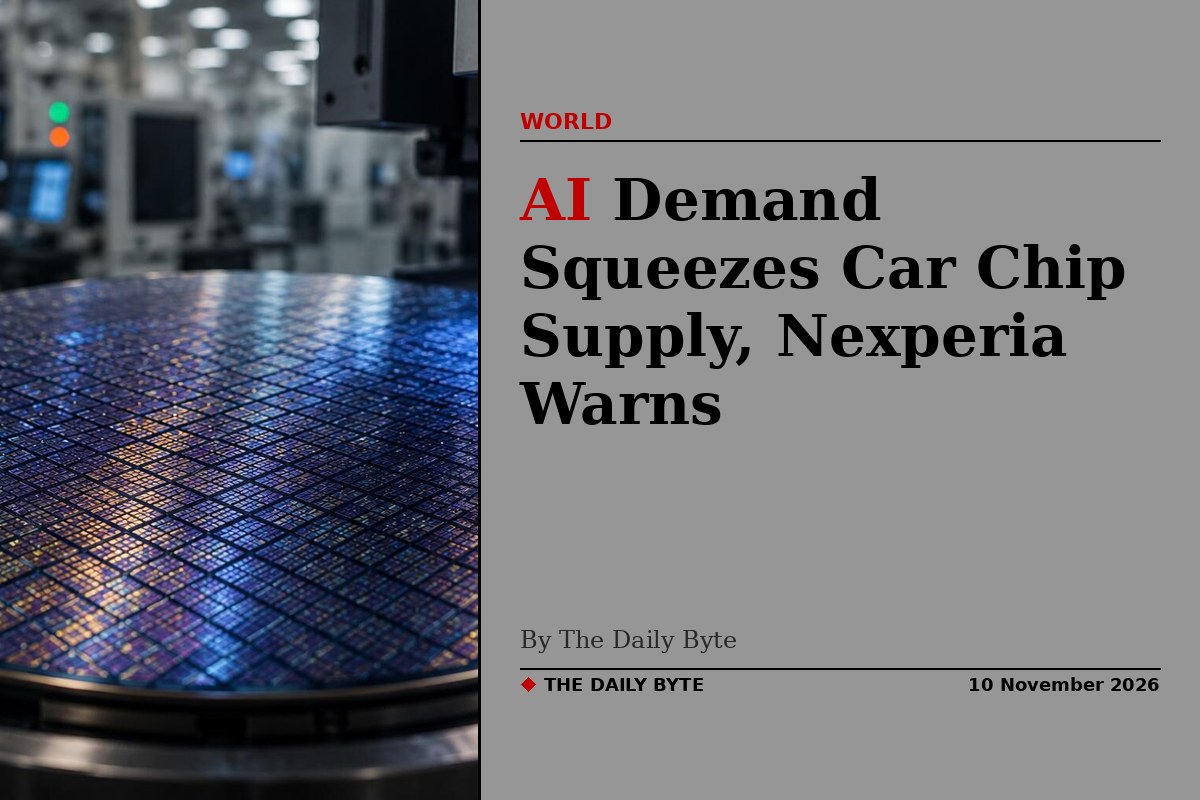
Dutch chipmaker Nexperia has said it is totally oversubscribed as manufacturing capacity is diverted towards fast-growing artificial intelligence data centres, leaving carmakers short of the basic chips their vehicles depend on. Interim chief executive Stefan Tilger gave the warning in an interview with Reuters at the Electronica trade fair in Munich on Tuesday, 10 November 2026.
Tilger said some competitors had shifted capacity away from the commodity semiconductors that Nexperia supplies, creating bottlenecks in parts of the automotive supply chain. “The automotive industry is suffering at the moment quite heavily,” he said.
Foundries are walking away from mainstream chips
The warning was echoed a day earlier by Jean-Marc Chery, chief executive of STMicroelectronics, who told a panel ahead of the conference that foundries and chip-packaging companies were increasingly shifting resources away from products used in cars and industrial equipment. “We see many bottlenecks,” Chery said, adding that some firms that once served a broad range of customers “are disengaging ... from mainstream technology”.
The pattern is a side effect of the AI investment boom. Manufacturers are prioritising higher-margin work linked to data centres and artificial intelligence, while investment in the mature technologies used for diodes, transistors and other basic components has lagged for years. Tilger said demand from AI data centres and robotics was absorbing capacity that would once have gone to those parts.
The chips at stake are the unglamorous ones
Nexperia specialises in high-volume, low-cost semiconductors used mainly in vehicles and industrial equipment. Unlike larger rivals such as STMicroelectronics, it has a narrower range focused on mature-node components: the everyday transistors and diodes that switch power in door locks, fans, displays and engine controls. They are cheap and plentiful in normal times, but a car can contain hundreds of them, so a shortage of even one type can slow a production line.
Chery said STMicroelectronics was partly protected because it controls much of its own manufacturing. “We control a part of our future with our CapEx and our manufacturing,” he said.
Nexperia is still rebuilding after its split
The squeeze comes as Nexperia is still rebuilding its capacity after a geopolitical split with its Chinese operations more than a year ago. Tilger told Reuters the company could still reunite with its Chinese units, but that if the split became permanent its Chinese parent, Wingtech Technology, should be compensated.
Nexperia has expanded operations in Malaysia to replace Chinese packaging capacity, but Tilger said production was still insufficient to meet demand. Excluding the Chinese units it no longer controls, the company reported third-quarter revenue of 389 million dollars, up 9.3 percent on the previous quarter. Carmakers will be watching closely: the last time these basic chips ran short, in 2021 and again during the Nexperia standoff in 2025, factories from North America to Europe cut output.
Sources: Reuters and Global Banking and Finance.


