AI Has Made University Coursework 'Close to Impossible'
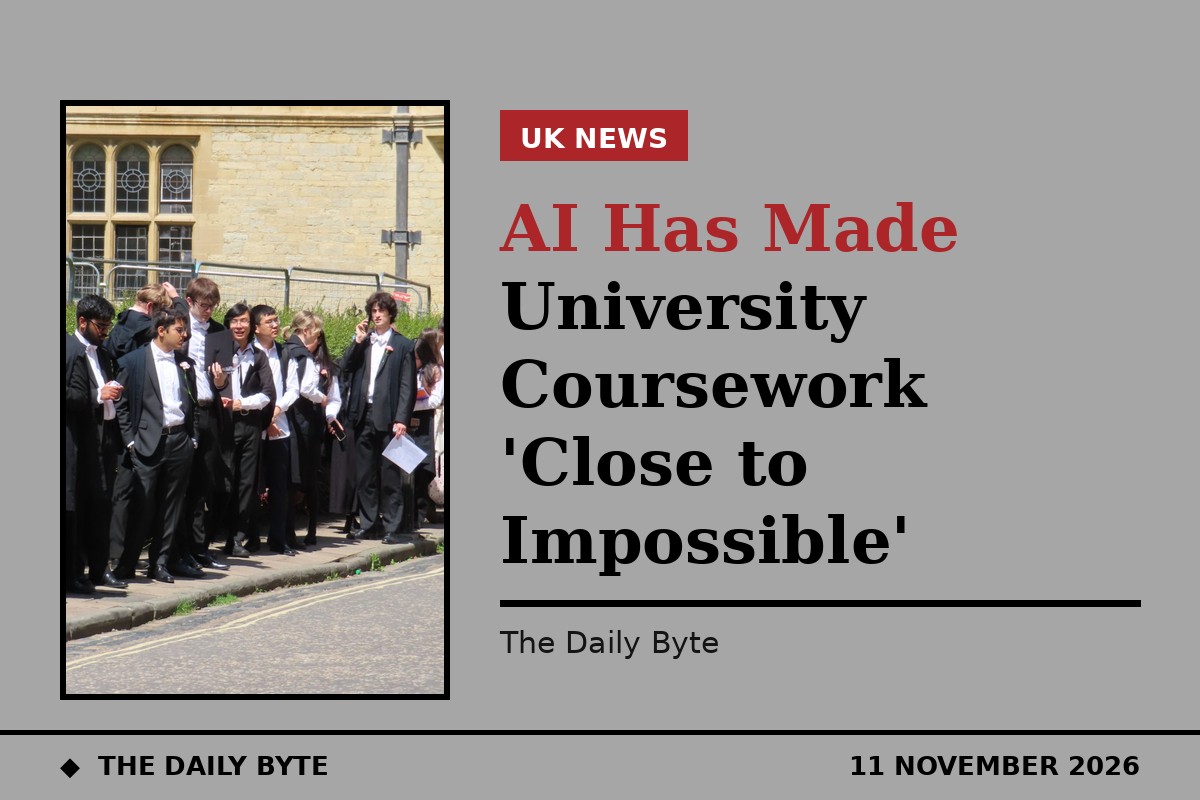
England's higher education regulator has warned that artificial intelligence has made it "close to impossible" to assess some university coursework reliably, and has told universities to make far greater use of examinations and other tests AI cannot complete for a student's behalf.
The Office for Students (OfS) published the warning on Wednesday 11 November 2026, alongside new research with Advance HE and fresh guidance on protecting degree standards. The regulator said the credibility of qualifications was at stake if assessment did not change.
Josh Fleming, the OfS director of strategy and delivery, said AI presented "a generational risk to the system as it stands, threatening to undermine students' learning and institutions' ability to assess them". He added: "We need to see far greater efforts to tackle these risks, including far greater use of AI-free assessment."
What the research found
The report, titled Making AI Work for Students, is based on research carried out between June and September 2026. It drew on 244 higher education staff and 91 students or student representatives from at least 127 universities and colleges in England.
Its central finding is that a significant share of assessment is still set in unsupervised formats, such as coursework and open-book examinations, where students can use AI tools freely. Researchers heard repeatedly that students had completed whole assessments with AI, sometimes in only a few minutes, and received grades similar to classmates who had done the work themselves.
Some of the students interviewed said plainly that they did not believe the assessments at their institution were fit for purpose, because the marks did not reflect what students actually knew or could do. Staff taking part raised concerns that assessments were not consistently measuring students' knowledge and skills.
The report also found that neither human markers nor detection software could be relied on to spot AI-written work. It concluded that trying to catch AI use after the event was not a workable answer, and that the design of the assessment itself had to change.
What universities are now expected to do
Under its existing quality rules, the OfS already requires universities to use assessment methods that genuinely test what a student has learned. The new guidance explains for the first time how those rules apply to AI, and what approaches are likely to satisfy the regulator.
Where an assessment tests knowledge or skills that AI can reproduce, the OfS says universities should use what it calls "secure" assessment — formats designed so that AI cannot be used, such as in-person examinations, presentations, oral examinations known as vivas, performances and practical or applied tasks. Closed-book examinations are identified as among the most reliable formats.
The guidance sets out a clear test: if an assessment can be completed using AI without the student showing the knowledge and skills it is supposed to measure, that assessment should be replaced. Where AI is allowed in an assessment, the rules must be set out clearly in advance, and students must still have to demonstrate the intended learning.
The regulator has also said it will hold institutions to account when they fall short. Under its new quality framework, concerns raised through university submissions or other regulatory intelligence could lead to a lower quality award and could prompt a further investigation. Reporting of the announcement said institutions that fail to meet the expected standard could face sanctions, including restrictions on higher tuition fees or caps on student numbers.
Universities say change is already under way
Universities UK, which represents more than 140 institutions, said universities were making significant progress in adapting to AI, including redesigning assessments and setting out where AI may and may not be used. Many have already brought back in-person written examinations or oral tests, or set tasks asking students to critique AI output or show how their work developed.
The report does not argue for removing AI from higher education. It stresses that students need to build AI skills for life after university, and that universities have an important role in teaching them to use the technology well and honestly. The OfS said courses must stay up to date and must require students to develop relevant skills, including AI literacy.
What happens next
The OfS and Advance HE will discuss the findings online on 16 November 2026, and Advance HE will launch an AI-focused Change Academy for member institutions early in 2027.
Simon Banks, a vice-dean for education at King's College London, told Parliament the day before publication that universities needed to be able to certify their students "with confidence".
For students, the essay or take-home test may increasingly give way to the examination hall and the viva. For universities, the message is blunter still: design assessments that AI cannot pass for a student, or face the consequences.