Alberta cuts oil sands royalty to 2% to spur growth
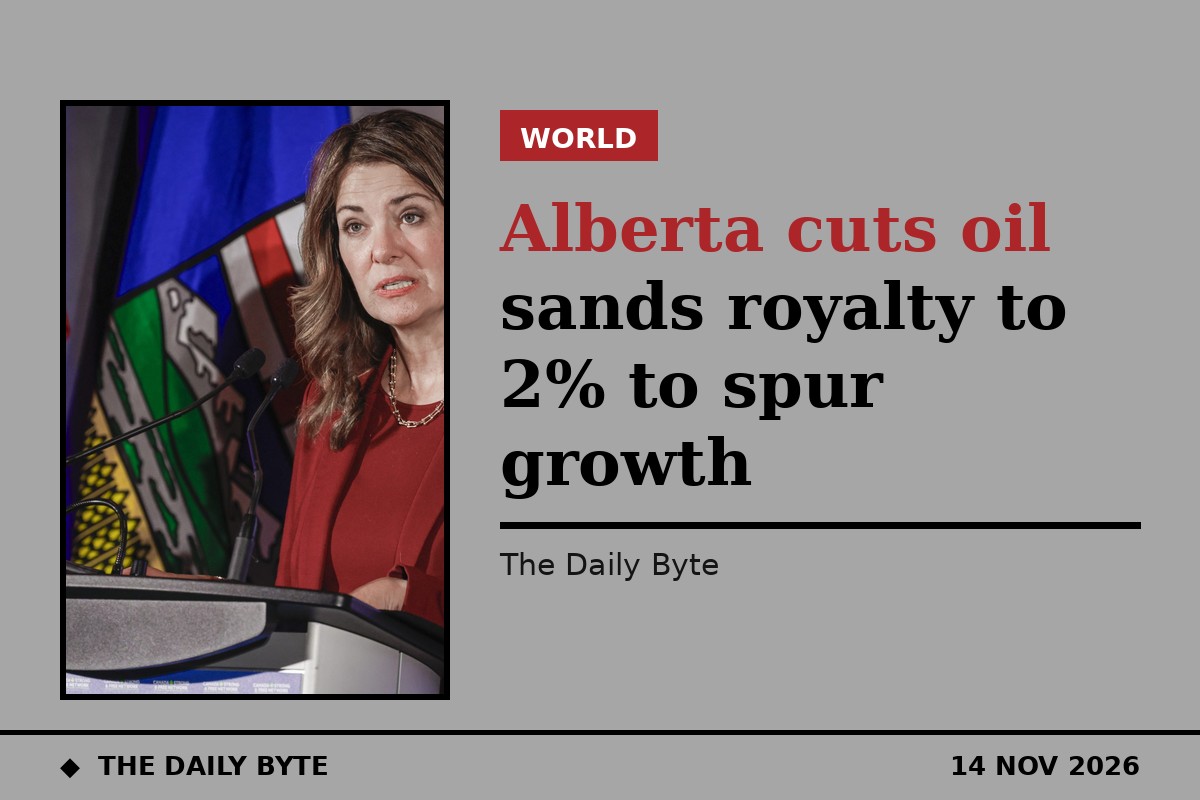
Alberta will charge new oil sands projects a royalty of just 2 per cent for their first five years, under a new programme announced on Friday, 13 November, aimed at doubling the province’s oil production.
Premier Danielle Smith, Energy Minister Brian Jean and Finance Minister Jason Nixon unveiled the Oil Sands Growth Program in Calgary, offering approved projects a guaranteed 10-year royalty framework. After the first five years at 2 per cent, the rate will rise by one percentage point a year until it reaches 6 per cent in years nine and 10. Projects will then return to the existing royalty system.
Only new projects, or expansions adding at least 5,000 barrels of oil a day, will be eligible. The programme is targeted to launch in spring 2027, but qualifying projects announced after 15 November 2026 will be grandfathered into the new terms. The government will review the programme by 31 December 2029.
Doubling production to eight million barrels a day
Alberta has set an ambitious goal of doubling oil production to eight million barrels a day, from nearly five million barrels a day at present. The government projects the programme could generate approximately $205 billion in cumulative additional revenues by 2040 and more than $1.3 trillion by 2060.
“To meet our goal of doubling oilsands production in the coming decade or so, we need hundreds of billions of dollars in new investment,” Smith told reporters. “Investors have choices about where they put that money, and we want them to put it here in Alberta.”
She said royalty revenues from the new projects would be modest to start, but would eventually mean tens of billions of dollars for the public programmes and infrastructure Albertans rely on. “Alberta has the resources, the expertise and the ambition to remain a global energy leader,” she said.
Industry backs it, critics question the cost
The heads of several major producers stood behind the premier at the announcement, including Cenovus Energy, Suncor, Canadian Natural Resources, ConocoPhillips Canada and Imperial. Strathcona Resources said it intended to grow from 125,000 barrels a day to 300,000 barrels a day by 2036, and that the programme gave it the confidence to invest now.
But the plan drew swift criticism from the clean energy think tank the Pembina Institute. Its oil and gas programme director, Janetta McKenzie, said the new system would return even less of the oil’s value to Albertans and even more to corporate shareholders, at a time when the industry was earning billions in profit. She also questioned the government’s revenue projections.
Finance Minister Jason Nixon and government officials who briefed reporters were unable to say exactly how much oil companies could save under the new programme, saying it would depend on each project and on factors outside the government’s control.
The wider context
The programme supports Alberta’s commitments under the Canada-Alberta-Oil Sands Alliance memorandum of understanding, and comes as the province tries to fill new pipeline capacity. Prime Minister Mark Carney designated the Pacific Link pipeline as a project of national interest last month. The pipeline, with a price tag of between $35 billion and $44 billion, would carry more than one million barrels of crude a day from Bruderheim, Alberta, to a port near Delta, British Columbia.
Oil companies currently pay rates on a sliding scale, depending on the benchmark price of oil and whether a company has recouped the capital it put into building a project. In the pre-payout phase, rates run between 1 per cent and 9 per cent of gross revenue, with the maximum taking effect when West Texas Intermediate hits US$120 a barrel. As of Friday afternoon, West Texas Intermediate was trading at about US$88 a barrel.
Projects under the new programme will still need regulatory approvals, must meet environmental requirements and, where required, undergo project-specific Indigenous consultation, with suspension or termination provisions for non-compliance.
Sources: Government of Alberta and Pipeline Online (The Canadian Press).


