Algeria local elections: 24m vote for councils
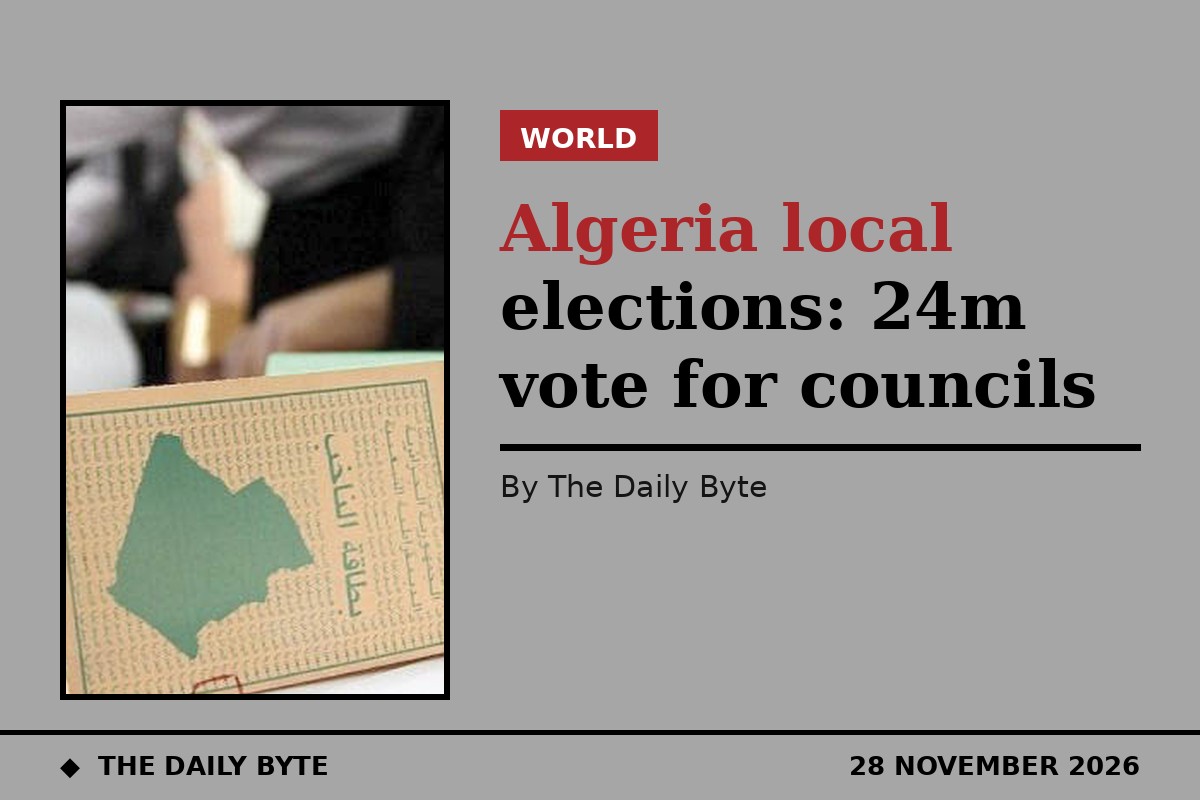
Voting is under way across Algeria, where more than 24 million people are choosing the councillors who run their towns and provinces for the next five years.
Polling stations opened at 8am local time on Saturday 28 November and are due to close at 7pm, with the election authority able to extend voting by up to an hour where needed. The vote is for members of the People's Communal Assemblies and the People's Provincial Assemblies, the two tiers of local government below the national parliament.
Algeria's election authority put the number of registered voters at 24,236,959. More than 160,000 candidates are standing, and just over half of them — 54.02 percent — are under the age of 40, according to the National Independent Authority for Elections (ANIE).
It is the country's second local election since President Abdelmadjid Tebboune took office in 2019, and the first vote of its kind in which Algerians are choosing local representatives across all 58 provinces under the current electoral system.
More than 6,000 lists on the ballot
Voters face a crowded ballot. A total of 6,052 electoral lists are competing, including 428 lists for the provincial assemblies and 5,624 for the municipal assemblies. Of those, 5,765 are party lists, 24 are party blocs and 263 are independent lists.
The campaign ran for 20 days and ended on Tuesday. The election authority said no violations of its ethical charter for political campaigning had been recorded during the campaign, which was fought largely on local services, development and jobs.
For voters in remote areas, polling began early. Mobile polling stations were sent into the far south and south-west, including Adrar, Timimoun, In Salah, El M'Ghair, Djanet, Tindouf, Ouargla, Illizi and Tamanrasset, opening up to 72 hours before the main polling day so that nomadic communities and people living far from a fixed polling station could take part.
What the councils do
The communal assemblies run day-to-day services in Algeria's towns and cities, while the provincial assemblies oversee broader planning and development across each province. Their decisions touch on local roads, markets, housing, youth facilities and the small-scale development projects that most directly affect daily life.
That is why the vote matters beyond the national politics that usually dominates headlines. The councillors chosen on Saturday will control local budgets and set local priorities for five years, at a time when many Algerians say they want faster improvements to services where they live.
How the vote works
Algeria uses proportional representation with an open list and preferential voting for these elections. Voters choose one list, then mark one or more candidates from that list, up to the number of seats available. Seats are then shared out in proportion to the votes each list receives, subject to a legally defined threshold.
The election authority says it trained poll workers, tested digital systems for tabulating results and ran election simulations ahead of the vote, and that the justice sector chaired municipal committees that reviewed the electoral roll and ruled on candidacy appeals.
Turnout will be watched closely
Attention will now turn to turnout, which has been low in Algeria's recent national votes. A strong showing would give the new councils a clear mandate; a weak one would underline the distance many voters still feel from local politics.
The count begins once polls close, with official results to follow in the coming days.


