Alibaba beats revenue forecasts as AI cloud jumps 53%
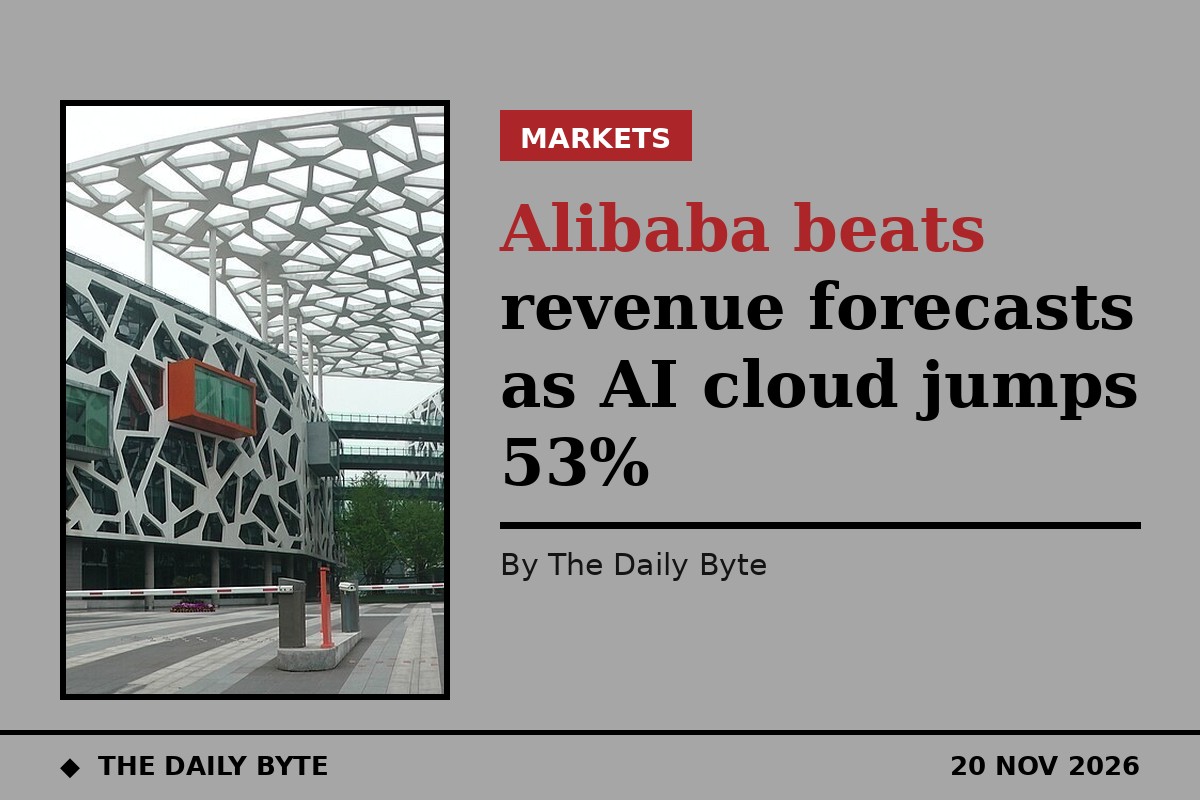
Alibaba beat revenue forecasts in its September quarter as demand for its artificial intelligence cloud services surged, but the cost of building the infrastructure behind that growth is mounting.
The Chinese technology group reported revenue of 271.52 billion yuan, about 40.5 billion dollars, for the quarter ended 30 September, up 10 per cent on a year earlier and ahead of analysts' average estimate of 269.81 billion yuan, according to LSEG data. Barron's, citing a FactSet survey, put the consensus slightly higher at 270.1 billion yuan. The shares rose 2.8 per cent in New York trading on Thursday after the results, before slipping about 1.5 per cent in pre-market trading on Friday.
AI cloud grows 53 per cent
The star of the results was Alibaba's AI Cloud and Compute Services division, where revenue jumped 53 per cent year on year to 60.97 billion yuan. Revenue from external customers rose 64 per cent, driven by the adoption of AI-related products, while adjusted earnings in the division rose 121 per cent to 8.84 billion yuan.
Chief financial officer Toby Xu said the quarter delivered strong growth in both revenue and earnings because of the company's strategic focus on AI and cloud growth and on profit in its e-commerce business.
That e-commerce business, still nearly three-quarters of total revenue, grew more slowly. E-commerce revenue rose 2 per cent to 197.24 billion yuan, although adjusted earnings in the division jumped 243 per cent to 38.85 billion yuan as profitability improved and losses narrowed in quick commerce. Revenue at the China e-commerce business fell 5 per cent, while international e-commerce revenue dropped 8 per cent after European Union customs reforms.
Profit triples on investment gains
Reported profit more than tripled, helped by gains outside the operating business. Net income attributable to shareholders rose to 64.54 billion yuan, including an 87.07 billion yuan gain from disposals and the revaluation of investments. Excluding investment gains and other items, non-GAAP net income leapt 92 per cent to 19.91 billion yuan.
Operating income rose 443 per cent to 29.12 billion yuan, and adjusted earnings before interest, tax and amortisation increased 260 per cent to 32.64 billion yuan. Diluted earnings per American depositary share were 3.87 dollars, while non-GAAP diluted earnings per share reached 8.10 yuan, below analysts' expectations of 11.16 yuan.
Spending surges as cash burn widens
The price of the AI push showed in the cash flow figures. Capital expenditure rose 60 per cent to 50.48 billion yuan, about 7.5 billion dollars, in the quarter, and free cash outflow widened to 34.47 billion yuan from 21.84 billion yuan a year earlier. Operating cash flow rose 55 per cent to 15.69 billion yuan, but infrastructure purchases consumed far more.
Alibaba ended September with 487.93 billion yuan in cash and other liquid investments and a net cash position of 220.72 billion yuan, down from 260.83 billion yuan at the end of March. During the quarter it repurchased about 2.24 million American depositary shares for 221 million dollars. In August it launched a 10 billion dollar share placement, saying the proceeds would fund computing infrastructure and AI data centres.
In September the company said it planned to expand global data-centre capacity to more than 20 gigawatts by 2032, and that its next-generation Qwen 4 model was in training. Its chip-design unit T-Head, which confidentially filed for a Hong Kong listing earlier this month, also unveiled a new AI processor scheduled for commercial release in early 2027.
Shares still down about 40 per cent in 2026
Despite Thursday's bounce, Alibaba's US-listed shares are down about 40 per cent this year, as investors worry about weak consumer demand in China and rising spending on AI and cloud infrastructure. The company has also reorganised its businesses into four main units: e-commerce, AI cloud and computing services, AI model applications and other businesses.
The results show AI becoming a powerful growth engine for Alibaba, but also a demanding one. Cloud revenue is compounding at more than 50 per cent, yet each quarter of that growth now requires billions of dollars of new infrastructure, and the cash outflow is widening rather than narrowing. Whether the spending earns an adequate return is the question that will decide the shares from here.
Sources: Barron's; The Edge.