Alphabet Cloud Doubles as HSBC Sets $360 Target
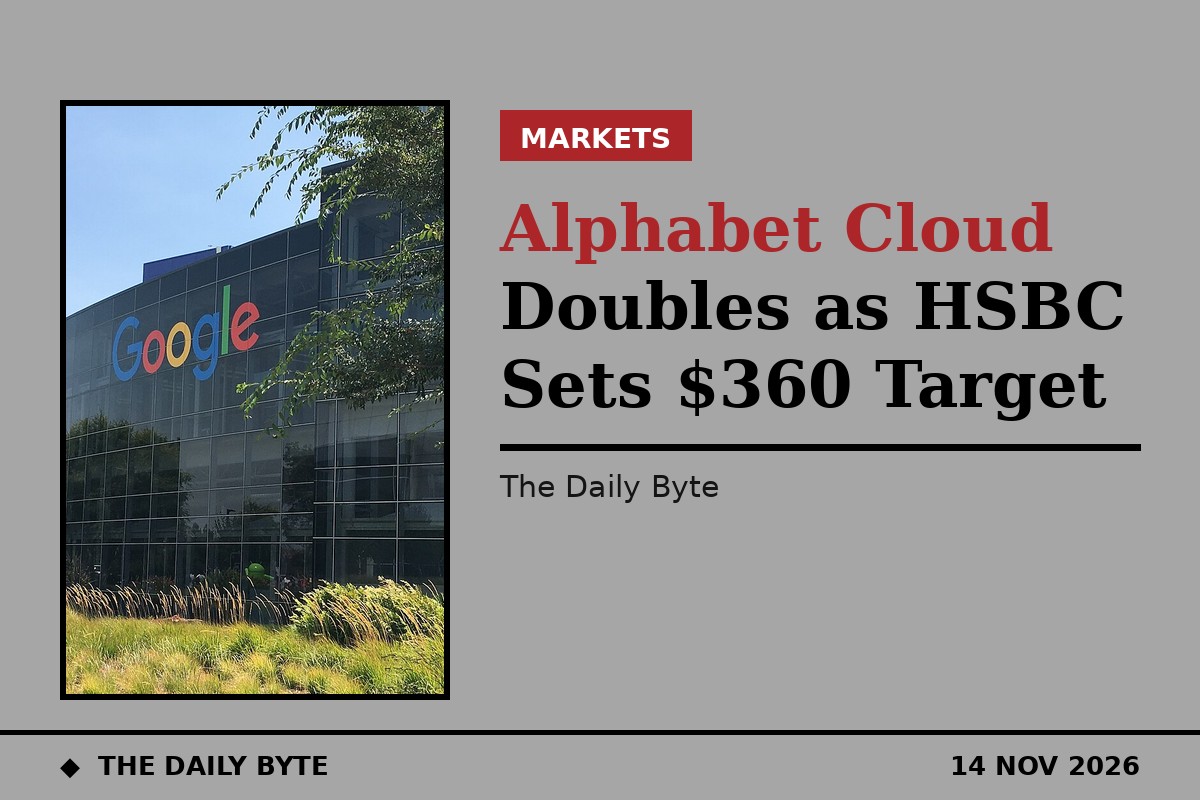
Alphabet's cloud business has doubled in a year, with Google Cloud revenue rising 103% to $30.7 billion in the third quarter of 2026 and the Gemini app passing one billion monthly users. Yet analysts are split on the shares: HSBC set a $360 price target on 14 November, while JPMorgan has dropped Alphabet from its Analyst Focus List.
The contrast captures the debate around the Google parent. The operating numbers from its cloud division are the strongest Alphabet has ever reported, but the cost of building the infrastructure behind them pushed quarterly free cash flow into negative territory.
Cloud growth powers the quarter
Google Cloud posted revenue of $30.7 billion in the third quarter, up 103% on the same period last year, following an 82% jump in the second quarter. Chief executive Sundar Pichai said the performance was powered by huge demand for artificial intelligence infrastructure and AI solutions, with demand for the company's Tensor Processing Units also robust.
The division is now profitable at scale. Operating profit more than tripled to $11.1 billion, and its operating margin reached 36.2%, up from 23.7% a year earlier. Alphabet also reported a $561 billion order backlog for Google Cloud, a sign of contracted demand that still has to be delivered and converted into revenue.
The Gemini app reaching one billion monthly active users matters because Google Cloud provides the infrastructure behind it. Pichai described Gemini as the fastest-growing product in Google's history. More cloud revenue gives Alphabet greater capacity to keep investing in its AI models, which in turn supports the app's position against rivals.
The spending question
The other side of the story is the bill for that growth. Alphabet spent $51.4 billion on capital expenditure in the third quarter, more than double the $23.95 billion it spent a year earlier, and free cash flow fell to minus $9.1 billion. Management has guided to investment of $195 billion to $205 billion for 2026 as a whole, with significantly higher spending expected the following year.
HSBC analyst Paul Rossington is betting the shares can recover from their recent slide, publishing a $360 price target on 14 November. His case rests on the pace of Google Cloud's expansion, provided Alphabet can eventually turn its heavy infrastructure spending into stronger free cash flow.
JPMorgan took a more cautious step earlier in the week, removing Alphabet from its Analyst Focus List while keeping an Overweight rating. The bank pointed to slower monetisation of AI search and elevated spending as concerns. The two calls frame the same facts differently: one side sees a growth engine worth paying for, the other wants proof that the spending will pay off.
Search still the biggest earner, but slowing
Google Search remains Alphabet's largest source of revenue, at $63.4 billion in the quarter, but its growth slowed to 12%, down from 17% in the second quarter. Search advertising revenue of $63.35 billion also came in short of the $64.99 billion analysts had expected.
Over the past 12 months, Google Cloud added $15.6 billion of sales, compared with $6.8 billion of additional advertising revenue from Search. The gap explains why investors are increasingly judging Alphabet as a cloud company as much as a search company, even though Search still brings in roughly twice as much revenue per quarter as Cloud.
Group revenue rose 25% to $127.6 billion in the quarter. Alphabet shares closed at $295.77 on Friday 13 November, down 0.98% on the day and 28% below their peak, trading at a forward price-to-earnings ratio of 19.3.
What analysts are watching next
Google unveiled its Gemini 4 Hydrogen model and said it will be folded into Google Search, building the new model for fast, multi-step work handled by AI agents. Whether that integration produces commercially meaningful usage, rather than simply more product launches, is now one of the main tests for the shares.
Financing is also in focus. Demand for Alphabet's Hong Kong and Singapore dollar bonds priced this week exceeded the targeted issue volume, according to Reuters, with the placement spanning seven tranches totalling roughly $3.8 billion and settlement scheduled for 19 November.
For now, the investment case turns on execution: cloud momentum must hold, AI search must start earning its keep, and the infrastructure bill must eventually produce a larger cash surplus. Until then, Alphabet's best-ever cloud quarter and its sliding share price will continue to tell two different stories. The Motley Fool and ad-hoc-news reported the figures.