Amazon builds new home robot team around Sprout
Amazon has assembled a new home-robotics team and is hiring for a “new-to-world robot product”, five years after its Astro home robot stalled in an invite-only trial. The effort is built around Fauna Robotics, the New York startup Amazon acquired in March, and its 3.5-foot humanoid robot Sprout.
CNBC reported on 8 November that Amazon has spent the past several months forming a Personal Robotics Group and recruiting for the new product, based on job postings the outlet reviewed. Amazon has not announced a name, a price or a launch date for the robot.
What Sprout is
Sprout is a small humanoid designed to be approachable rather than industrial. It stands 3.5 feet (about one metre) tall, with a rectangular head, windshield-wiper-like “eyebrows”, grippers for hands and a soft, padded exterior of sage-green foam. A five-year-old child can talk to it at eye level.
Fauna unveiled Sprout in January 2026 after two years of secret development, pitching it as a developer platform for homes, schools and social spaces rather than a finished consumer product. The robot costs $50,000, cannot lift heavy objects, but can dance, pick up a toy block or teddy bear, get up from a chair and walk around an office. Early customers include Disney and Boston Dynamics, and Fauna says it has been hand-delivering the first models to research labs.
Fauna announced on 24 March that it had officially joined Amazon and would continue selling Sprout Creator Edition robots and supporting existing customers as Fauna Robotics, an Amazon company. Its founders are Rob Cochran, the chief executive, and Josh Merel, the chief technology officer, who previously worked on robot locomotion at Google DeepMind and later together at CTRL-labs.
Learning from Astro
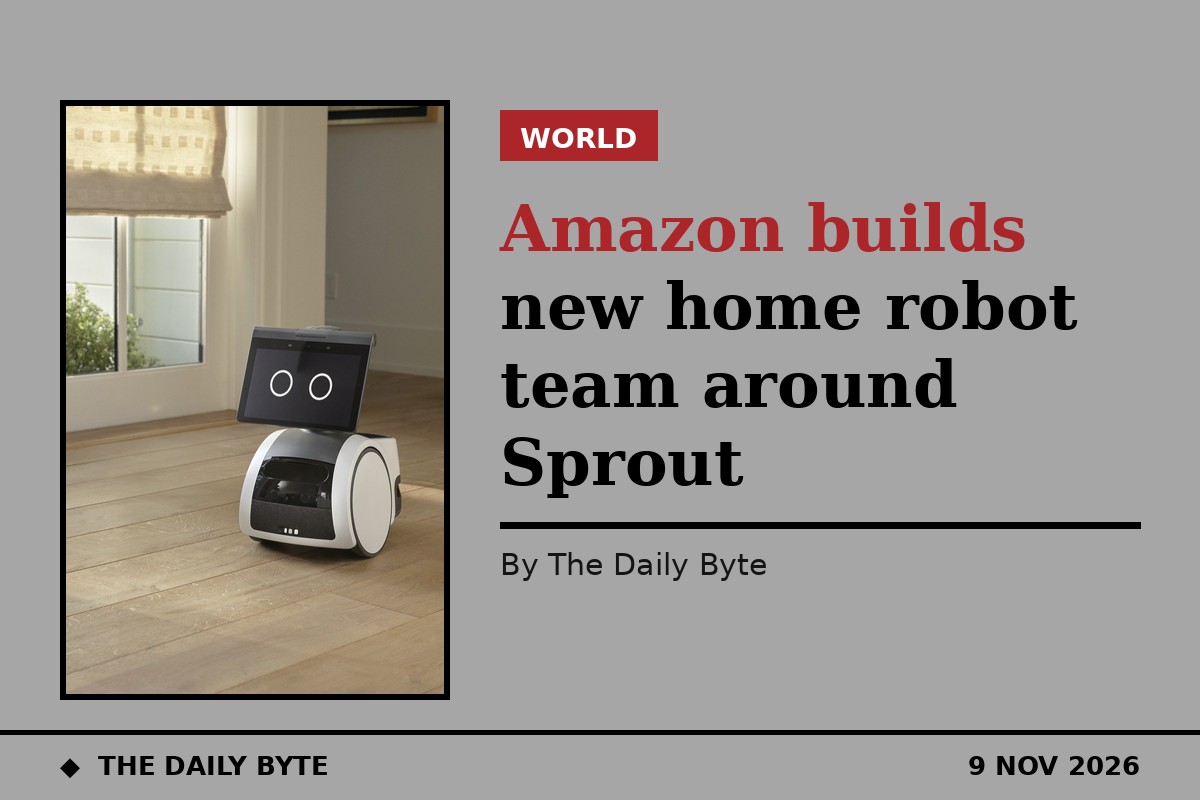
Amazon’s first home robot, Astro, was unveiled in 2021 as a $1,450 Alexa-equipped tablet on wheels that could navigate a home, recognise faces and act as a roving security monitor. It reached only a few thousand customers in an invite-only trial, and a business version released in 2023 was discontinued within a year.
Earlier this year Amazon redeployed much of the team behind Astro onto the new project and brought in a robotics researcher from the Massachusetts Institute of Technology, according to staff profiles cited by CNBC. Some of the Personal Robotics Group’s staff previously worked in Lab126, the Amazon hardware lab behind the Kindle, Echo and Fire TV.
Job listings reviewed by CNBC describe the ambition. One engineering listing, since removed, said “Robots are about to step out of the movies and into our homes” and described a product able to navigate “dynamic home environments” and operate autonomously “alongside family members”. Another seeks a user-experience designer to “define what it feels like to live with a Fauna robot”, while a scientist role focuses on conversation, memory and long-term relationships between robots and users, and a software role covers perception, navigation, motor control, reasoning and human-robot interaction.
Amazon’s case for a second attempt
Amazon spokesperson Brad Glasser told CNBC the company acquired Fauna because it is “committed to tackling the challenges that can unlock the personal robotics category”. He said there remains a substantial gap between what works in a controlled lab and what works in a living room, and that Amazon is working with the robotics community to close it. Glasser added that Amazon continues to support Astro customers.
The renewed push comes as advances in artificial intelligence have set off a new wave of robotics development. Barclays estimated in a January report that the global humanoid robot market, currently valued at $2 billion to $3 billion, could reach roughly $40 billion by 2035. Venture funding for robotics and physical AI reached $33.4 billion in the first half of 2026, already ahead of $28.7 billion for all of 2025, according to PitchBook figures cited by CNBC. Amazon chief executive Andy Jassy named artificial intelligence and robotics among the “biggest inflections of our lifetime” in his latest annual letter to investors.
Whether a friendly, child-sized humanoid succeeds where Astro did not will depend on what the new team can actually ship. For now, Amazon is hiring, Sprout is the foundation, and the home robot remains a promise rather than a product.