Ambarella shares crash 36% as memory shortage hits
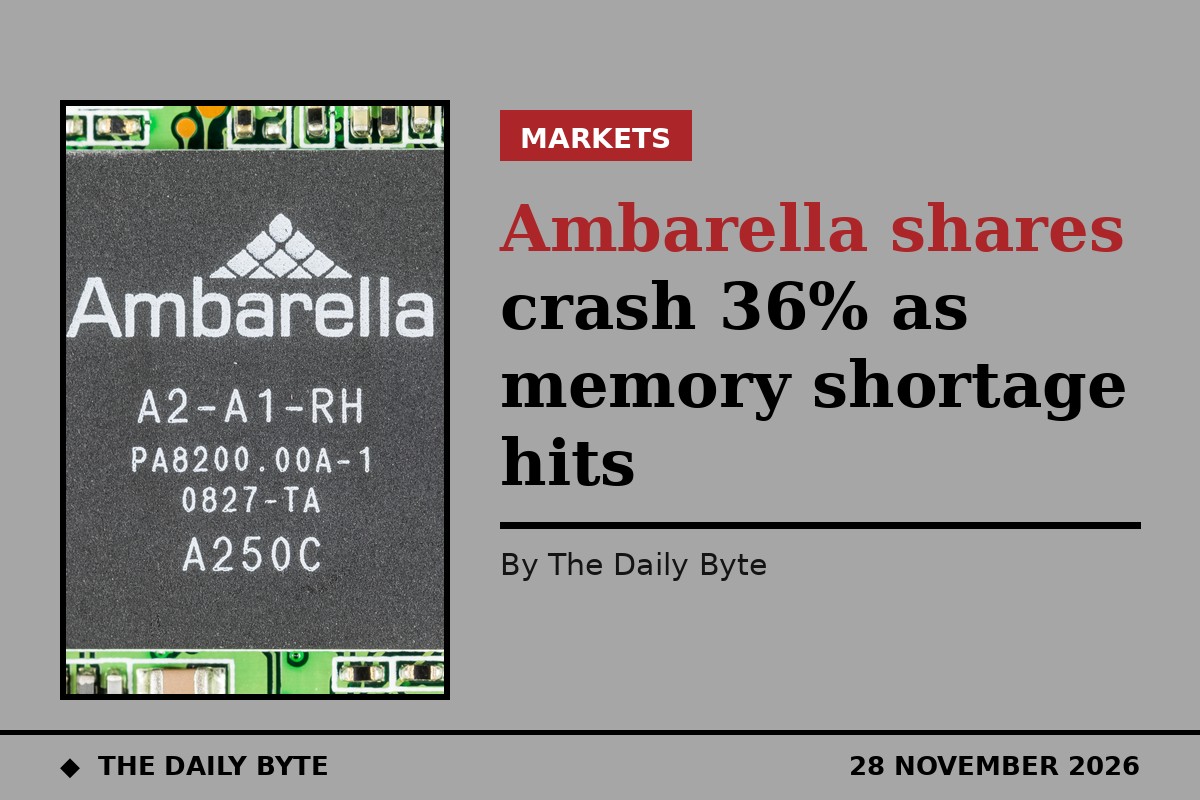
Ambarella shares have lost about 36 per cent of their value in two sessions after the chipmaker cut its revenue guidance sharply, blaming a shortage of memory chips that is forcing customers to delay or cancel orders.
The company reported third-quarter fiscal 2027 results on Tuesday 24 November. Revenue for the quarter ended 31 October was 115.2 million dollars, up 6.2 per cent on a year earlier but below the roughly 119.4 million dollars analysts had expected. Adjusted earnings were 0.28 dollars per share, against a consensus estimate of 0.32 dollars.
The quarter itself was not the problem. The guidance was. Ambarella told investors it expects fiscal fourth-quarter revenue of only 70 million to 75 million dollars, far below the roughly 112 million dollars Wall Street had pencilled in. At the midpoint of 72.5 million dollars, the guide implies a sequential decline of about 37 per cent and removes roughly 42 million dollars of quarterly revenue in a single step.
Management blamed the memory market. Chief executive Fermi Wang said Ambarella delivered record revenue from its edge AI products in the quarter, but sales in consumer internet-of-things devices weakened because rising memory prices and scarce supply led customers to cancel or delay orders. The company said the shortage has spread beyond consumer devices into its wider markets.
Shares fall by a third in two sessions
The market reaction was swift. Ambarella shares closed on Monday at 55.56 dollars, fell 20 per cent on Tuesday to 44.47 dollars, and dropped a further 19.8 per cent on Wednesday to close at 35.68 dollars. The low on Wednesday was 30.50 dollars, about 45 per cent below Monday's close. By the close on Friday 27 November, the shares stood at 35.26 dollars, leaving the company's market value at about 1.56 billion dollars.
Analysts moved quickly to cut their ratings and price targets. Stifel cut its target from 80 dollars to 50 dollars. Morgan Stanley downgraded the stock to equal-weight from overweight and cut its price target to 42 dollars from 70 dollars. The downgrades reflect a view that the memory squeeze could last longer than a single quarter and that Ambarella has given investors little to measure it against: the company issued no gross margin guidance for the quarter beyond a non-GAAP range of 59.0 to 60.25 per cent, and named no memory supplier, process node or customer in its outlook.
The company's balance sheet is not the immediate worry. Ambarella held 283 million dollars of cash and no debt, and its GAAP net loss for the quarter narrowed to 12.7 million dollars. The problem is the earnings arithmetic. With revenue guided down by more than a third, holding expenses flat would imply a non-GAAP operating loss of roughly 15 million dollars in the fourth quarter, according to analyst calculations.
Ambarella's case also carries a wider warning for the chip sector. Memory prices have climbed steeply as AI data centre demand absorbs supply, and the shortage is now reaching smaller chipmakers whose products depend on memory they do not make themselves. Ambarella is a fabless company: it designs low-power systems-on-chip for cameras, security equipment and vehicles, and relies on outside suppliers for the memory its customers need alongside its chips.
The company says growth depends on product launches in the second half of fiscal 2028, after a weak first half. But it has attached no revenue figure, part number or customer to that ramp, so investors have nothing to test it against yet. Until Ambarella can show that memory pricing and supply have stopped deteriorating, or put a number on the recovery it expects, the 37 per cent guidance cut stands as a warning rather than a floor.


