AMD launches EPYC 6 Venice server CPUs for AI
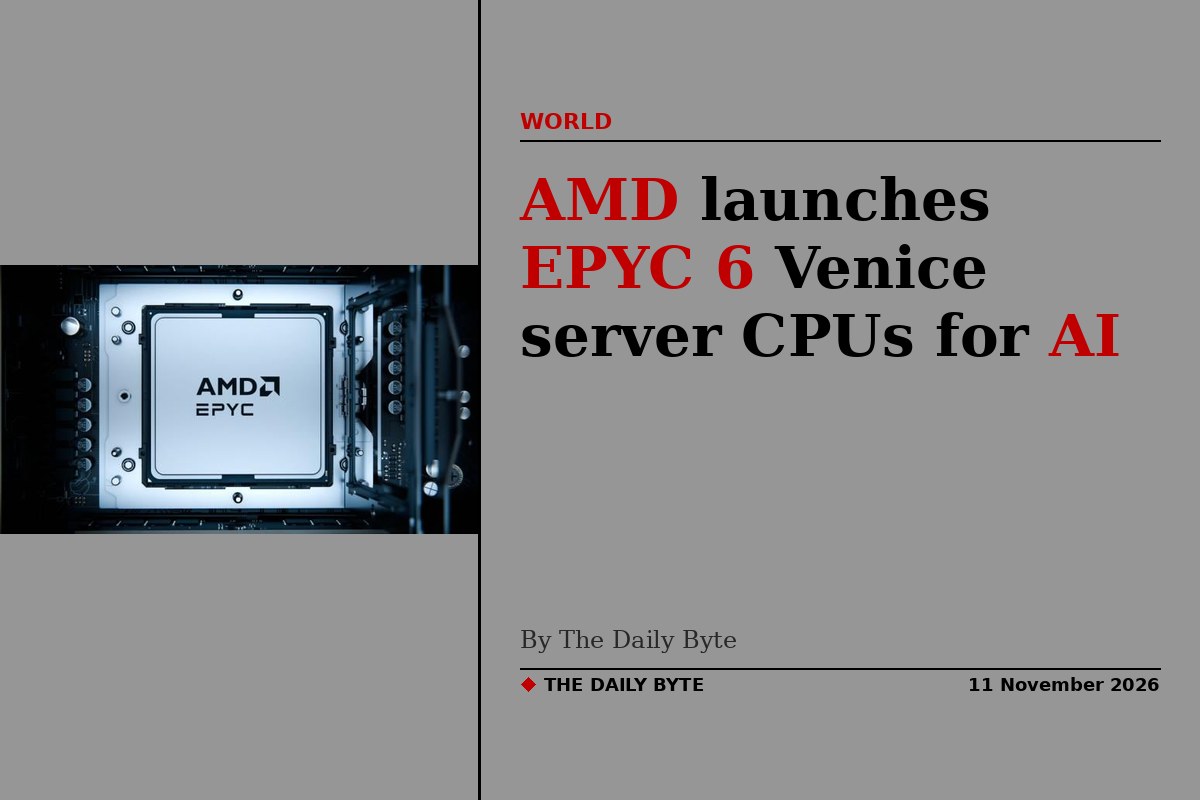
AMD has launched its sixth-generation EPYC server processors, codenamed Venice, in a move aimed squarely at the data centres now running fleets of AI agents alongside everyday business software. The company announced general availability of the new chips on 10 November, saying systems using them are already shipping from leading server makers.
The new processors are built on AMD's Zen 6 architecture and are designed for a data centre that looks very different from the one of a few years ago. A single AI agent workflow can now call a model, retrieve data, run code and query a database, and AMD argues that each of those jobs needs a different kind of processor rather than one general-purpose chip.
Ten chips in two groups
The EPYC 6 range, also known as Venice, comprises ten processors split into two groups. The densest chips pack 256 cores, while the highest-frequency models offer 96 cores with a base speed of 4.05 GHz and a boost speed of up to 5.3 GHz, with 384 MB of cache. The split lets customers choose between raw core count for running many agents at once and higher clock speeds for work that depends on single-thread performance.
AMD has made bold performance claims for the flagship EPYC 9996, saying a system based on it delivers up to 3.7 times the performance of a system using Nvidia's Vera CPU, and up to 2.2 times the performance of Intel's Xeon 6980P, along with twice the performance per dollar. Those are vendor figures, based on AMD's own testing, and have not been independently verified across the full range of workloads.
For AI agent work specifically, AMD says high-density EPYC 6 processors can offer up to around 3.3 times as many agents per CPU watt as Nvidia Vera when hosting agent sandboxes, and high-frequency models can deliver up to 1.8 times the large language model output throughput of the previous EPYC generation. Early independent testing has produced a more mixed picture, with one database test reported as favouring the older 192-core chip while a processor benchmark estimate showed a large generational gain, a reminder that real-world results will vary by workload.
Cloud and rack-scale plans
Cloud availability is coming rather than immediate. Microsoft Azure is bringing the new chips to customers across its AI infrastructure stack, with its HDv2 instances now in preview for AI data processing, agentic AI and high-performance computing, and Oracle Cloud Infrastructure plans Compute E7 instances powered by the processors. Meta is working with AMD as a lead customer and has been validating the new platforms ahead of deployment at scale.
AMD is also pitching the chips as part of its Helion rack-scale designs for agentic AI, with some configurations reaching up to 73,728 threads in a single rack. The pitch is that the CPU, rather than being sidelined by GPUs, still does much of the coordinating work in AI systems: feeding accelerators, running agents and keeping business applications going at the same time.
Whether the new range lives up to its claims will become clearer as independent benchmarks and customer deployments accumulate. For now, the launch underlines how fiercely the server chip market is being fought over the infrastructure behind AI agents, with AMD, Nvidia and Intel all arguing that their hardware is the right foundation for the next wave of data centre spending.
Sources: AMD Newsroom and SiliconANGLE.


