Amini Soma-1X Lite Turns Paper Archives Into AI Data
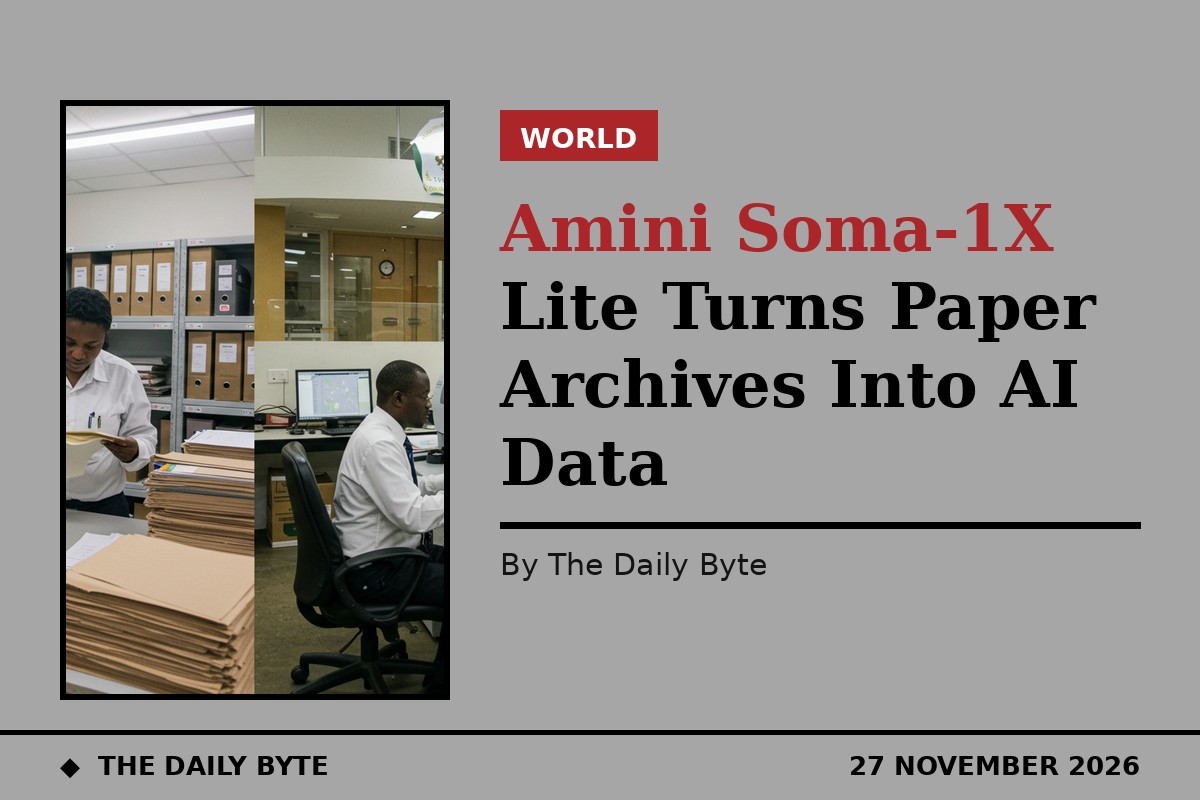
Amini, an African technology company building sovereign AI infrastructure, has released Soma-1X Lite, a compact open-weight AI model that turns scanned paper records into structured, machine-readable data. The release was announced on 25 November from Bridgetown, Barbados, where much of the work behind the model began.
The model is aimed at a problem that affects governments across the Global South: most public knowledge still sits on paper. Cabinet papers, land registries, civil registries, geological surveys and handwritten ledgers hold the records of whole countries, yet they cannot be searched, analysed or used by modern software. Amini's argument is that countries in this position do not need to digitise first and adopt AI a decade later. They can go straight from analogue records to AI-ready data.
Small enough to run at home
Soma-1X Lite has two billion parameters, which makes it small by the standards of today's frontier models. Amini says it can run on a single graphics processing unit inside an institution's own infrastructure, so sensitive records never have to leave the country's jurisdiction. It can also run on a central processing unit, although more slowly.
The model is a vision-language model: it reads a scanned page as an image and turns it into structured data, preserving the text, the layout, tables, mathematical content and the position of information on the page. It handles printed text and handwriting, and it is designed for difficult material such as faded ink, damaged pages and complex tables.
Amini has published the model weights, inference instructions and evaluation code on Hugging Face under the Apache 2.0 licence, so governments, archives, universities and developers can run it privately, reproduce its results and adapt it to their own needs.
Benchmark claims, with a caveat
Amini reports that Soma-1X Lite scored 84.7 on olmOCR-Bench, a public document-processing benchmark, ahead of Gemini 3.8 Flash, GPT-5.5 and Claude Sonnet 5 in its comparison, and 84.37 on OmniParse-Bench. These are the company's own figures, not independently verified results, and the comparison is against the specific models Amini names.
The company also says the model can process about 15,000 pages an hour on a single Nvidia RTX PRO 6000 graphics card, at an estimated computing cost of 22 US cents per 1,000 pages, roughly a tenth of the cost of the frontier models it compares itself with.
Built for African languages
The most distinctive part of the release is language coverage. Amini tested the model on 435 held-out document pages across ten African languages, including Swahili, Yoruba, Hausa and Wolof, and reports an average character error rate of 2.9 percent, the lowest among the five open models it evaluated.
That matters because the details of these languages are easy for a general model to get wrong. Yoruba uses dotted letters such as e with a dot below, Hausa uses hooked letters, and Lingala uses open vowels. Amini says Soma-1X Lite preserves those characters and diacritics correctly. In Swahili, soma means read.
From Barbados to Botswana
The model grew out of real archive work. In Barbados, the government's R.O.A.D. programme is preserving and digitising one of the world's most extensive archives documenting Atlantic slave societies, millions of pages, many handwritten, fragile and centuries old. Working on those records, alongside cabinet papers and other government archives, shaped how Soma was built.
The work has since extended to Botswana, where Amini is digitising geological maps and mineral-resource records that remain on paper, working with the Ministry of Minerals and Energy. The Central African Republic is set to follow.
Amini, founded in 2022 by Kate Kallot, a former Nvidia executive, says its next release will extend Soma to more underrepresented languages and scripts, including the Ethiopic script used for Amharic and Arabic-based writing traditions such as Ajami, as well as historical archives, maps, forms and registries.
For governments sitting on paper archives, the pitch is practical rather than grand: a small, open model that runs on their own hardware, reads their own languages, and turns records nobody can search into data their public servants can actually use.


