Amnesty urges El Salvador to reveal Haiti troop deal
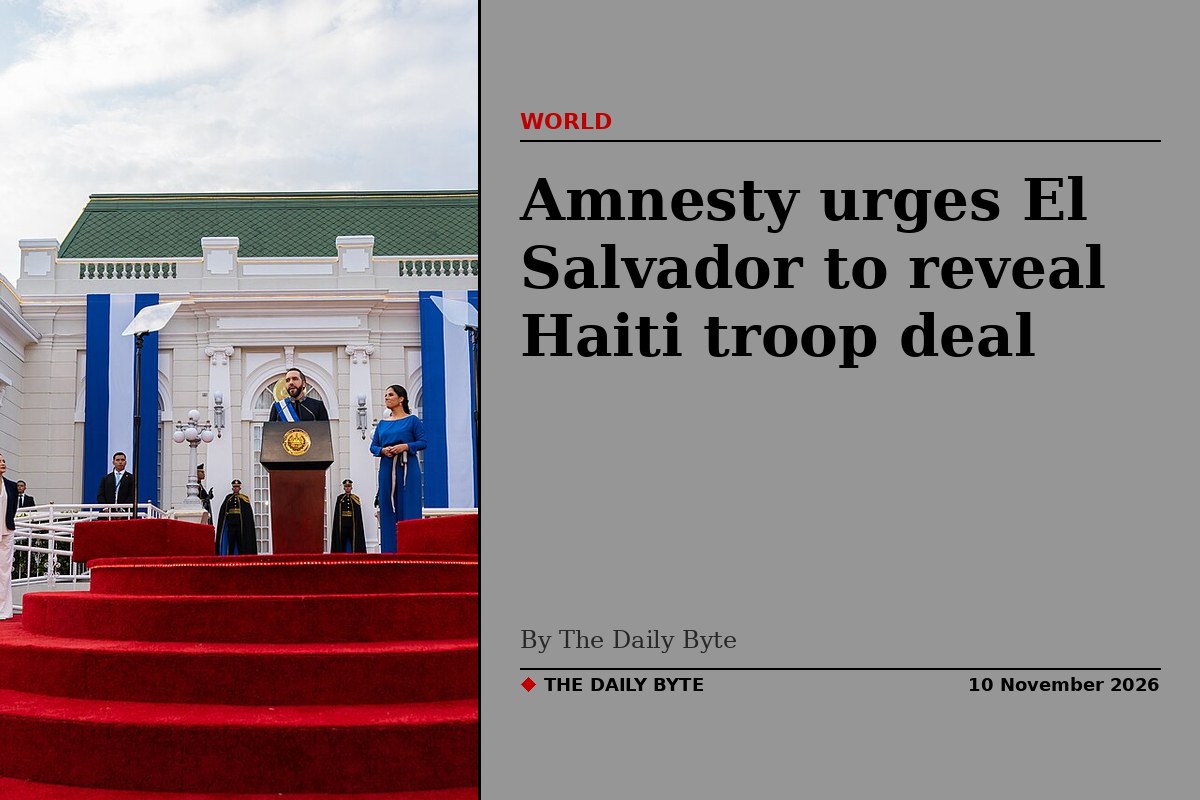
Amnesty International has called on El Salvador and Haiti to make public the agreement governing the deployment of around 2,000 Salvadoran troops to the gang-plagued Caribbean nation, warning of risks to human rights and accountability.
The call, issued on Monday 9 November, concerns the terms of the arrangement under which the Salvadoran troops are to be deployed. Amnesty said the governments of both countries must ensure the deployment respects human rights. Amnesty International issued the call in a statement on Haiti, and France 24 reported the organisation's demand for disclosure.
Outside the UN force's mandate
The concern follows clarification by Stéphane Dujarric, spokesperson for the United Nations Secretary-General, that the vast majority of Salvadoran military personnel recently deployed to Haiti are not part of the Gang Suppression Force, the force authorised by the UN Security Council. They therefore fall outside the mandate and monitoring mechanisms of the United Nations Support Office in Haiti.
That leaves the deployment operating without the oversight that applies to the UN-backed force, even though the Salvadoran contingent is roughly equal in size to it. Amnesty warned that the lack of a published agreement makes it impossible to know who commands the troops, what rules govern them, or how long they will stay.
A rescue mission that grew
El Salvador has sent more than 2,000 soldiers to Haiti in the space of about ten days, a deployment that matches what the UN-backed security force took more than a year to assemble. The stated trigger was narrow: on 18 October, four Salvadoran aviation technicians serving with the Gang Suppression Force went missing after armed men ambushed their vehicle in Croix-des-Bouquets, east of Port-au-Prince.
President Nayib Bukele has said the deployment is nearly complete and that El Salvador will shoulder 90 percent of the costs. Writing in Haitian Creole, he said: "This is not an operation against the Haitian people nor an invasion of Haiti... Our only goal is to bring our four aviation technicians back home. Furthermore, we intend to teach a lesson to the gangs." Ten days after the ambush, local sources said it was unlikely the missing four could be recovered.
The Salvadoran contingent is also operating outside the force's main base in Port-au-Prince, according to sources cited by CNN, and its command structure has not been publicly established. The deployment was launched without a signed status-of-forces agreement with Haiti, according to the Miami Herald.
What happens next
Haitian Prime Minister Alix Didier Fils-Aimé is set to visit El Salvador on 16 and 17 November to decide the future of the troops, Vice President Félix Ulloa confirmed. The talks will take place during an international conference on democracy in San Salvador, and will determine whether the contingent extends its mission or sets out a withdrawal timeline.
Ulloa said El Salvador had achieved tangible results with a fraction of the budget of broader multilateral efforts, but stressed that San Salvador does not intend to replace the UN-backed multinational force. For now, all operational costs remain fully covered by the Salvadoran government.
Meanwhile, one of Haiti's main gang leaders, Wilson Joseph of the 400 Mawozo gang, has sent a letter to UN Secretary-General António Guterres asking for dialogue with the international forces. Haiti's electoral authorities have also postponed the first round of presidential and parliamentary elections from 13 December to 18 July 2027, with a second round on 4 October 2027, in part because foreign troops have been deployed since 2024 to create conditions safe enough for a vote.
Amnesty's demand puts the focus on transparency: until the agreement is published, neither Haitians nor Salvadorans can judge the legal basis, the limits or the accountability of a foreign deployment that is already one of the largest in Haiti.


