ANC makes DA last resort in coalition talks
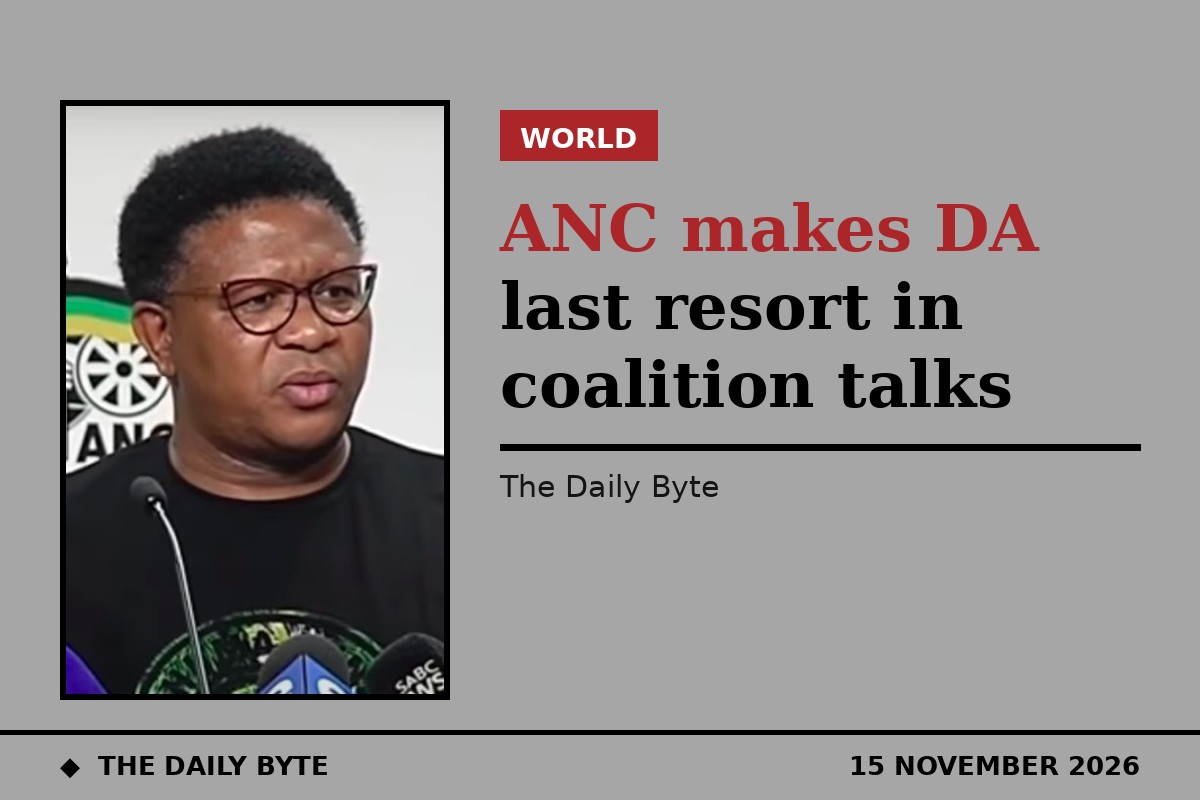
The African National Congress has decided that the Democratic Alliance should be treated as a last resort in coalition talks in South Africa’s hung municipalities, after the governing party recorded its worst local election result since the end of apartheid.
The decision was reported after an extended meeting of the ANC’s National Executive Committee, held on Thursday 12 November at the Birchwood Hotel in Boksburg, Gauteng. The meeting followed the local government elections of 4 November, in which the ANC’s national support fell to about 30.76 per cent, down from 45.59 per cent in 2021.
What the ANC decided
According to reports of the meeting, the ANC’s national executive agreed that the party should first explore coalition arrangements with other parties, and turn to the DA only where those talks fail to produce a workable government. The approach applies to municipalities where no party won an outright majority, of which there are more than 120 across the country.
The position does not amount to a complete refusal to work with the DA. It means the DA, the ANC’s partner in the national Government of National Unity, would be approached last in local coalition negotiations rather than first. Reporting on Sunday 15 November also said the ANC had ruled out a national stability pact with the DA that would mirror the national unity arrangement at local level.
Why the ANC is rethinking the DA partnership
Senior ANC figures have questioned whether the party’s national partnership with the DA has cost it support among its traditional voters. ANC national chairperson Gwede Mantashe, speaking after the election, dismissed the idea that working with the DA guarantees stability. “This notion that when you work with the Democratic Alliance one gets stability, I don’t buy that,” he said in an interview reported by Newsday.
President Cyril Ramaphosa had earlier urged ANC leaders to explore a coalition in Johannesburg without the DA, according to the Sunday Times. In Johannesburg, the DA won the largest share of the vote, with 34.79 per cent, followed by the ANC on 20.25 per cent and Herman Mashaba’s ActionSA on 16.27 per cent. The DA also finished first in Tshwane, Ekurhuleni, Nelson Mandela Bay and Cape Town, leaving seven of South Africa’s eight metropolitan municipalities without a single party able to govern alone.
Opposition is also on the table
The ANC is also considering going into opposition in councils where it won less than 30 per cent of the vote, and in cities where it took less than 20 per cent, according to the Daily Maverick’s reporting of the national executive’s discussions. That would be a marked change for a party that has governed South Africa nationally since 1994 and has far more experience in government than in opposition.
Despite the resistance inside the ANC, talks between the ANC and the DA formally opened on Sunday afternoon, 15 November, as both parties continued discussions with alternative partners. Any final coalition agreement, particularly in the major metropolitan municipalities, still requires approval from the ANC’s National Executive Committee.
The coming days will show whether the “last resort” position holds, or whether the arithmetic of hung councils forces the two parties back to the table sooner than either would like. With mayors to be chosen and budgets to be passed, the ANC’s choice will shape how South Africa’s largest cities are governed for the next five years.
Sources: Zambian Observer; Daily Maverick, via PMN Sports; Newsday.


