Android 17 QPR3 Beta 4 fixes Pixel lag and battery drain
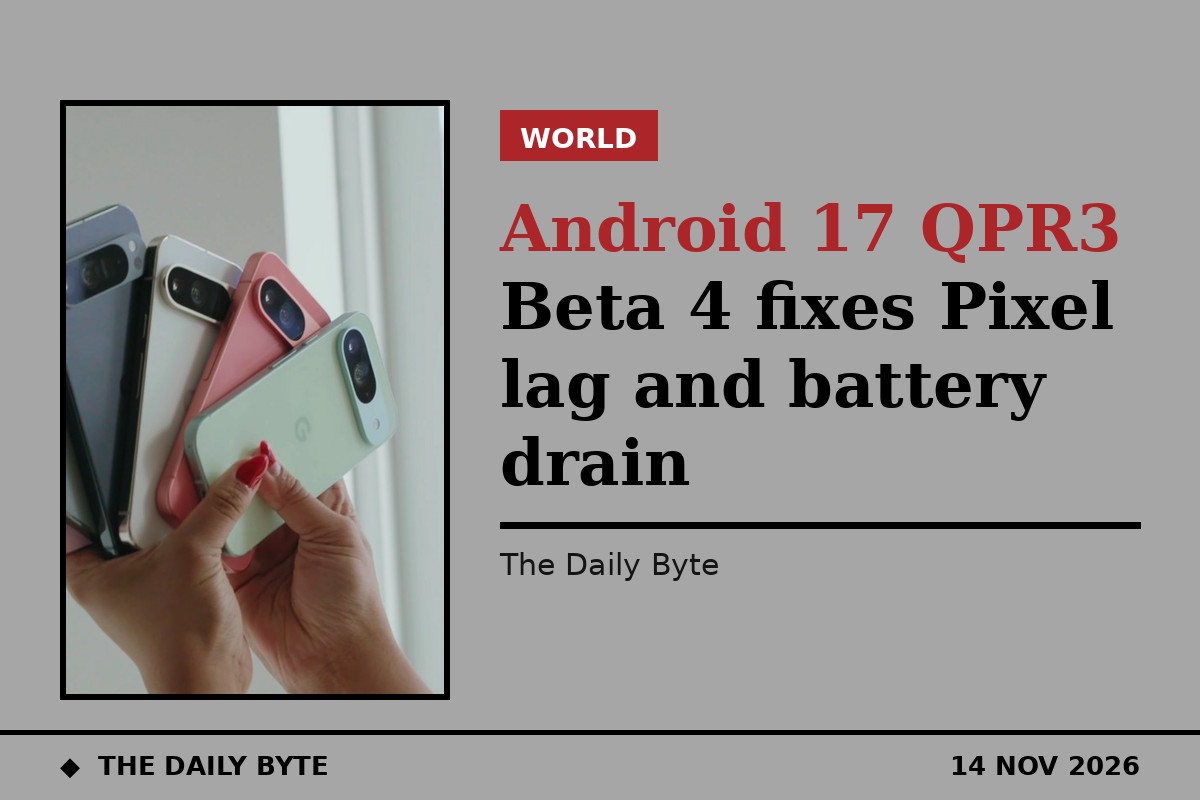
Google has rolled out Android 17 QPR3 Beta 4 to Pixel phones, fixing memory leaks behind severe interface lag and crashes and a Bluetooth bug that was draining batteries. The update, build DP11.261030.003, began reaching devices enrolled in the Android Beta for Pixel programme on 12 November 2026, and was widely reported on 13 November.
Unlike the feature-packed November Pixel Drop that arrived just days earlier, Beta 4 is a fixes-first release. Google's release notes list four corrections, and the headline one tackles memory leaks in system_server, the core Android process that manages the system interface. Those leaks were causing severe user-interface lag, crashes in the Pixel Launcher and unexpected device restarts.
What Android 17 QPR3 Beta 4 fixes
The second major fix targets battery life. Google says excessive Bluetooth background activity was consuming an abnormal amount of power, draining affected phones quickly. Beta 4 resolves that runaway process, which should restore normal standby and connected battery endurance.
The update also fixes an on-screen keyboard problem, in which the keyboard appeared visually clipped or partially cut off during text input. A developer-facing fix corrects an unclear error message from Conscrypt, Android's security library, when older TLSv1 or TLSv1.1 connection protocols were rejected for apps targeting API level 36.
Reports also say Beta 4 restores the “Disable absolute volume” option for Bluetooth audio, which can now be switched off under Settings, System, Developer options, Bluetooth. The toggle is not listed in Google's release notes, but 9to5Google reports that it has returned after user feedback. Absolute volume links a phone's volume with the volume of a connected Bluetooth device, so one slider controls both.
Which Pixel phones get Beta 4
The beta covers 23 Pixel devices: the Pixel 6a; Pixel 7, Pixel 7 Pro and Pixel 7a; Pixel Tablet and Pixel Fold; Pixel 8, Pixel 8 Pro and Pixel 8a; Pixel 9, Pixel 9 Pro, Pixel 9 Pro XL, Pixel 9 Pro Fold and Pixel 9a; Pixel 10, Pixel 10 Pro, Pixel 10 Pro XL, Pixel 10 Pro Fold and Pixel 10a; and Pixel 11, Pixel 11 Pro, Pixel 11 Pro XL and Pixel 11 Pro Fold, as well as the Android Emulator.
The original Pixel 6 and Pixel 6 Pro are not included, having wrapped up their official update cycle earlier this year, while the cheaper Pixel 6a stays on the list. The update carries the 5 October 2026 security patch level.
How to get it — and the beta warning
Pixel owners already enrolled in the Android Beta Program receive Beta 4 as an over-the-air update, and can check manually under Settings, System, Software Updates. Anyone not enrolled can join through Google's Android Beta Program portal, after which the update should be offered.
Google and reviewers alike warn that this is a beta build, not a stable release, and that testers may run into new bugs along the way. Owners who rely on their Pixel as their only phone, and who are not troubled by the lag or battery drain Beta 4 addresses, may prefer to wait for the stable release. Leaving the beta track before QPR3 reaches stable status requires reverting to a public build, which wipes the phone's data.
Where Beta 4 fits in Google's schedule
Beta 4 follows Beta 3 on 29 October, Beta 2 on 20 October and Beta 1 on 2 October. It arrives just two days after the stable Android 17 QPR2 release on 10 November, which came as part of the November Pixel Drop with Gemini Intelligence and Pixel Tag. QPR3 lays the groundwork for Google's early 2027 platform drop, and Google says QPR releases reach regular users through Feature Drops, so these fixes should land in a stable build later.
For Pixel owners who have been living with the lag, the launcher crashes or the fast-draining battery, Beta 4 is the first build that promises relief — with the usual beta caveat that testers should expect the unexpected. Sources: Android Headlines and Android Pure.


