Anti-Dumping Bill 2026: Appeal Window Cut to 30 Days
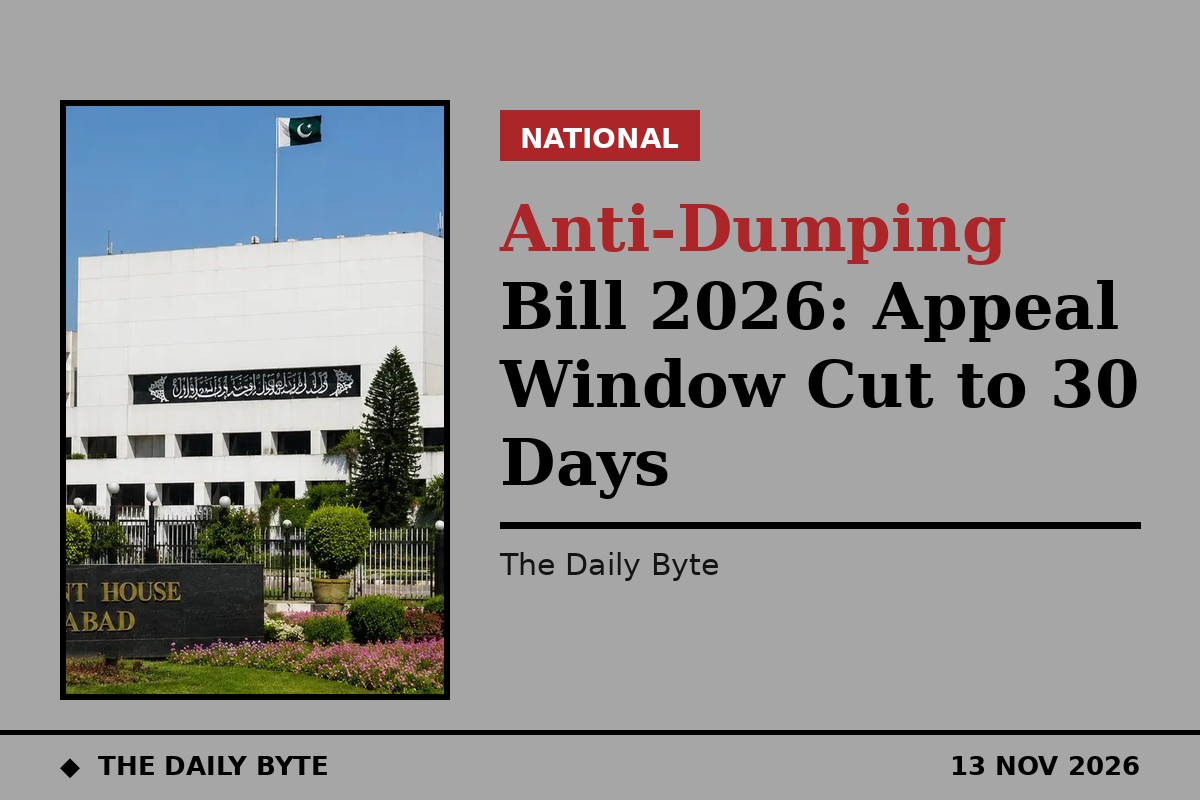
The National Assembly's Standing Committee on Commerce has recommended that the House pass the Anti-Dumping Duties (Amendment) Bill, 2026, a package of changes that would cut the time to challenge an anti-dumping decision from 45 days to 30 days. Pakera reported that the committee, chaired by Muhammad Jawed Hanif Khan, took the decision at its 27th meeting on 11 November 2026, after a briefing from the Ministry of Commerce.
An anti-dumping duty is an extra charge on imported goods sold in Pakistan below their normal price. The National Tariff Commission investigates suspected dumping and sets the duty, and Customs collects it at the border. A company that disagrees with a commission decision can appeal to the Anti-Dumping Appellate Tribunal, and today it has 45 days to do so. Under the bill, that window would fall to 30 days.
Six changes in the bill
The committee's press release lists six changes. The period for provisional measures, the temporary duty that can apply while the commission investigates, would be revised. The appeal period would drop from 45 days to 30 days. The Islamabad High Court would get exclusive power to hear appeals beyond the tribunal. Recovery of unpaid anti-dumping duty under the Customs Act would be strengthened. The rules on financial security, such as bank guarantees importers must post, would be revised. And the duty rates applied to foreign exporters who do not cooperate with a commission investigation would be rationalised.
The release does not give the new provisional period, the new security rules or the new rates. Those figures will appear only in the bill text itself. The committee said the aim of the changes is to strengthen the legal framework against unfair trade, improve the collection and recovery of duties, and speed up appeals.
What changes for importers
The shorter appeal window is the change most businesses will feel first. An appeal needs the commission's decision, the company's own sales and cost records, and a lawyer's grounds, and a firm that waits until the end of the window could find the door closed. Companies affected by a commission decision should now count 30 days, not 45, as their safe deadline.
The Islamabad High Court's exclusive jurisdiction would also matter. Today a company unhappy with a tribunal decision may be able to go to a high court in its own province. If the bill passes as described, appeals at that level would go only to the Islamabad High Court, meaning a Karachi or Lahore importer would need a case in Islamabad and a lawyer who practises there. The committee's stated reason is to speed up the process and produce one consistent line of rulings rather than several.
Not law yet
The bill is not law. The committee's recommendation is one step: the bill still has to be passed by the National Assembly and the Senate and receive the President's assent before any of the changes take effect. Importers and local manufacturers who rely on anti-dumping protection should watch the National Assembly's bills page for the bill's passage and the Gazette of Pakistan for the final text.
The same meeting also took up the Trade Organizations (Third Amendment) Bill, 2026, a private member's bill moved by Dr Farooq Sattar about the status of the Karachi Chamber of Commerce. The committee repeated that chambers should be organised at division level rather than district level and sent the bill to the National Assembly's drafting branch. On trade, the committee was told that exports to ASEAN countries more than doubled in July to October, that rice exports rose about 46 per cent in the first four months of the fiscal year, and that China takes more than 90 per cent of Pakistan's sesame seed exports. It asked the food security ministry for a five to seven year report on sugar and wheat imports and exports, Pakistan News Gazette reported.