Antonia Romeo calls for fundamental Whitehall overhaul
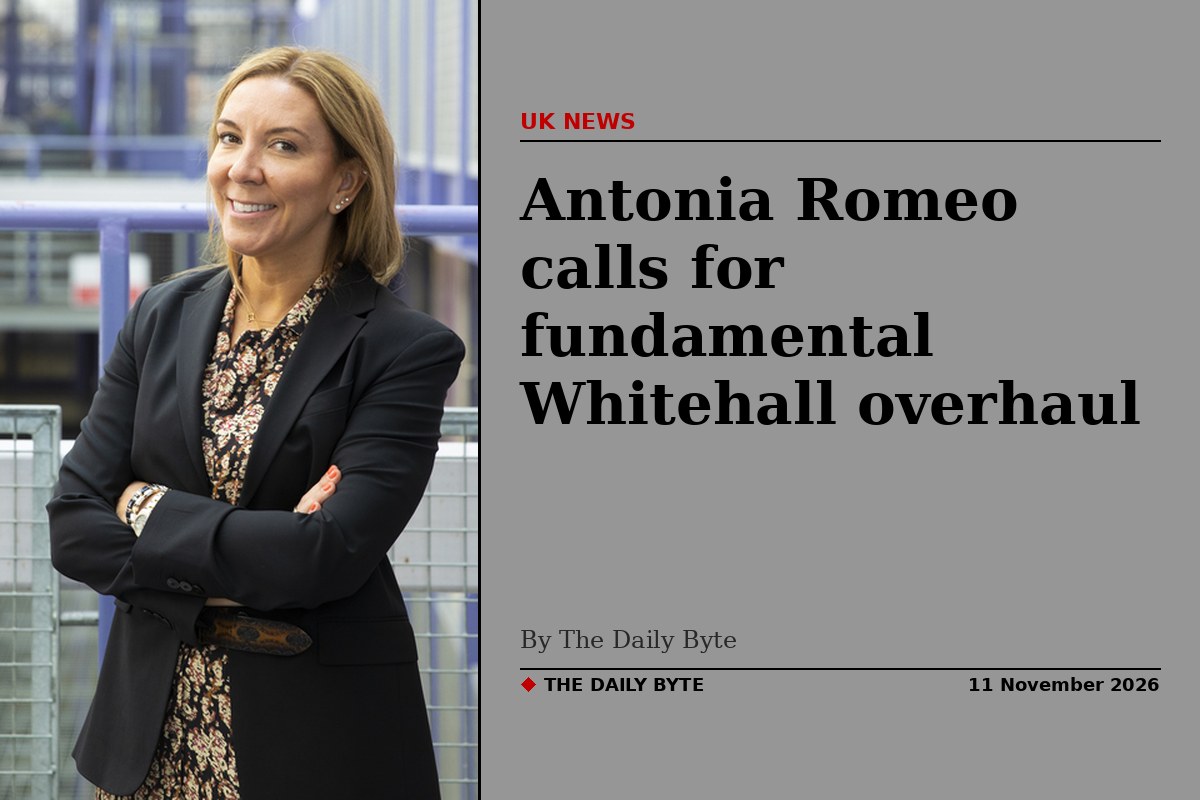
Dame Antonia Romeo has called for the Civil Service to be reimagined in the most fundamental way since its formation, warning that Whitehall faces a burning platform for change.
The Cabinet Secretary and Head of the Civil Service delivered the Cabinet Secretary's Annual Lecture, entitled Rewiring the State and the Future Civil Service, at the London School of Economics on Tuesday 10 November 2026. Prime Minister Andy Burnham and the First Secretary of State attended the lecture.
Dame Antonia, who took over as Cabinet Secretary in February 2026, said the service needed urgent and vital reform. She acknowledged familiar criticisms of Whitehall, describing it as tame and risk-averse, reactive rather than strategic, and siloed rather than working across boundaries, and said she had observed some of them herself in 26 years in the service, nine of them as a Permanent Secretary.
Five pressures driving change
Dame Antonia set out five imperatives that together create the case for reform: the advance of artificial intelligence, new global threats facing the UK, declining public trust in institutions, the urgent need to increase public service productivity, and the Prime Minister's devolution by default agenda.
On trust, she cited OECD figures showing that only four in ten members of the public report trusting the Civil Service, significantly down in half a decade. On productivity, she said UK public service productivity was almost 3 per cent below its pre-pandemic peak, despite extra resources invested since the pandemic.
She also set out the scale of the organisation she leads: more than half a million people across England, Wales, Scotland and Northern Ireland, with 80 per cent based outside London. Traditional policymakers make up just 7 per cent of staff, while operational delivery accounts for 55 per cent. In a Blavatnik Index in 2024, the UK Civil Service ranked joint sixth in the world. Dame Antonia said she wanted it to be first.
What the reform programme will do
The transformation programme, known as the Future Civil Service programme, has three central principles: delivery, innovation and productivity, and pride and trust. Its stated mindset is: Make it happen. Make it better. Make it count.
Dame Antonia said 8,000 responses had been received from civil servants to a new Future Civil Service Portal, with staff asking to use AI and technology to replace bureaucracy, to overhaul the things that get in the way of delivery, and to be rewarded for building expertise. She promised simpler recruitment, an end to formulaic job adverts and slow processes, and an expanded Fast Stream graduate scheme that is more place-based and AI-focused. The Fast Stream is the number one programme of choice for new graduates for the second year running.
Small, agile Frontier Teams within departments will be given an explicit licence to operate differently, recruit specialist talent at pace and redesign outdated processes. She pointed to the AI Security Institute, set up in just six months in 2023, as proof of what the system can do when it moves quickly.
AI at the centre of the new Civil Service
Artificial intelligence runs through the reform plan. Dame Antonia said AI would radically rewrite every domain in which the Civil Service operates, from policymaking to direct service delivery, and that for the first time public service need not be constrained by the limits of human bandwidth.
She gave three examples already in use: HMRC protected and recovered £10 billion in tax revenue during the last tax year alone by applying machine learning; the Home Office is rolling out biometric, contactless e-gates; and the Ministry of Housing, Communities and Local Government is deploying AI to analyse planning applications, helping halve processing times for routine householder applications.
She was clear that jobs will change and that the transition must be handled carefully, but said AI would not replace the need for human creativity, interaction or decision-making. Ethical and transparent deployment of AI, with appropriate guardrails, must be the overriding principle, she said.
She closed her account of her own career with a story from her first day in 2000, when facilities staff replaced the six armchairs in her office with four chairs without arms after realising they had mistaken her seniority. It was, she said, an example of a system where rules designed for one purpose ended up with energy spent literally reorganising the furniture.
Frequently asked questions
Who is Dame Antonia Romeo? She is the Cabinet Secretary and Head of the Civil Service, the first woman to hold the role, appointed in February 2026. She previously served nine years as a Permanent Secretary.
What is the Future Civil Service programme? It is the Government's transformation programme for the Civil Service, built around delivery, innovation and productivity, and pride and trust, with AI, devolution of power from Westminster and simpler recruitment at its centre.


