Aoun allies want Israeli withdrawal before disarmament
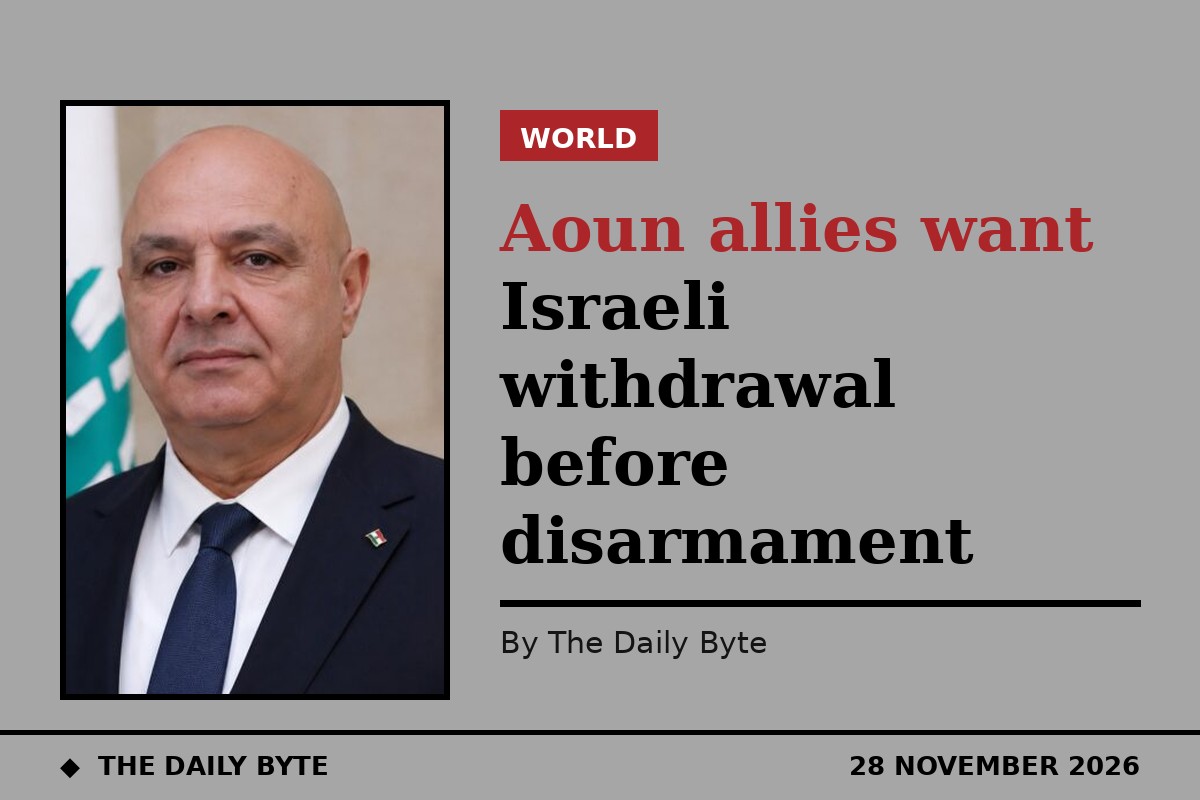
People close to Lebanese President Joseph Aoun want Israel to withdraw its troops, the Lebanese army to be strengthened and reconstruction to begin before Lebanon takes up the question of disarming Hezbollah, according to a report in the Lebanese newspaper Al-Akhbar.
Sources at the Baabda presidential palace described that sequence to the newspaper in an article published on 27 November. The same sources said the US administration had become more receptive to Aoun's position that Israel should withdraw first, and better understood why Lebanon rejected forcibly disarming Hezbollah and what that could mean for the country's stability.
The account, attributed to unnamed palace sources, has not been confirmed by any US official in a public statement. But it points to a growing dispute over the order in which the June framework agreement between the United States, Israel and Lebanon should be carried out.
Disarmament first, or withdrawal first?
The framework agreement, signed on 26 June 2026, ties verifiable disarmament and effective control by the Lebanese army to a phased Israeli withdrawal and reconstruction. Under its first phase, the Lebanese army is to disarm non-state armed groups and dismantle their infrastructure in pilot areas, paving the way for subsequent phases of the Israeli withdrawal.
Israel wants confirmation that the areas have been cleared and that the army can hold them before its troops pull back. Aoun's camp wants the sequence reversed: withdrawal first, then army support and reconstruction, with Hezbollah's weapons addressed afterwards.
Verification remains a sticking point. Military talks in Tampa on 20-22 October ended without agreement on how compliance would be verified, or on who would carry out independent verification, according to an analysis by the Washington Institute for Near East Policy.
Hezbollah's parliamentary bloc has rejected any approach that links Israeli withdrawal or reconstruction to disarmament. In a statement reported last weekend, the bloc repeated its call for Israel's complete withdrawal and a halt to attacks before any internal discussion of a defence strategy or the state's monopoly on arms.
Aoun's balancing act
Aoun has tried to hold both lines at once. In a speech on the eve of Lebanon's independence anniversary on 21 November, he accused Iran of meddling in Lebanese affairs through Hezbollah's weapons and demanded that Israel withdraw from every inch of Lebanese territory and stop its attacks. He also told Hezbollah its weapons must be handed over to the state.
At the same time, his office has been seeking international help to keep the south secure as the UN peacekeeping force, UNIFIL, approaches the end of its mandate on 31 December. At a meeting with Jens Plötner, a representative of Germany's Defence Ministry, Aoun proposed ensuring UNIFIL's duties were still carried out during its withdrawal, citing UN Security Council Resolution 1701 as the legal basis, with changes if necessary.
He listed specific tasks for foreign assistance to the army, including clearing mines, disposing of unexploded ordnance and removing rubble, and called for an international reconstruction conference and funding for work in the pilot areas. Plötner said a European delegation would visit Lebanon early next month to discuss the details.
The timetable for the peacekeepers' departure is set by Security Council Resolution 2790, adopted on 28 August 2025, which extended the mission's mandate for a final time through 31 December 2026 and provided for an orderly reduction and withdrawal of personnel over the following year.
With Israeli strikes continuing in the south and the army's capacity in question, the argument over sequencing is now the central obstacle to implementing the framework deal, and to any lasting calm along the border.


