Applied Optoelectronics Falls 17% on Dilution Fears
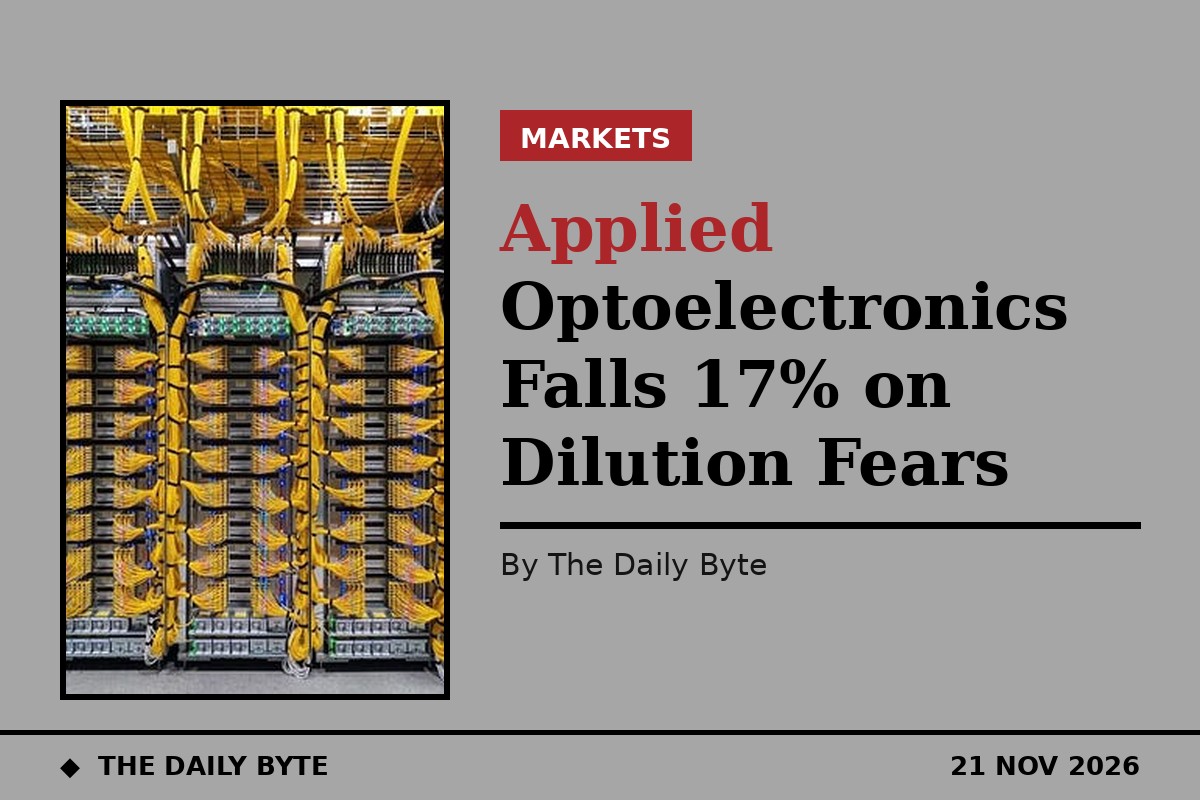
Applied Optoelectronics fell sharply on Friday, extending a brutal week for the optical networking supplier as investors fretted about dilution from its latest share-sale plan and the wider rout in artificial intelligence stocks.
The shares closed 16.55% lower at 32.93 on Friday, according to BestStocks, after the S&P 500 fell 3.8% and the Nasdaq Composite dropped 5.1% in a session that erased the Nasdaq's gains for the year.
The immediate trigger was a filing made late on Tuesday, in which the company said it had entered into an equity distribution agreement allowing it to sell up to 550 million of common stock from time to time. Raymond James and Needham will act as sales agents, collecting a 2% commission on gross proceeds, and the proceeds will be used for general corporate purposes.
Investors took fright at the scale of the authorisation. With a market value of roughly 3.5 billion, the company is small enough that the full 550 million would amount to about a sixth of the business, and it is the fourth such at-the-market programme the company has launched this year, reviving concern about repeated dilution.
A volatile year gets worse
The shares had already fallen 12% to 39.70 on Wednesday after ending Tuesday at 45.22, Barron's reported, and Friday's slide took the stock to its lowest level in months. The stock closed at a record high of 223.10 on 13 May but has since fallen about 80% from that peak, with the decline accelerating this month.
The equity deal follows an offering in October in which Applied Optoelectronics sold around 5.7 million shares for about 588 million to fund data-centre capacity expansion. The company is slated to spend around 1 billion in 2026 upgrading and expanding capacity in the United States and Taiwan to support the manufacture of high-speed optical transceivers for data centres.
The company previously signalled the proceeds could be used both to pay off debt and for capital spending to scale up its AI data-centre offerings. Management has said the business is well positioned to scale manufacturing and "support the next phase of AI data center deployment".
Strong sales, weak shares
The paradox for investors is that the underlying business has been growing fast. Applied Optoelectronics reported earlier in November that third-quarter revenue surged 127% from a year ago, while revenue from data centres grew 44% sequentially.
Wall Street analysts remain broadly positive on the longer term, even after cutting their price targets. Needham analysts maintained a Buy rating on 6 November but reduced their target to 100 from 170, saying delays were affecting the timeline for capacity and revenue growth but that the pace of build-out "remains exceptional". Rosenblatt kept a Buy rating while cutting its target to 115 from 220, arguing: "We like the stock here. Demand isn't the constraint; supply is."
For now, though, the market is focused on the supply of shares rather than the supply of transceivers. With the Nasdaq in negative territory for the year and AI infrastructure stocks under heavy pressure, Applied Optoelectronics has become a symbol of how quickly sentiment has turned: a stock that traded above 220 in May now changes hands below 33, with investors waiting to see whether the next buyer steps in or the dilution fears deepen further.


