Apprenticeship adverts plunge 36% in a year
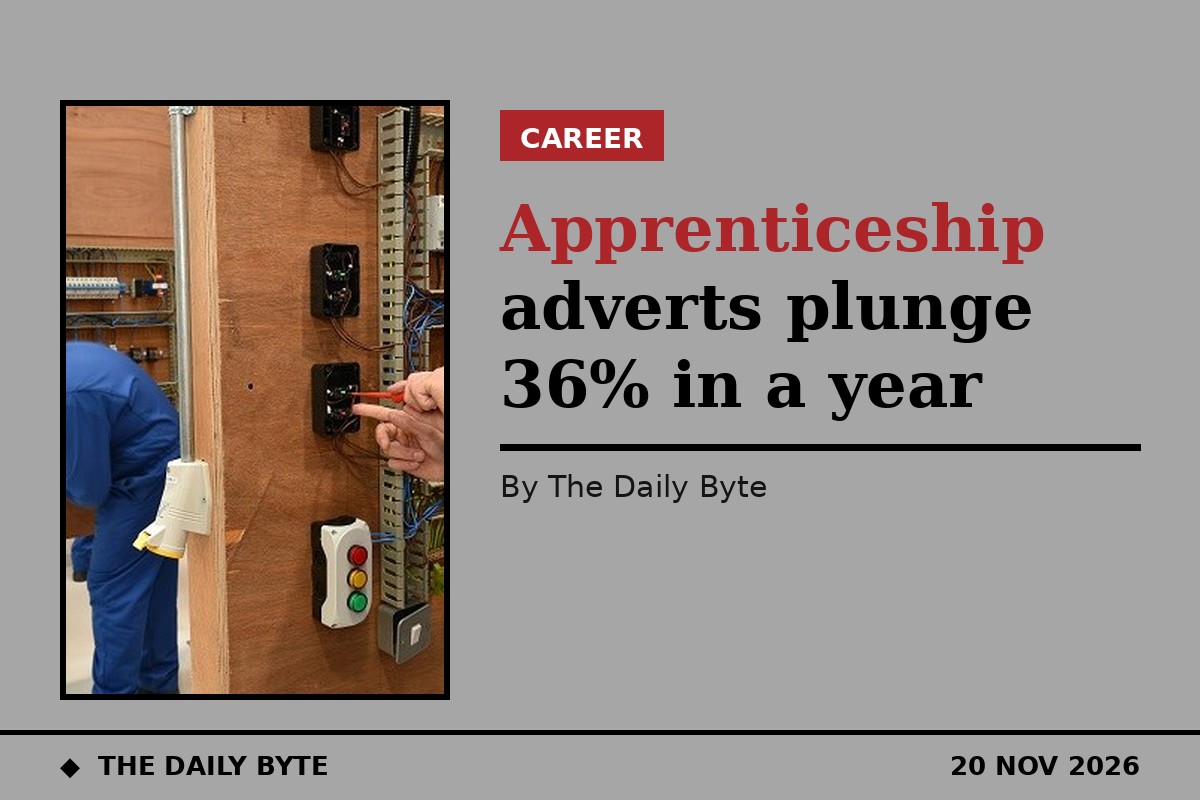
Apprenticeship adverts on Indeed fell 36% in August to October 2026 compared with the same period a year earlier, while postings overall on the platform fell 10%, according to figures supplied by the company and reported by Onrec. The drop leaves one of the main paid routes into skilled work far scarcer for young jobseekers, just as an independent review calls for apprenticeship numbers to double.
Indeed says apprenticeship postings were around two-thirds below their 2019 level and represented only 0.7% of all postings on its platform. The figures describe advertisements on Indeed, not official apprenticeship starts, which are measured separately — but they are a timely signal of how many openings employers are actually advertising.
A shrinking route into work
The fall lands against a difficult backdrop for young people. The Office for National Statistics estimated that 981,000 UK 16- to 24-year-olds were outside education, employment or training in April to June 2026, or 13.0% of the age group — up 30,000 on the year, though down 30,000 on the previous quarter.
Over a longer period, the Institute for Fiscal Studies found that apprenticeship starts in England among under-25s declined by 35% between 2016–17 and 2024–25. Higher-level apprenticeships accounted for nearly a quarter of starts in that age group in 2024–25, up from 4% in 2016–17, meaning the apprenticeships that remain are increasingly taken at higher levels rather than by school leavers.
What the Milburn review proposes
Alan Milburn’s final Young People and Work report, published on 17 November, recommends doubling the number of young people completing an apprenticeship over the next decade. It sets an ambition for around 35% of each cohort to have started a high-quality apprenticeship by age 25 by 2036, with annual starts among under-25s rising towards 270,000, and proposes an initial 25,000 pre-apprenticeship places.
The independent review also proposes a locally led Youth Opportunity Service throughout England to deliver two statutory guarantees: an Opportunity Guarantee offering a route into education, training or work, and a Support Guarantee providing the health, employment and practical help young people need to take up and sustain those opportunities. The proposals would extend access to 18- to 24-year-olds outside education, employment or training who need a route back, regardless of whether they claim benefits.
The government’s response
The government told Parliament on 17 November that it strongly endorsed the need for a new settlement for young people and would consider the report in full alongside the forthcoming Timms review. It pointed to £2.5 billion of investment in the Youth Guarantee, supporting nearly a million young people with up to 500,000 opportunities to earn or learn, and said the Jobs Guarantee would be made available sooner — from 12 months of unemployment rather than 18 — from spring next year.
Ministers also announced a new Youth Opportunities Unit, based in the Office for the Prime Minister and Cabinet and chaired by Alan Milburn, and said a White Paper in early 2027 would set out detailed proposals for delivering the new settlement.
Why employers are holding back
Jack Kennedy, senior economist at Indeed, said the review was an opportunity to examine the different barriers young people face when trying to enter employment. “Indeed data shows how challenging the starting point can be, especially for apprenticeships. Between August and October, apprenticeship job postings were 36% lower than a year earlier, a far steeper fall than the 10% drop across overall postings,” he said.
Kevin Fitzgerald, UK managing director of Employment Hero, argued that expanding apprenticeships, work experience and flexible opportunities for disabled young people would require support for businesses that take on new entrants. “When the cost of hiring keeps rising, employers are more cautious about taking a chance on someone without experience,” he said. Employment Hero reported that quarter-on-quarter employment growth among Gen Z workers in its own platform data was 0.9% in its October reading, the lowest since April 2025 — a figure that describes the company’s dataset, not nationwide employment growth.
Kennedy said the test of the response would be practical: “The test will be whether the response helps young people prepare for work while creating more opportunities for them to get that first step on the career ladder.” For young applicants, the message is stark: competition for each apprenticeship place is intensifying, and the places themselves are becoming harder to find.
Sources: Onrec, reporting Indeed figures; UK Parliament (Hansard), 17 November 2026.