Araghchi: US attacks on Iran breach UN Charter
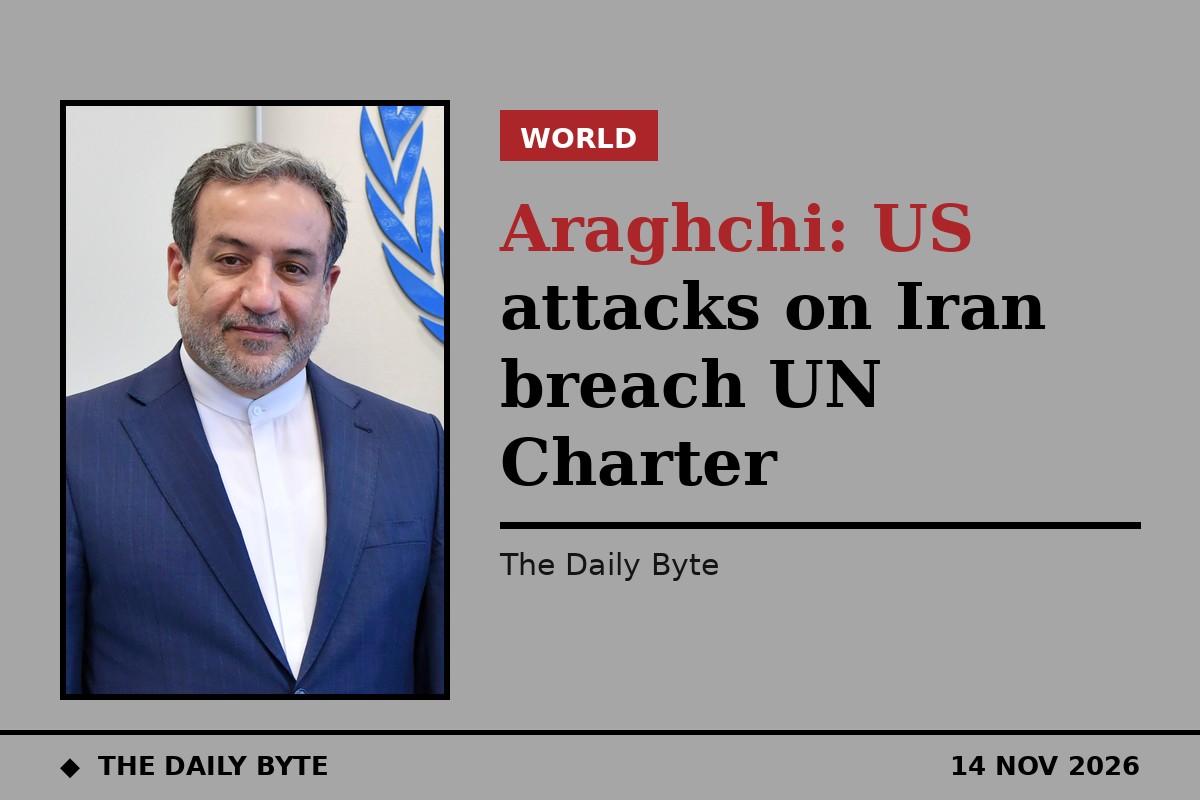
Iran’s Foreign Minister Abbas Araghchi has said the military strikes launched by the United States and Israel against Iran are a clear violation of the prohibition on the use of force and an infringement of Iran’s sovereignty. Writing in an opinion article for Japan’s Kyodo News, he argued that the attacks breach the United Nations Charter and international law, and that Washington must be held legally accountable.
The article, titled “The UN Charter Under Fire: Why US Attacks on Iran Violate International Law”, was published on Saturday. Araghchi asked: “If states were free to attack one another based on their own assessments of possible future threats, what would be left of the international legal order?”
The legal argument
Araghchi’s central argument is that Article 2(4) of the UN Charter prohibits the threat or use of force against the territorial integrity or political independence of any state. He wrote that the United States had neither obtained authorisation from the UN Security Council nor established grounds for invoking self-defence under Article 51, which permits force in response to an armed attack.
“Their legality must be assessed against the U.N. Charter and established principles of international law, not against political arguments or justifications advanced after military operations have begun,” he wrote. He added that the question “goes well beyond the political dispute between Iran and the United States”, writing: “It concerns one of the fundamental principles on which the international order established after the Second World War rests: the use of force is governed by law, and no state, however powerful, is entitled to place its own judgment above binding rules of international law.”
Araghchi also referred to the International Court of Justice’s 1986 judgment on the prohibition on the use of force, and to UN General Assembly Resolution 3314 on the definition of aggression. He argued that claims about potential future threats cannot justify the use of force, and that appealing to such claims does not provide a sufficient legal basis for self-defence.
Attacks on civilian and nuclear sites
The foreign minister wrote that attacks on schools, sports stadiums and civilian infrastructure, as well as on Iranian nuclear facilities subject to International Atomic Energy Agency safeguards, raise further questions under international law and must be examined under international humanitarian law.
At the same time, Araghchi maintained that Iran retains its right of legitimate self-defence under Article 51 of the UN Charter in response to an armed attack, subject to the conditions and limitations imposed by international law. He warned that if power were permitted to prevail over law, Iran would not be the only casualty.
Iran presses its case at the UN
Iran made the same argument at the United Nations on Friday, when its deputy permanent representative, Gholamhossein Darzi, addressed a Security Council meeting on the Middle East. “The United States is the aggressor, not the victim,” Darzi said, accusing Washington of waging an unlawful war of aggression against Iran in violation of the UN Charter.
Darzi accused the United States of bombing civilian infrastructure, threatening the Iranian population and imposing a military and maritime blockade, and warned of an “immediate and decisive response” to any renewed American or Israeli military attack.
The intervention comes as President Donald Trump has told advisers he may hold off on further attacks on Iran if there are no new provocations from Tehran or the Iran-backed Houthis in Yemen, according to Reuters. The war, which the United States launched with Israel in February, has continued alongside a US naval blockade and sanctions on Iran, while talks on ending the conflict have stalled.


