Argentina Recession: Milei Economy Shrinks Again
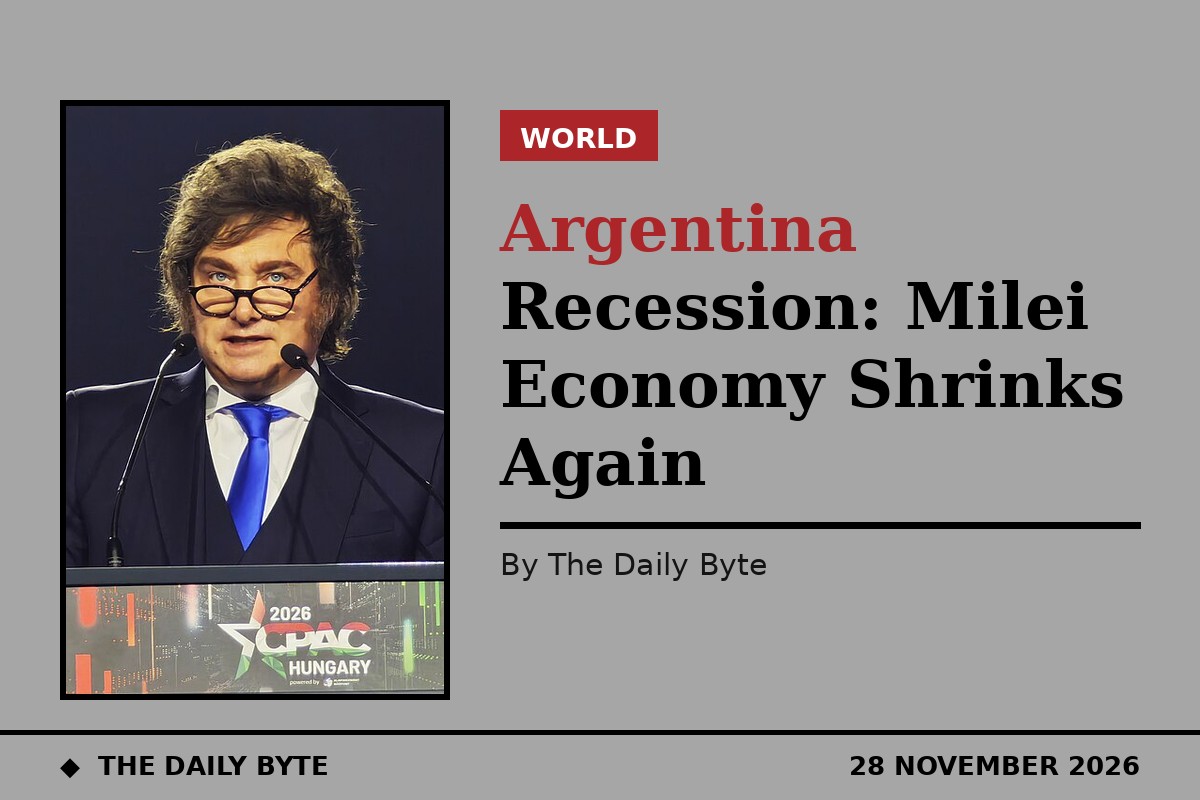
Argentina has slipped into a technical recession, according to economists, after official data showed the economy shrinking for a second consecutive quarter, in a fresh blow to President Javier Milei’s austerity programme.
Argentina’s statistics agency, INDEC, reported this week that economic activity rose 1.1 per cent in September from August on a seasonally adjusted basis, but was 1.2 per cent lower than a year earlier. Economists calculate a fall of about 1.8 per cent in the third quarter against the second, after an official 0.6 per cent contraction in the second quarter — two straight quarterly declines, the common definition of a technical recession.
What the figures show
September’s rebound came too late to save the quarter: activity plunged 2.5 per cent in July, after a revision, and grew by only 0.4 per cent in August. Activity fell year on year in every month of the quarter: by 1.5 per cent in July, 1.6 per cent in August and 1.2 per cent in September.
Ten of the 15 sectors tracked by INDEC shrank from a year earlier. Fishing plunged 48.6 per cent, financial intermediation fell 11.5 per cent and manufacturing fell 1.8 per cent. Mining and quarrying rose 11.1 per cent, electricity, gas and water rose 4.0 per cent and construction rose 3.5 per cent. Activity was still 1.0 per cent higher over the first nine months of 2026 than a year earlier.
Formal confirmation is still to come: INDEC will publish its third-quarter GDP estimate on 16 December, and only that can confirm a second quarterly fall. INDEC said deciding whether the economy was in recession was not its function. Presidential spokesman Adrian Ravier said on 24 November that it was too early to confirm and that third-quarter GDP might not end up negative.
“With the recently published data, we have entered a technical recession,” University of Buenos Aires economist Federico Glustein told the AFP news agency, while adding that the 16 December figure was needed for confirmation.
Markets lose confidence
Investor confidence has fallen sharply alongside the economy. Argentina’s country risk, a measure of how much more its bonds yield compared with US Treasury securities, has tripled in four months, from 402 points in July to 1,067, making it more expensive for the country to borrow money.
The peso has also weakened to a nominal record of 1,625 to the dollar, against around 1,447 a year earlier. Consultancies have cut their 2026 growth forecasts to about 1 per cent or less, Eco Go to 0.8 per cent. The International Monetary Fund had already cut its forecast to 2.1 per cent from 3.5 per cent on 13 October.
Unemployment reached 7.9 per cent in the second quarter, its highest level under Milei, according to official figures cited by AFP. Inflation has eased to around 30 per cent over the past 12 months.
Milei dismisses the label
Milei rejected the diagnosis. “The definition of a technical recession is a mere arbitrary definition,” he wrote on X in response to the latest economic data.
His economy minister, Luis Caputo, admitted on the A24 channel on Wednesday that the economy had grown less than the government would have liked. “I am not concerned about the rise of the dollar,” Caputo said, blaming a period of global crisis with a worldwide impact.
Milei took office in December 2023 promising to take a chainsaw to the state, slashing public spending, balancing the budget and breaking hyperinflation — but growth has not followed.
Guido Zack, director of Fundar, a Buenos Aires-based development think tank, told Latin America Reports that stagnation had been the rule, not the exception, under Milei: the sharp adjustment and devaluation on taking office caused a recession in the first half of 2024, a recovery followed, interrupted in February 2025, and the economy had not grown since.
Zack said the fourth quarter would probably grow against the third, ending the technical recession, but that would not end Argentina’s stagnation. For him, the culprit is government policy, stuck in a cycle of fiscal adjustment to cut the deficit which reduces activity and revenue, creating the need for further adjustment.
Since the start of Milei’s administration in December 2023, 32,000 companies have closed and 386,000 jobs have been lost, according to figures cited by Fundar and the University of Buenos Aires.
What happens next
The downturn tests Milei’s programme ahead of the 2027 presidential election. In the second quarter, private consumption fell 2.4 per cent and fixed investment 0.8 per cent, while exports rose 2.5 per cent. Whether the 16 December GDP release confirms the recession, the data already show an economy that has stopped growing, with weak domestic demand set against strong mining and energy output.


