Argentina threatens jail for Rockhopper boss over Sea Lion
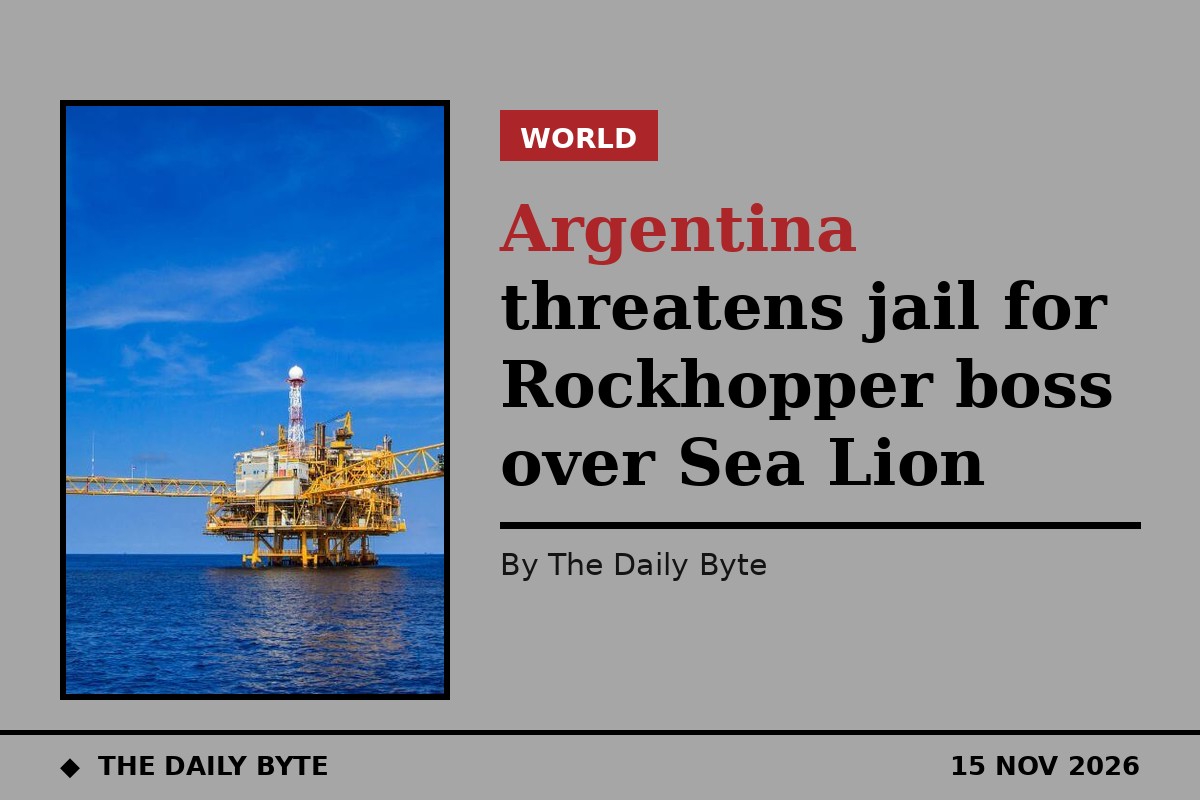
Argentina threatened the chief executive of British oil company Rockhopper Exploration with imprisonment over the Sea Lion offshore oil project near the Falkland Islands, as an international tribunal prepares to rule on whether drilling should be halted.
Sam Moody, Rockhopper's chief executive, said Argentina wrote to him and the company's chief financial officer on 1 September 2026, threatening criminal prosecution, imprisonment and fines under Argentine domestic law. The disclosure was made in a witness statement submitted by the United Kingdom to the International Tribunal for the Law of the Sea, known as ITLOS, and unsealed after an application by the Guardian.
Argentina has asked the Hamburg-based tribunal to order an urgent suspension of drilling at Sea Lion, an offshore project about 220 kilometres north of the Falkland Islands, led by Rockhopper and Israel's Navitas Petroleum. The tribunal heard two days of argument on 10 and 11 November and is expected to rule on Argentina's request for provisional measures on 28 November.
Buenos Aires seeks an urgent halt
Argentina argues that Britain's agreement to the project is unlawful while sovereignty over the islands is disputed, and that drilling should not go ahead before the underlying dispute is settled. It cites a 1976 United Nations resolution calling on both countries to refrain from acting unilaterally in a way that could change the situation in the Falklands, known in Argentina as the Malvinas.
Argentina opened arbitration against the United Kingdom on 28 September and asked the tribunal on 13 October to order provisional measures blocking new drilling and the installation of production infrastructure. Its foreign minister, Pablo Quirno, warned in an opinion article published on Sunday that the project could cause irreversible environmental damage, saying a company contingency plan showed a spill could reach Argentine waters within 30 days.
Buenos Aires has passed domestic legislation criminalising the project and has taken action against companies and financial institutions involved. It banned Navitas from operating in Argentina for 20 years. US oilfield services company Halliburton has said it will not take part in the project after discussions with Argentina.
London says tribunal has no jurisdiction
The United Kingdom told the tribunal it had no jurisdiction over what London describes as a sovereignty dispute, and argued that the 1976 UN resolution was not legally binding. Attorney General Ellie Reeves told the tribunal that a suspension would end the project's hopes of success, with devastating consequences for the people of the islands.
Jack Ford, the chair of the Falkland Islands Legislative Assembly, told the tribunal in a further submission that the collapse of the project would be felt across the whole of the islands, and that the impact would be social as well as economic.
Sea Lion is expected to double the Falkland Islands' gross domestic product and bring the islands' government 8 billion pounds in revenue over the field's lifetime. Navitas operates the project and holds a 65 per cent stake, while Rockhopper owns the remaining 35 per cent. The project would involve 23 wells and 35 years of production, with the earliest possible date for new drilling given as 21 March 2027 and first oil planned for 2028.
A decision that is not about sovereignty
The ruling expected on 28 November will deal only with Argentina's request for provisional measures, not with the underlying question of sovereignty over the islands, which has been disputed since Argentina invaded the Falklands in 1982, triggering a 74-day war.
Until the tribunal rules, no suspension order is in force, and the project remains in its planning phase. Both governments are expected to await the decision before setting out their next steps.


