Ariane 6 Amazon Leo launch moves to 24 November
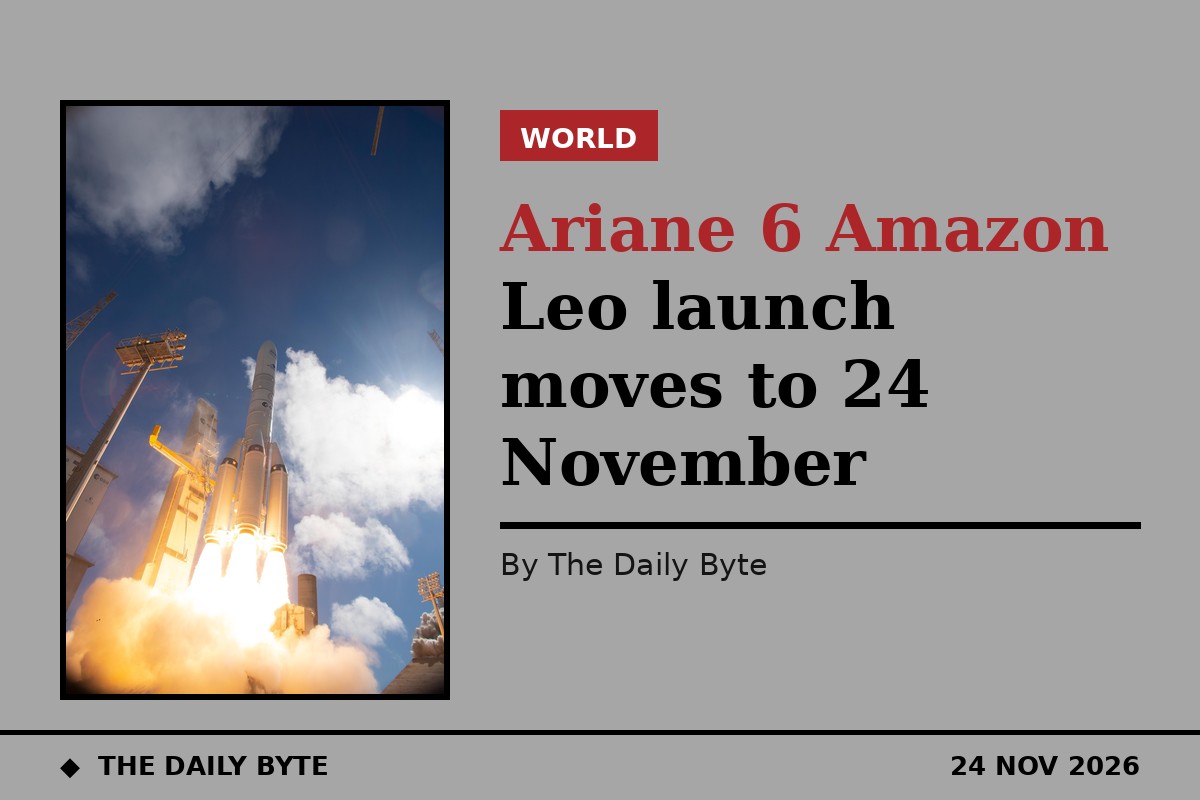
Arianespace has moved the launch of 36 Amazon Leo internet satellites to Tuesday, 24 November, after a technical problem with the rocket's ground support systems halted the countdown on Monday. The Ariane 6 flight, designated VA271 by Arianespace and LE-04 by Amazon, will now lift off from Europe's Spaceport in Kourou, French Guiana, in a window running from 10:45 to 11:14 UTC, Arianespace announced on Monday.
The new window opens at 05:45 in Washington, 07:45 in Kourou and 11:45 in Paris and Berlin. The final satellite separation is expected about two hours and four minutes after liftoff. Arianespace said its teams had carried out the necessary analyses and checks after the problem on Monday, and that the rocket and its 36 satellite passengers remained in stable and safe conditions.
What stopped the countdown
The countdown was interrupted after a technical event affecting the launcher's ground support systems, the equipment on the ground that supports the rocket before launch. The sequence was stopped before the mobile gantry, the tall structure that surrounds the rocket during final assembly, was removed, and before the launcher's own systems were started. That timing matters: stopping early, before the rocket itself was put through its launch sequence, is the cautious end of a scrub, and it left both the vehicle and the payload untouched.
Arianespace has not named the component that failed, and its statement gives no further detail about the fault. What it does say is that the checks needed to restart launch operations have been completed. The flight will use Ariane 64, the most powerful version of Ariane 6, fitted with four solid rocket boosters. It is the tenth Ariane 6 flight overall and the fourth in the Ariane 64 configuration.
The flight itself
Once it leaves the pad, the flight is a long one. The upper stage fires its Vinci engine twice and releases the satellites in turn between about one hour and 39 minutes and two hours and four minutes after liftoff, according to Orbinauts, which tracks the mission. A third firing then brings the upper stage down out of orbit. The satellites are released at an altitude of about 465 kilometres, and Amazon's team then takes control of them from its mission operations centre in Redmond, Washington, checks their health and raises them to their working height of 630 kilometres.
This flight is also the second to use the upgraded P160C boosters, each carrying 156 tonnes of solid propellant, 14 tonnes more than the boosters they replace. That upgrade lifts what the rocket can carry to low orbit to about 22 tonnes. The first flight with the new boosters, in June, carried Amazon's previous batch of 36 satellites.
First launch since the Vulcan failure
The rescheduled flight is Amazon's first attempt to launch Leo satellites since 15 November, when a United Launch Alliance Vulcan rocket failed on its first flight for the constellation and 40 satellites were lost. That rocket remains grounded while United Launch Alliance investigates the failure and the American Federal Aviation Administration reviews the findings. No return-to-flight date has been announced, although the company has said its early indications point to an inadequate fuel supply to the first stage's two engines.
The failure has made the Ariane 6 flight more important than a routine deployment. Amazon already has 392 Leo satellites in orbit, all of them working, and these 36 would take the total to 428. The company plans a constellation of more than 3,200 satellites to deliver fast broadband beyond the reach of existing networks, and it has bought 24 Ariane 6 launches, six of them ordered in September. This is the fourth of those launches, and once it flies Arianespace will have put 136 Amazon Leo satellites into orbit.
For Amazon, the delay of a day is a small setback against that larger programme. The satellites are safe, the rocket is safe, and the new window is less than 24 hours after the original attempt. What the scrub does show is how tight the margins have become: with Vulcan grounded, Ariane 6 is carrying the constellation's deployment schedule on its own, and every launch window matters.


