Army delays Iowa blast of toxic lead explosive
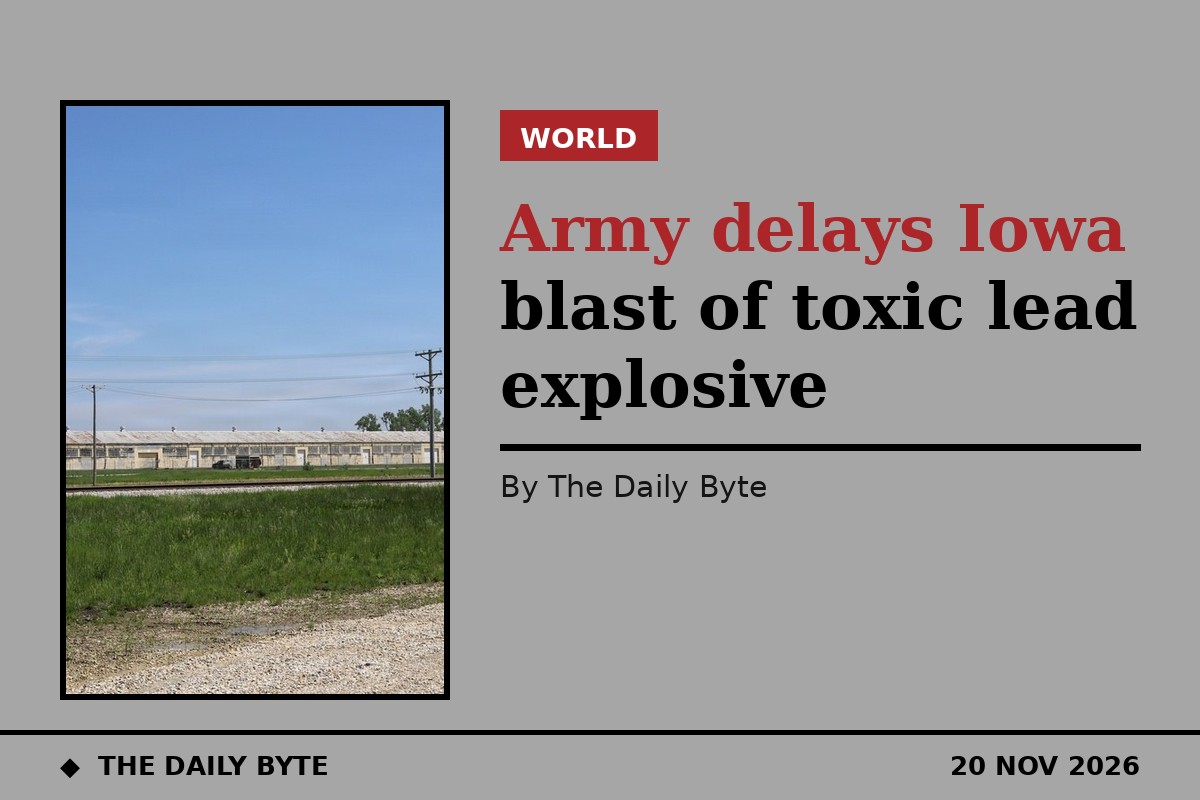
The United States Army has delayed the controlled detonation of 68 barrels of unstable lead azide at the Iowa Army Ammunition Plant, pushing the operation from Friday 20 November to Monday 23 November after growing public concern and a last-minute legal challenge.
Adam Telle, the acting secretary of the Army, announced the delay on Thursday evening in a post on social media, saying "public safety is the Army's top priority." He said the postponement moved the blast to "the latest possible moment prior to a forecasted temperature drop, which would risk further destabilization of the material."
Nearly 9,500 pounds of unstable explosive
The planned detonation involves nearly 9,500 pounds of lead azide, a highly sensitive explosive used in munitions manufacturing. Army officials said the material has been stored at the plant near Middletown, in south-eastern Iowa, for more than 20 years and has become too unstable to transport or process elsewhere, making an on-site detonation the safest option.
The lead azide was found to be unstable during an inspection in March 2026. The Army said recrystallisation of the stored compound had increased its sensitivity to friction and shock, and that disturbing the containers could create an unacceptable risk of unintentional detonation. The material is currently held in secure, earth-covered magazines.
The Environmental Protection Agency approved an emergency permit for the detonation on 13 November, and the Army publicly announced its plans on 15 November. The Army had shared details at a public meeting in Middletown in October, but a public advisory on Sunday was the first time many communities, some as far as 100 miles away, became aware of the potential impact.
Fears of a toxic lead plume
The Army warned that the blast could release a plume of toxic lead dust extending up to 100 miles north-east from the facility, possibly reaching towns including Wapello in Iowa and New Boston in Illinois. Army modelling showed the dust was expected to linger for about an hour, depending on wind speed, and residents in the area were encouraged to leave or to shelter at the US Army Reserve Center in Middletown.
Lead is a neurological toxicant that can harm the brain, nervous system and other organs, and children are especially vulnerable because exposure can cause irreversible neurological damage, medical toxicologist Jennifer Sample told the Des Moines Register. The Army said the barrels would be detonated inside earth-covered concrete magazines surrounded by sand-filled Hesco barriers about two storeys high, with the soil above thoroughly saturated before and during the blast.
Iowa Governor Kim Reynolds, who was among those calling for a delay, spoke directly with Telle on Thursday. The office of Iowa Senator Chuck Grassley had said the Army was concerned that a spontaneous explosion of the lead azide could occur.
Lawsuit seeks to halt the blast
Environmental groups filed a lawsuit on Thursday seeking to stop the detonation. The Sierra Club's Iowa chapter and the Iowa Environmental Council asked the US Court of Appeals for the Eighth Circuit for an emergency order halting an EPA permit authorising the destruction of the 68 drums, arguing that the permit was issued without sufficient consideration of environmental standards, less dangerous disposal alternatives and adequate notice to communities in the potential hazard zone.
According to EPA and Army documents, alternatives such as neutralising and decomposing the drums' contents with other chemicals were considered. The Army has said that taking no action could lead to an accidental detonation and "the sudden, uncontrolled release of vaporized lead, particulate matter, and toxic combustion gases."
The Army said it would continue to engage with state and local officials throughout the region to distribute accurate, up-to-date information before Monday's detonation.
Sources: CNN; Reuters.


