Iowa Lead Azide Detonation to Proceed by Tuesday
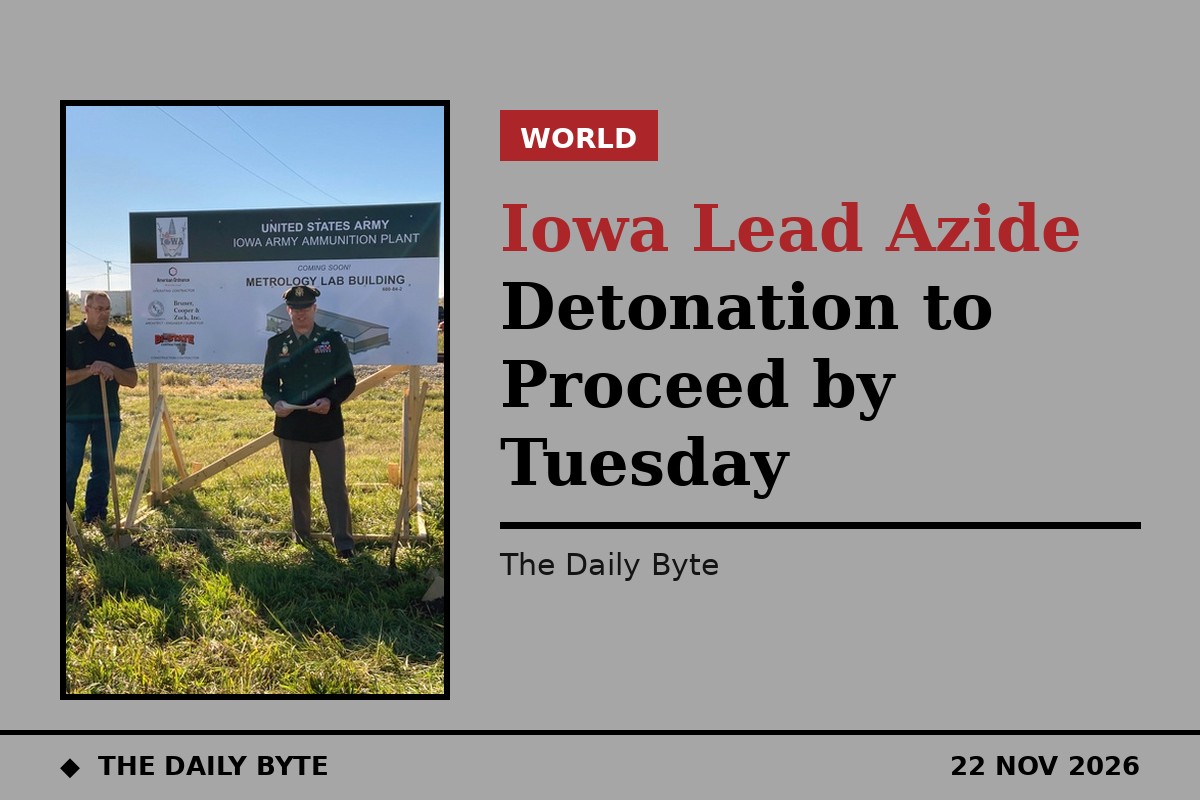
The United States Army will detonate 68 barrels of degraded lead azide at a munitions plant in Iowa by Tuesday, 24 November, after telling a federal appeals court that it will use emergency powers to proceed without an environmental permit. The Justice Department disclosed the plan in a court filing late on Saturday, 22 November, in a move that sidesteps a court order pausing the controversial operation.
The filing said the Army intends to act by 24 November and argued that the court's order does not prevent it from proceeding under a separate legal authority. The government said the Army would invoke an emergency munitions and explosives exception to federal environmental protection laws, allowing the detonation to go ahead even though the permit issued by the Environmental Protection Agency (EPA) remains on hold.
Lead azide is a compound used to detonate munitions, and the stockpile at the Iowa Army Ammunition Plant in the small town of Middletown amounts to nearly five tons. The Army discovered during routine stockpile surveillance in March that the material, stored in bunkers at the plant, had been degrading. Officials said the degraded compound had become extremely unstable and sensitive to even slight friction or movement.
The Army warned that falling temperatures in the coming days could destabilise the material further and cause it to explode on its own. In its filing, the government put the choice in stark terms, saying the real choice was not between a detonation and no detonation, but between a planned and mitigated detonation and an unplanned and unmitigated explosion. It said crystals in the waste could break as temperatures drop below 30 degrees Fahrenheit in the next several days.
Court pause and public concern
The detonation was originally scheduled for Friday, 20 November, but was postponed to Monday, 23 November, after pushback from residents, farmers and elected officials. The United States Court of Appeals for the Eighth Circuit then temporarily froze the EPA permit on Thursday, after the Iowa Environmental Council and the Sierra Club's Iowa chapter sued, arguing that the agency had skipped necessary steps in issuing it. The emergency permit had taken effect on 13 November and was due to run until 11 February 2027.
The plan has drawn heavy opposition in Iowa and across the border in Illinois. The Army has warned that the blast will send up a plume containing lead particles that could travel 100 miles or more from the site, dispersing over rural Iowa, the Mississippi River and parts of western Illinois. Lead is harmful at any level of exposure and is especially dangerous to children. The Army said extensive modelling predicted that lead particles in the air may be elevated after the blast and would settle on the ground.
Iowa Governor Kim Reynolds activated a state emergency operations centre on Friday, while officials in nearby Illinois warned residents about dust drifting into their state. The Federal Aviation Administration has restricted flights around Middletown from Monday through Wednesday. Senator-elect Josh Turek had called on Thursday for a delay, saying he had heard from many Iowans worried about their health and safety.
Army says it will keep safety measures in place
Environmental groups criticised the government's filing. Rachel Rintelmann, a managing attorney at Earthjustice, which represents the groups that brought the lawsuit, said the filing laid the groundwork for a detonation without a permit that would effectively bypass judicial process and review. The Army said it intended to act consistently with the terms of the emergency permit and its mitigation measures to limit the dispersal of lead dust, even if the permit itself was not in effect.
The Army, working with the EPA and the Department of Health and Human Services, said on Friday that the whole of the interagency was working together to ensure the controlled detonation was conducted in the safest fashion possible. Army officials held a community meeting on 15 October to discuss a possible detonation in late November, and residents were formally notified of the Friday date on 15 November.
The Army did not respond on Sunday to questions about the precise timing of the detonation. The EPA had said in a court filing that it planned to submit its response to the environmental groups' challenge by 22 November. The Iowa Army Ammunition Plant, built in 1941, produces medium and large calibre munitions, and the lead azide had been held in bunkers there for years before its deterioration was found.


