ASEAN Bars Myanmar Junta Chief from Manila Summit
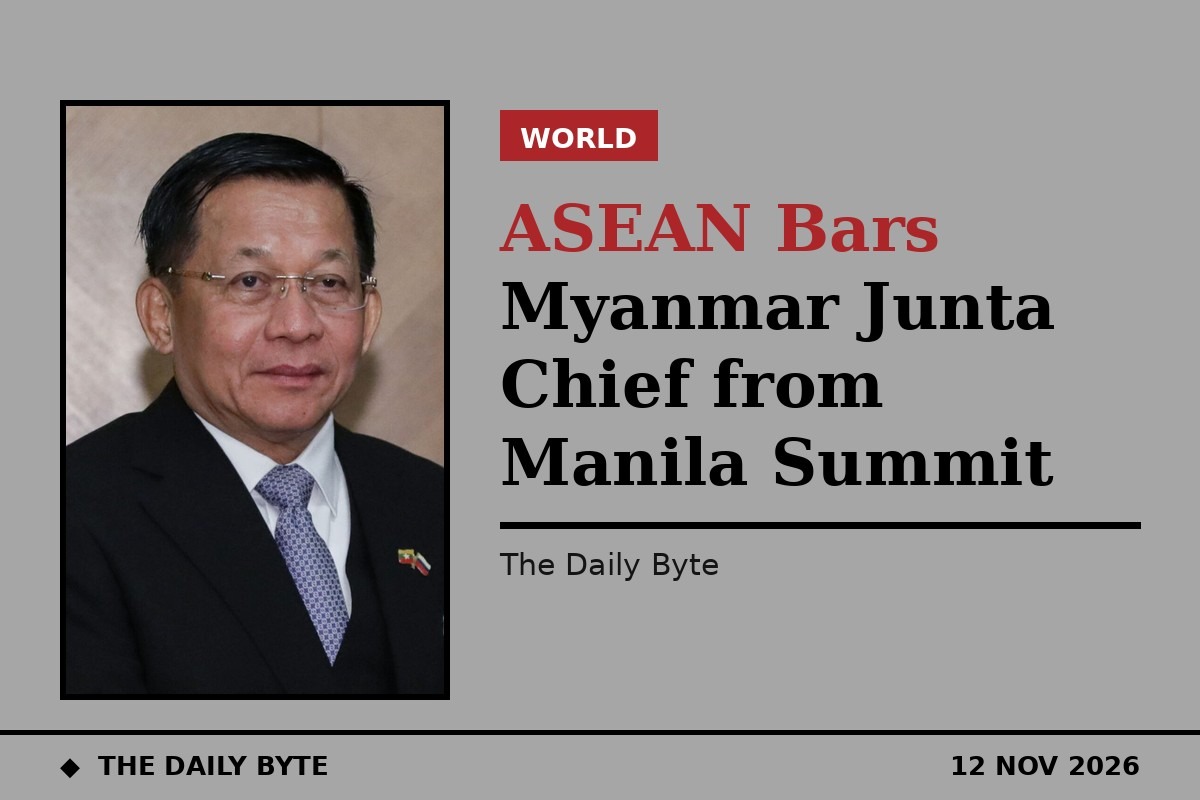
Myanmar's military ruler Min Aung Hlaing will not be invited to the ASEAN summit in Manila next week, the Philippines has confirmed, keeping the junta leader out of the region's top-level gathering even as several member states have begun welcoming him on bilateral visits.
The Philippine Department of Foreign Affairs confirmed on 11 November that Min Aung Hlaing would not attend the 49th ASEAN Summit, which runs from 15 to 17 November in the Philippine capital. Myanmar will instead be represented only at the level of the Director-General of the ASEAN Affairs Department of its junta-controlled Foreign Ministry, a sharp downgrade from head-of-government representation.
The decision upholds a position ASEAN has held since the 2021 military coup: Myanmar's political leadership is barred from the bloc's summits and foreign ministers' meetings, although the country remains a member. The exclusion has survived repeated pressure from Naypyitaw to restore full participation, including a push ahead of this year's summit after Min Aung Hlaing installed himself as president in April following elections widely condemned as a sham.
Pressure to re-admit the junta
The confirmation came after months of diplomatic manoeuvring by the regime. Since rebranding itself in civilian clothing in April, the junta has courted individual ASEAN members, and Min Aung Hlaing has received official invitations from Laos, Thailand, Vietnam, Cambodia and Malaysia. Rights groups sharply criticised Malaysia and Thailand, in particular, for hosting the junta leader after years in which the bloc had held a common line.
Human Rights Watch, which had written to Philippine President Ferdinand Marcos Jr. on 5 November urging him to hold the line, welcomed the confirmation. The organisation said world leaders gathering in Manila for the ASEAN and East Asia summits should press the bloc to keep junta officials out of its meetings and to increase pressure on the regime to end abuses. Its Asia advocacy director, John Sifton, said ASEAN could play an important role in bringing a stop to Myanmar military abuses.
Progressive Voice, a Myanmar civil society network, also applauded the decision, saying that keeping the junta leader out of the summit sends a clear message that there is no place for war criminals on the regional stage. The group noted that the Philippines, as this year's ASEAN chair, was acting on the commitment the bloc made to the people of Myanmar in 2021, when it adopted its Five-Point Consensus calling for an end to violence, inclusive dialogue and humanitarian access.
A crisis that has not eased
The backdrop to the summit decision is a conflict that continues to deepen. The United Nations reports that at least 8,384 civilians have been killed by regime forces since the 2021 coup, and more than four million people have been displaced by the fighting. Airstrikes against civilian areas have escalated since the junta organised its elections earlier this year, according to Human Rights Watch.
The timing also matters for the Rohingya. Days after the ASEAN meetings close, on 19 November, the International Court of Justice in The Hague is due to deliver its judgment in the case brought by The Gambia against Myanmar over alleged violations of the Genocide Convention. Min Aung Hlaing is also implicated in crimes under investigation by the International Criminal Court, whose then-prosecutor asked judges in November 2024 to issue an arrest warrant against him.
For now, the summit ban holds. But analysts note that the test will come next year, when Singapore takes the ASEAN chair, and again in 2028, when Thailand — which has already argued for full normalisation of Myanmar's membership — assumes the role. Whether the bloc's consensus survives that pressure will shape how much leverage ASEAN retains over a regime that has spent the year steadily rebuilding its diplomatic standing, one bilateral visit at a time.
Sources: Human Rights Watch, Progressive Voice.