ASEAN Keeps Myanmar Ban, Offers Phased Return Path
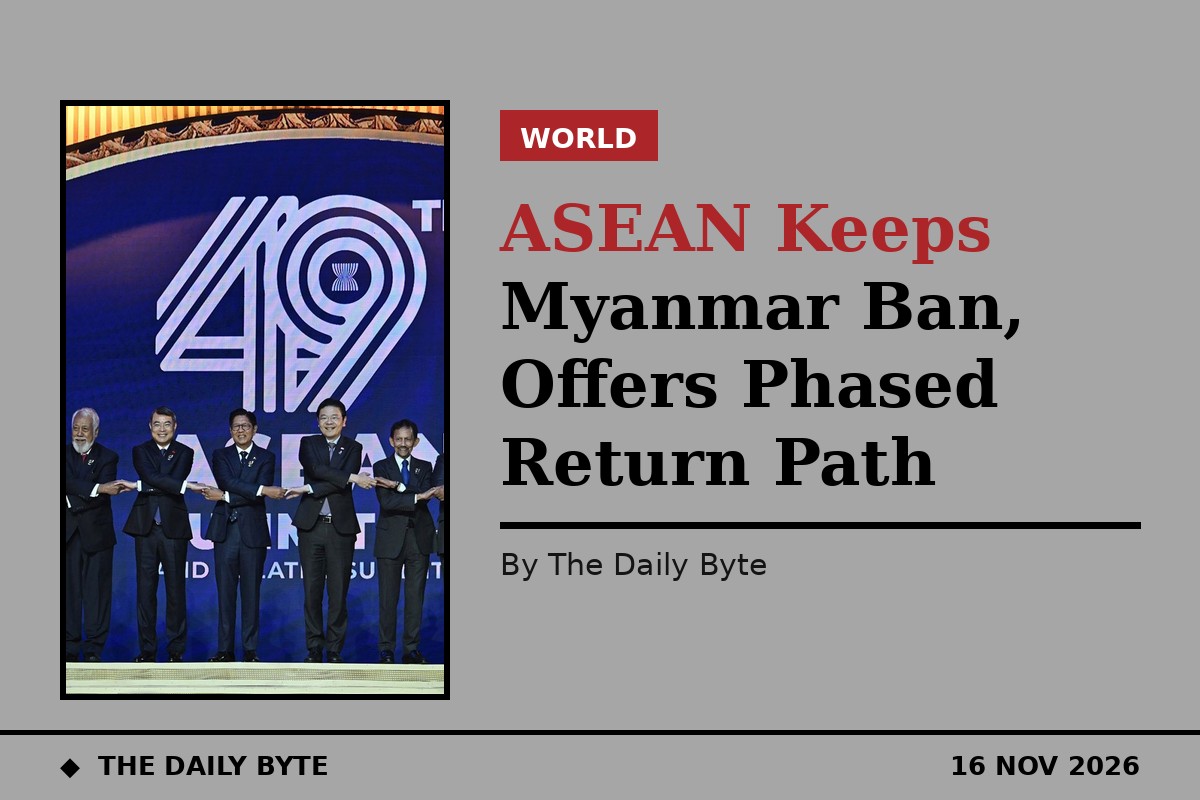
Southeast Asian leaders have decided to keep Myanmar barred from top-level political representation at their summits, while opening a conditional path back if the country makes real progress on the region's peace plan.
The decision was adopted on Sunday, 15 November 2026, on the first day of the 49th ASEAN Summit in Manila. Leaders of the 11-member Association of Southeast Asian Nations agreed to maintain Myanmar's non-political representation at ASEAN summits and foreign ministers' meetings until there is meaningful progress in implementing the Five-Point Consensus, the peace framework agreed after the military seized power in Myanmar in 2021.
At the same time, they agreed to pursue what they called a calibrated, phased and progress-based engagement with Myanmar. In the words of the decision adopted at the summit: "Subject to sustained and concrete progress in the implementation of the 5PC by Myanmar, ASEAN may consider the gradual restoration of Myanmar's full political representation."
Five years of exclusion
Myanmar has been in turmoil since the military ousted the elected government of Aung San Suu Kyi in February 2021, triggering a civil war that the United Nations estimates has killed 100,000 people and displaced more than 3.5 million.
Its political leadership has been barred from ASEAN summits and foreign ministers' meetings since then over its failure to implement the Five-Point Consensus, which calls for an immediate end to violence and the launch of constructive dialogue among all parties. At the Manila summit, Myanmar was represented at a lower level by the director-general of its ASEAN affairs department, while its military-backed leader, Min Aung Hlaing, remained excluded.
The decision followed pressure from some members, including Thailand, to ease the ban after stepping up engagement with Myanmar in recent months. The summit outcome keeps the restriction in place for now, but gives Myanmar a defined route back if conditions on the ground improve.
Call for a ceasefire and aid access
Leaders expressed deep concern at the lack of progress on the peace plan and at the continuing conflict and humanitarian crisis in Myanmar. They called on all armed forces, security forces and armed groups to halt indiscriminate violence against civilians and civilian infrastructure, exercise restraint and establish a sustained nationwide ceasefire.
They also insisted that humanitarian assistance must reach displaced people directly and without discrimination. Leaders noted an ASEAN humanitarian monitoring mission in late October that began a month-long aid operation for more than 11,000 households, including four priority townships that had not previously been reached, and urged international partners to increase funding for the relief effort.
Myanmar's participation in other ASEAN sectoral ministerial meetings will remain unrestricted. Foreign ministers were tasked with continuing engagement, monitoring progress and reporting back to the next ASEAN Summit, where the decision will be reviewed.
The summit, chaired by Philippine President Ferdinand Marcos Jr, also noted that ASEAN and China have provisionally agreed on about 80 per cent of a draft code of conduct for the South China Sea, a long-delayed pact that will not now be completed during the Philippines' chairmanship.
Sources: Reuters and ANI via Daily Prabhat, with the ASEAN leaders' decision reported by Bernama.


