ASEAN Ministers Open Manila Talks as Summit Nears
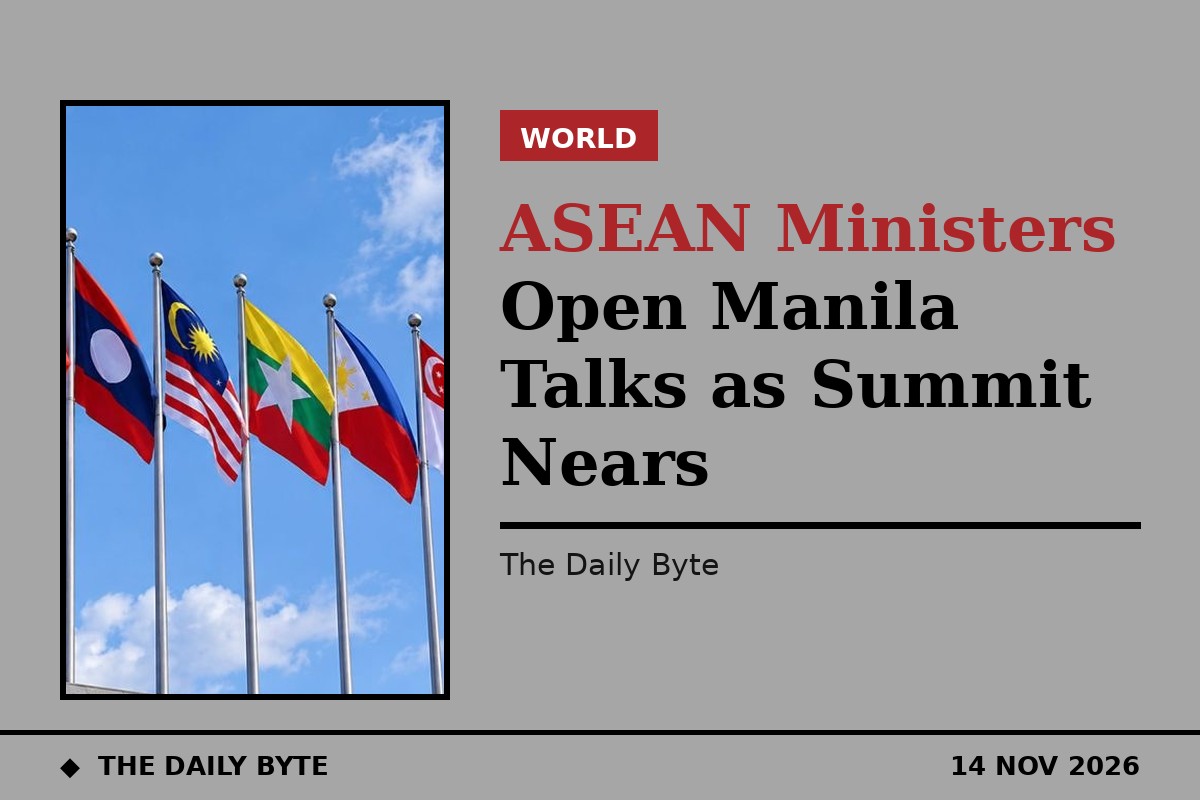
Southeast Asian foreign ministers begin meetings in Manila on Saturday as the regional bloc seeks a coordinated response to surging energy costs, security tensions and an approaching El Nino, challenges Philippine President Ferdinand Marcos Jr. has said demand collective action. "Especially at a time when we face multiple crises, from rising oil prices to security concerns and the approaching El Nino, ASEAN needs to act as one," Marcos said ahead of the meetings, which the Philippines will chair.
The ministerial meetings open a weekend of diplomacy culminating in the 49th ASEAN Summit from 15 to 17 November, when leaders will hold talks with counterparts from major powers including the United States, China and Japan. The Philippines is hosting the gathering under the theme "Navigating Our Future, Together". At least 19 world and global institution leaders are expected, including US President Donald Trump and Brazilian President Luiz Inacio Lula da Silva, while Canadian Prime Minister Mark Carney arrived in Manila on Saturday.
Energy, Myanmar and the South China Sea
The gathering comes as the Philippines and other import-dependent Southeast Asian economies grapple with higher fuel costs, which have squeezed households and businesses and added to inflation pressures. The crisis has exposed the limits of regional energy security, with proposals for a shared oil stockpile still under study. A summit on the Asia Zero Emission Community, a Japan-led framework for energy security, economic growth and decarbonisation, will also be held next week.
Myanmar will test ASEAN's ability to hold a common position. Leaders are expected to review the implementation of the bloc's five-point consensus, its main framework for addressing the crisis since the military seized power in 2021, Philippine foreign ministry spokesperson Dominic Xavier Imperial said at a press conference on Friday. Their decision will be reflected in a negotiated document issued after the summit. The United Nations estimates the civil war has killed 100,000 people and displaced more than 3.5 million.
The South China Sea will feature in discussions with China, with negotiations on a long-delayed Code of Conduct about 70 per cent complete, Imperial said, adding that the figure represented overall progress in negotiations, not the proportion of text agreed. Transboundary haze, food security and the adoption of a concept note for a planned ASEAN Maritime Centre are also on the ministers' agenda.
Leaders' programme and handover
Foreign Affairs Secretary Ma. Theresa P. Lazaro will convene the ASEAN Foreign Ministers on 14 November for their final meeting this year, alongside the 32nd ASEAN Political-Security Community Council Meeting and the 39th ASEAN Coordinating Council Meeting. The leaders' programme starts on 15 November with the opening ceremony, followed by plenary and retreat sessions, and the Plus One summits with dialogue partners including Australia, China, India, Japan, South Korea, the United Nations and the United States run on 16 and 17 November.
On 17 November, Marcos will convene the 29th ASEAN Plus Three Summit and the 21st East Asia Summit, before the Philippines hands the ASEAN chair to Singapore at the closing rites. The day will culminate with the ASEAN-US Special Summit. Trump's visit is expected to draw protests from workers, students and left-wing groups, while activists are also planning demonstrations demanding ASEAN maintain its exclusion of coup leader-turned-president Min Aung Hlaing from leaders' meetings. For ordinary Filipinos, the impact of the Middle East conflict has been more immediate: jeepney driver Lito Albino told reporters higher fuel costs had forced him to work longer hours for less money. "No one truly wins in a war. It is the poor and marginalised people like us who suffer the most," he said.
Sources: Reuters and Philippine Information Agency.


