ASEAN Plus Three adopt pacts to protect shipping, food and energy supplies
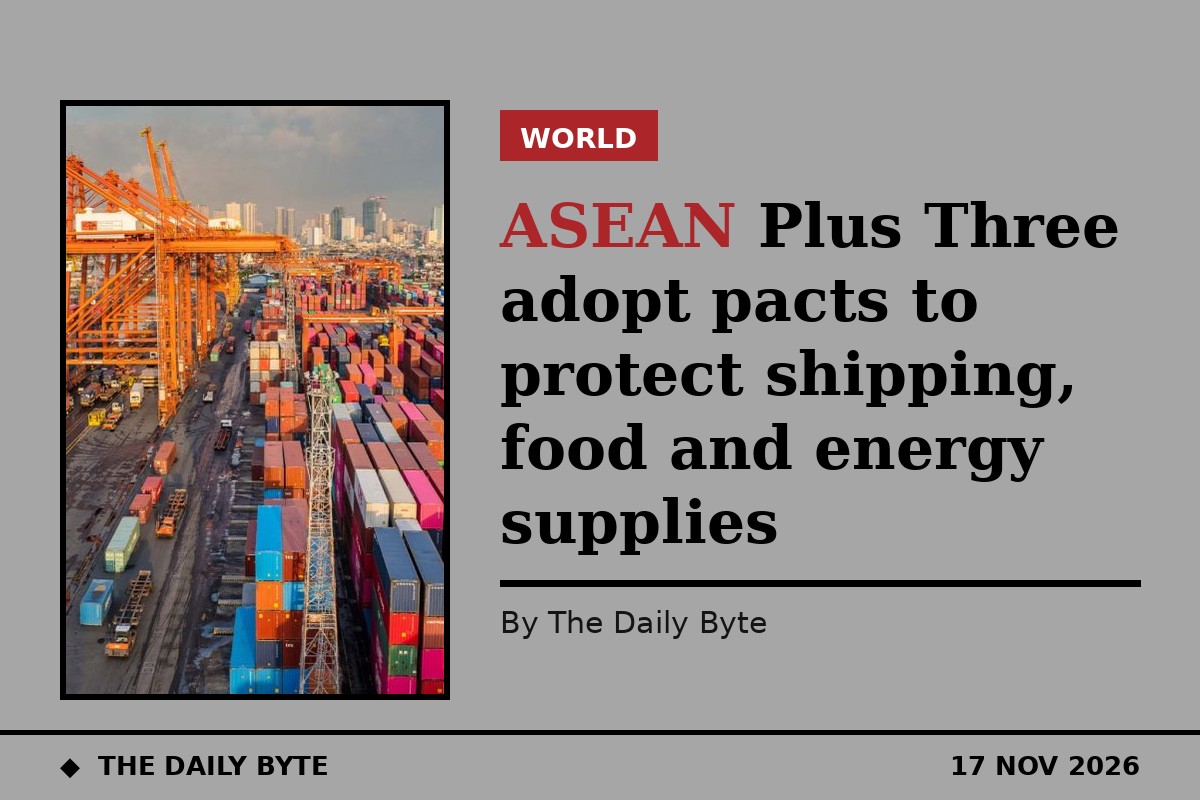
Leaders of ASEAN, China, Japan and South Korea have adopted two joint statements aimed at keeping shipping lanes open, stabilising food and energy supplies and strengthening supply chains against global shocks. The agreements were finalised during the 29th ASEAN Plus Three Summit in Manila on Tuesday, 17 November, a 90-minute session held alongside the 49th ASEAN Summit hosted by the Philippines.
The two statements cover maritime trade and logistics connectivity, and strengthening energy and food security resilience amid external shocks and supply chain disruptions. By formalising the commitments, the 14 participating governments gain coordinated mechanisms to prevent trade blockages and cushion their economies when global crises disrupt fuel or grain imports.
From commitments to household costs
Opening the session, Philippine President Ferdinand Marcos Jr urged leaders to translate regional cooperation into safeguards that people can feel in daily life. “A disruption thousands of miles away can reach households across East and Southeast Asia through the price of rice, the cost of energy, or the loss of a day's income,” he said.
“Our task today is to put our collective strength to work. In ships reaching their destinations, in reliable supplies of food and energy, in businesses continuing to operate, and in families facing the future with greater confidence,” Marcos added. He said the partnership remained an important platform for stability, resilience and shared prosperity as global fragmentation increased.
Who took part
The ASEAN Plus Three framework brings together the 11 ASEAN member states and China, Japan and South Korea. Japanese Prime Minister Sanae Takaichi, South Korean President Lee Jae Myung and Chinese Minister of Agriculture and Rural Affairs Zhang Zhu joined the talks, alongside the other ASEAN leaders.
As the cooperation framework approaches its 30th anniversary, Marcos urged leaders to shorten the distance between the commitments made around the table and the benefits their peoples feel in daily life.
Money, rice and financial safety nets
Marcos cited two existing mechanisms as the foundation for regional economic stability during emergencies: the Chiang Mai Initiative Multilateralization and the ASEAN Plus Three Emergency Rice Reserve. The Chiang Mai Initiative is a multilateral currency swap arrangement designed to safeguard the region against short-term liquidity and balance-of-payments difficulties. The emergency rice reserve, a permanent regional mechanism established in 2011, aims to strengthen food security, alleviate poverty and malnutrition, and stabilise rice price volatility caused by climate change or natural disasters without distorting trade.
Takaichi pledged continued Japanese support to reinforce the Chiang Mai Initiative, and Japan committed to expanding cross-border electronic payments, disaster risk financing and research collaboration with the ASEAN Plus Three Macroeconomic Research Office. Japan also announced plans to bolster the emergency rice reserve and improve data sharing through the ASEAN Food Security Information System, so emergency rice stocks can be deployed more rapidly during extreme weather or harvest shortages.
Scams, shipping lanes and security
The leaders also discussed joint action against transnational organised crime, particularly online scam operations that have increasingly targeted citizens across Southeast Asia. Japan said it would expand capacity-building assistance through the United Nations Office on Drugs and Crime to help member states disrupt cyber-enabled fraud networks.
On security, Takaichi urged the full implementation of United Nations Security Council resolutions on North Korea’s nuclear and missile programmes, warning against sanctions evasion and malicious cyber activities, while seeking regional support to resolve the long-standing issue of Japanese abductees.
Turning to the Middle East, Takaichi and fellow leaders underscored the economic risks posed by regional instability, stressing the need to keep vital maritime chokepoints — specifically the Strait of Hormuz and the Bab-el-Mandeb Strait — open and safe for international shipping. For ASEAN countries heavily reliant on imported Middle Eastern oil and global maritime trade, protecting these sea lanes is critical to preventing domestic fuel price rises and shipping delays.
The summit also comes as the region faces pressure from conflict, supply disruption, financial uncertainty and natural disasters. The test of the two statements will be implementation: whether the rice reserve, the financial safety net and the maritime cooperation they promise are used quickly enough when the next shock arrives.
Frequently asked questions
What is ASEAN Plus Three?
It brings together the 11 ASEAN member states with China, Japan and South Korea for cooperation on economic, financial, food and energy security.
What did leaders adopt in Manila on 17 November?
Two joint statements: one on maritime trade and logistics connectivity, and one on strengthening energy and food security resilience amid external shocks and supply chain disruptions.
Source: Philippine News Agency. Also reported by Context.ph.


