Asia Markets Split: KOSPI and Nikkei Rally, Hang Seng Falls
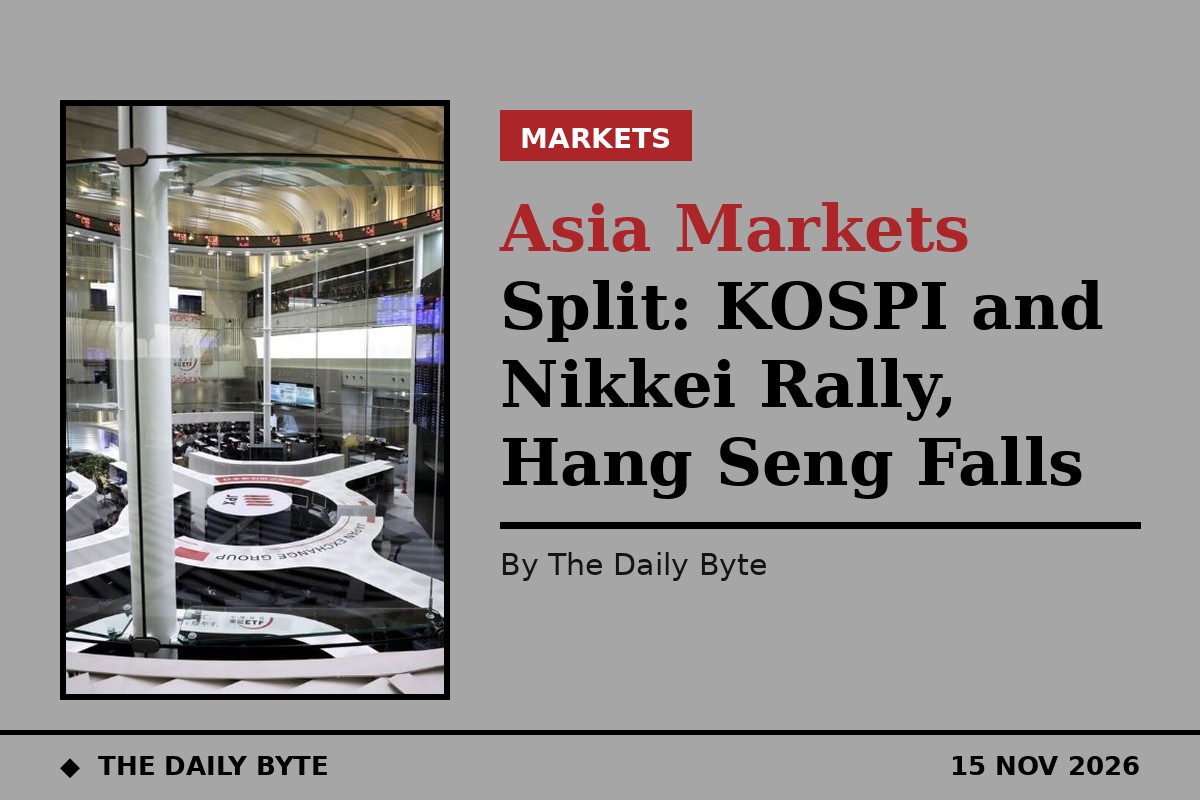
Asian stock markets split sharply in the week to 13 November, with South Korea and Japan rallying while Hong Kong and mainland China fell, as Nvidia's leadership turmoil unsettled the artificial intelligence trade without triggering a broader sell-off.
South Korea's KOSPI climbed 5.41% over the week and Japan's Nikkei 225 gained 4.03%. By contrast, the Shanghai Composite slipped 0.41% and Hong Kong's Hang Seng fell 3.45%, the weakest result among the Asian indices tracked in a weekly market review. The divide shows how differently country and sector exposures are behaving in the same region.
Friday's session captured the split. The KOSPI fell 0.98% to 5,290.53, while Japan's Nikkei gained 0.53% and Taiwan's TAIEX rose 1.35%. Hong Kong's Hang Seng lost 1.61% on the day. In the preceding US session, the Nasdaq had declined 0.39% and the S&P 500 slipped 0.35%.
Nvidia turmoil and China chip fears
The late-week shock followed the resignation of Nvidia chief executive Jensen Huang, which unsettled the AI trade and put pressure on technology shares across the region. Market reports also highlighted pressure on China-based internet and AI shares amid concern that US lawmakers could tighten semiconductor-export restrictions.
Combined with the Nvidia volatility, that kept attention firmly on the region's technology supply chain. Korea and Japan's gains alongside losses in Hong Kong and Shanghai show sharply different exposures: markets tied to memory chips and hardware held up better than those weighted towards Chinese internet companies.
Semiconductor memory prices stayed elevated despite the uncertainty. DRAM spot prices stood at $60.66, up 165.8% from a year earlier, while 128-gigabit NAND prices were $50.99, up 396.6%, according to Aju Press.
Dollar strength and rising yields
The unease spread to currencies and bonds. The dollar index strengthened to 103.17, up 1.73% on the week, the Korean won weakened to 1,336.7 per dollar, and the US 10-year Treasury yield climbed to 5.127%. The divergent moves suggest investors are reassessing AI-related risks against a backdrop of elevated borrowing costs.
US markets still ended the week higher. The S&P 500 gained 2.51%, the Nasdaq Composite rose 2.27%, the Dow Jones Industrial Average advanced 2.07% and the Russell 2000 added 1.32%, their first winning week since early October, according to the Associated Press. European benchmarks also advanced, with Germany's DAX up 3.60%, France's CAC 40 up 2.82% and the FTSE 100 up 2.14%.
What comes next
The next test for markets is US October retail sales on Tuesday, 17 November, followed by the Federal Reserve's October meeting minutes on Wednesday, 18 November. Retail data will test consumer resilience, while the minutes may clarify policymakers' inflation assessment after a run of hotter-than-expected price data.
Nvidia's earnings on Tuesday will also be closely watched. The chipmaker reports for the first time under interim chief executive Colette Kress, and its guidance will test whether the AI trade can steady after a week in which its own shares fell sharply. Investors will also be watching AI shares and the dollar for signs of whether the week's split in Asia was a one-off or the start of a longer divergence.
This article is for information only and is not investment advice. Figures are as reported by the cited sources at the time of writing.