Asia Shares Rebound as AI Stocks Rally on Thanksgiving
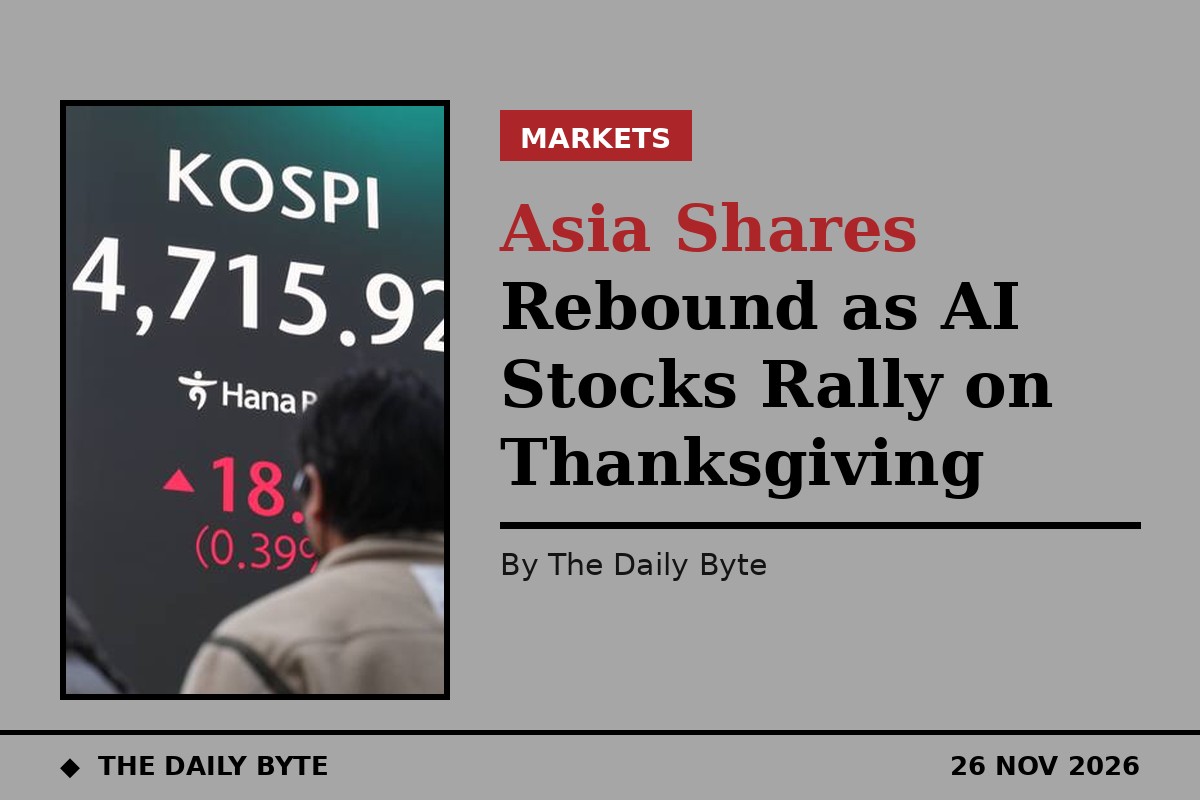
Asian shares rebounded on Thursday, 26 November 2026, as artificial intelligence stocks recovered from a sharp sell-off and investors looked past a fresh round of proposed United States tariffs. United States markets were closed for the Thanksgiving holiday, leaving Asia and Europe to set the tone for the day.
Japan’s Nikkei 225 closed 0.9 percent higher at 57,499.16, recovering part of the 2.8 percent it lost the day before. SoftBank Group, a major investor in OpenAI, jumped 7.3 percent, while memory chipmaker Kioxia Holdings surged 12.6 percent. Shares of chip equipment maker Tokyo Electron rose 0.6 percent.
South Korea’s Kospi added 0.3 percent to 4,711.21, a day after plunging 6.2 percent. Samsung Electronics gained 0.4 percent and memory chipmaker SK Hynix rose 2.2 percent. Taiwan’s Taiex was 2.5 percent higher, although its leading chipmaker, Taiwan Semiconductor Manufacturing Co., edged 0.2 percent lower.
Hong Kong’s Hang Seng index rose 1.2 percent to 22,226.88, ending a run of seven straight declines. The Shanghai Composite index was up less than 0.1 percent at 3,476.88, while Australia’s S&P/ASX 200 gained 0.8 percent to 8,763.80. India’s Sensex rose 0.5 percent.
Europe follows Asia higher
European shares also advanced in early trading. Germany’s DAX jumped 1.9 percent to 25,180.12, France’s CAC 40 climbed 1.8 percent to 8,126.47, and Britain’s FTSE 100 added 1.6 percent to 10,591.83. United States stock futures climbed too, with S&P 500 futures up 0.5 percent. United States markets reopen on Friday for a holiday-shortened session.
The rebound followed a dramatic reversal on Wall Street on Wednesday. The S&P 500 lost 0.3 percent after falling as much as 3.2 percent earlier in the day, marking its ninth loss in 10 sessions. The technology-heavy Nasdaq Composite closed 0.6 percent lower after recovering from a drop of as much as 4.6 percent, while the Dow Jones Industrial Average picked up 0.3 percent.
Tariff proposals in focus
Investors have grown cautious about the AI trade after a long rally in technology shares, and they are also watching the impact of the latest tariff plans from Washington. The United States said on Wednesday it will propose new tariffs on China and dozens of other nations, which the Trump administration argues are harming American companies by supporting their own domestic industrial production. The proposed tariffs would not be stacked on top of earlier tariffs levied against 60 economies over forced labour concerns; instead, the higher of the two rates will apply, and the new rates would take effect in January at the earliest, following a comment period.
Analysts said the announcement was less alarming than it first appeared. Stephen Brown, chief North America economist at Capital Economics, said the effective tariff rate is set to be slightly lower than anticipated, while MUFG analyst Lloyd Chan described the move as a reconstruction and legal hardening of the Trump tariff regime rather than a fresh shock.
Oil and currencies
In commodities trading, oil prices climbed early on Thursday as tensions in the Middle East persisted. Brent crude, the international standard, was 0.5 percent higher at 91.09 dollars per barrel, while benchmark United States crude gained 1 percent to 84.51 dollars per barrel. Recent reports of vessels being targeted in the Strait of Hormuz have contributed to concerns over oil flows and brought supply risks back into focus, according to ING commodities strategists Ewa Manthey and Warren Patterson.
In currency markets, the United States dollar rose to 159.30 Japanese yen from 159.16 yen. The euro was trading at 1.0968 dollars, down from 1.0974 dollars.
Thursday’s gains steadied nerves after a volatile stretch for global markets, but the caution around AI valuations and trade policy has not gone away. With United States markets closed, Friday’s shortened session and the next round of tariff comments will be the next tests for the rebound.


