AU Says Sudan Talks Must Be Sudanese-Led After Rejection
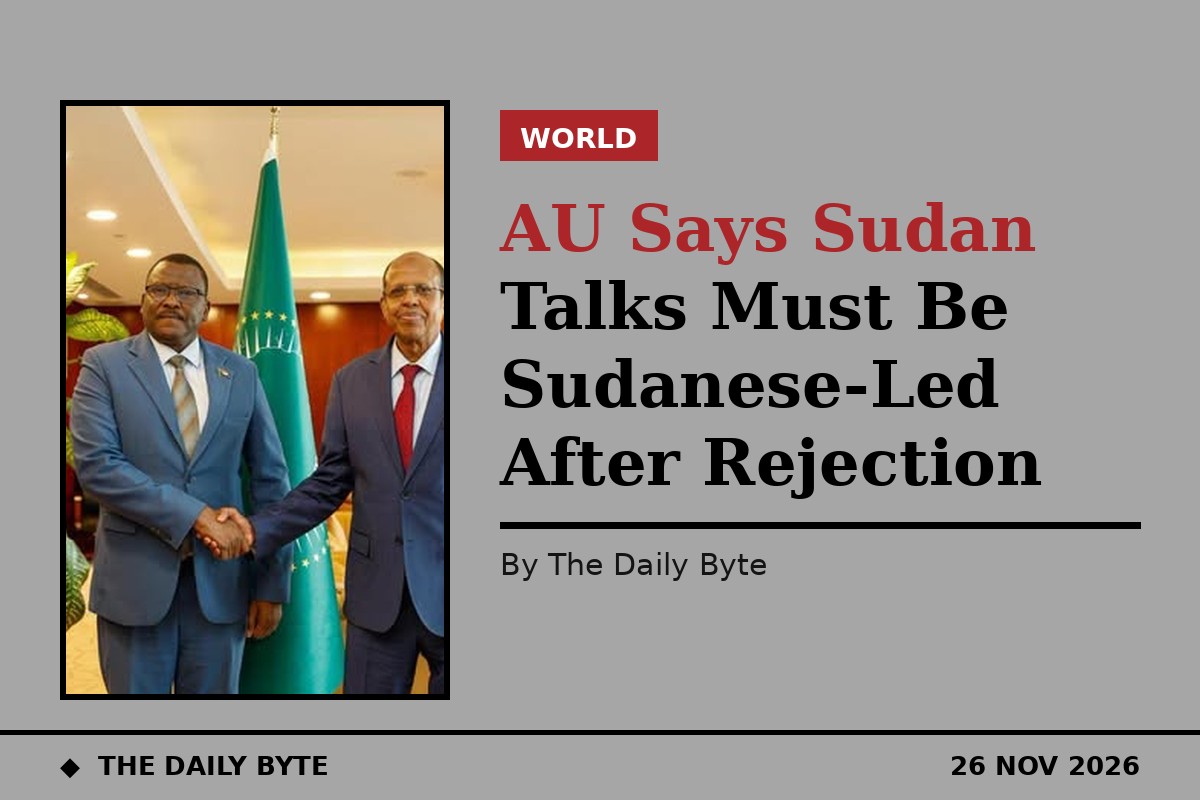
The African Union has said any dialogue to end Sudan's war must be inclusive, Sudanese-led and Sudanese-owned, after Khartoum rejected Ethiopia's offer to host peace talks in Addis Ababa.
African Union Commission Chairperson Mahmoud Ali Youssouf issued the statement on 25 November, saying he had taken note of Ethiopia's proposal to convene an intra-Sudanese dialogue, as well as the position expressed by the Sudanese authorities on the initiative. He reaffirmed the African Union's commitment to a peaceful and inclusive resolution of the conflict through dialogue and negotiation, while preserving Sudan's sovereignty, unity and territorial integrity.
The carefully worded statement stopped short of explicitly endorsing Ethiopia as the host or facilitator of the talks, a distinction that matters. It acknowledged Khartoum's rejection without amplifying it, and it did not directly address the Sudanese government's request that Ethiopia be excluded from mediation arrangements.
Abiy's offer and Khartoum's rejection
Ethiopian Prime Minister Abiy Ahmed announced the initiative on 24 November, proposing that Ethiopia host and sponsor an inclusive Sudanese national dialogue bringing together the country's military, political and civilian actors. The plan envisaged the talks leading to a broadly accepted national unity government, the restoration of state institutions and the rebuilding of what the war has destroyed. Abiy said Ethiopia was ready to stand at an equal distance from all Sudanese parties, and stressed that the initiative did not come from any special political agenda.
Khartoum swiftly rejected the offer. The Sudanese government, which is battling the paramilitary Rapid Support Forces, accused Addis Ababa of supporting the RSF and of allowing drone attacks to be launched from Ethiopian territory, allegations Ethiopia has denied. Sudan's government has also filed formal complaints against Ethiopia with the United Nations Security Council and the African Union's Peace and Security Council, and has called on the African Union and other actors to exclude Ethiopia from arrangements to host or facilitate Sudanese dialogue, arguing that the country lacks the necessary neutrality.
Not all Sudanese actors share Khartoum's position. The civilian coalition Somoud and the RSF-led Sudan Founding Alliance, known as Tasis, both welcomed Ethiopia's proposal, underlining the split between the parties to the conflict over who should mediate and where talks should be held.
No venue, no mediator, no date
Youssouf also reaffirmed the commission's support for Burundian President Evariste Ndayishimiye, the current chairperson of the African Union, in pursuing a peaceful settlement in coordination with international and regional partners. In a separate meeting, Youssouf held talks with Sudan's Ambassador to Ethiopia and Permanent Representative to the African Union, Elzein Ibrahim Hussein, and the two discussed the possibility of a visit by the AU Commission chairperson to Khartoum.
The diplomatic manoeuvring comes as Sudan's war enters its fourth year. Humanitarian assessments put the death toll above 200,000, and the country is enduring the world's most acute hunger and displacement crises. The conflict, which erupted in April 2023 between the Sudanese Armed Forces and the Rapid Support Forces, has split the country and displaced millions of people.
Ethiopia's credibility as a mediator is contested on both sides. Addis Ababa points to a long record of regional conflict resolution, including the 1972 Addis Ababa Agreement that ended Sudan's first civil war and Ethiopia's role alongside the African Union in guiding Sudan's transitional arrangements after the ouster of Omar al-Bashir in 2019. Khartoum, by contrast, argues that Ethiopia's alleged support for the RSF disqualifies it, and that the venue and agenda of any dialogue must remain under Sudanese control.
Sudan's own standing at the African Union is also in question. The Union suspended Sudan's membership in October 2021, two days after the military coup led by General Abdel Fattah al-Burhan, and the Peace and Security Council reaffirmed that suspension in February 2026. Sudan remained barred from the African Union summit for a fifth consecutive year.
For now, there is no agreed venue, no agreed mediator and no date for talks. The African Union's statement keeps the door open to dialogue while refusing to take sides on the question that divides the parties: whether Ethiopia can be trusted to host it. That question, rather than the principle of talks itself, is now the central obstacle to any negotiation.


