Australia and China Agree AI Talks After Beijing Meeting
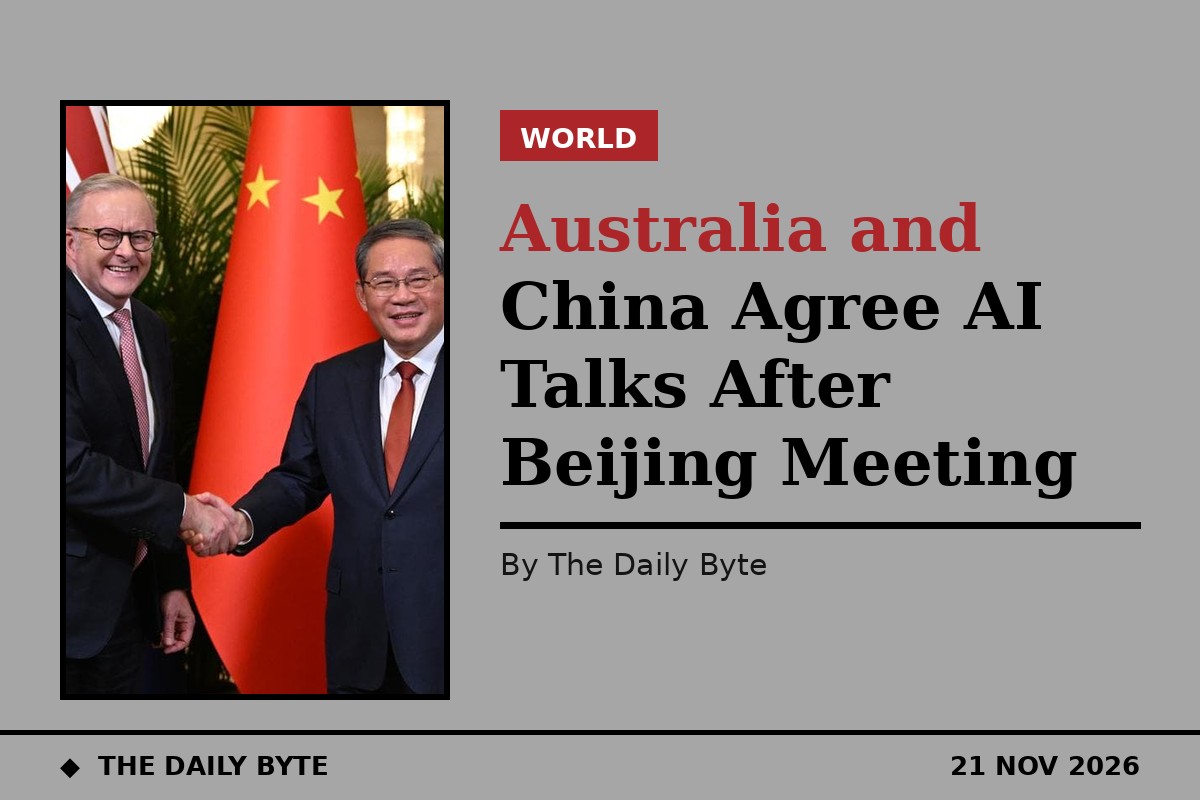
Australia and China have agreed to hold talks on artificial intelligence, after Prime Minister Anthony Albanese and Chinese Premier Li Qiang agreed in Beijing on Friday to set up a bilateral dialogue on AI safety, governance and applications.
The agreement came at the 11th China-Australia Annual Leaders' Meeting, held at the Diaoyutai State Guesthouse in Beijing on 20 November, at the end of Mr Albanese's 11-day tour of international summits. A joint statement released by Beijing after the meeting said the two sides would establish a bilateral dialogue mechanism on artificial intelligence "to exchange views on AI safety, governance, and applications".
The dialogue was the clearest concrete outcome of a day of meetings that began in Shenzhen, where Mr Albanese met Chinese President Xi Jinping on the sidelines of the Asia-Pacific Economic Cooperation (APEC) summit. Mr Xi hailed what he called a "comprehensive turnaround" in the relationship, and proposed deeper cooperation on agriculture, energy, the green economy and artificial intelligence, alongside stronger exchanges between ordinary citizens.
Business leaders press for market access
In Beijing, Mr Albanese was accompanied by several senior Australian business executives, including Rio Tinto's head of iron ore, Matt Holcz, and BHP's Australia boss, Geraldine Slattery, for a chief executives' roundtable with Chinese company executives. Premier Li told the roundtable that China took Australian businesses' concerns seriously, and said Beijing was willing to expand the scale of bilateral trade and improve its structure.
Mr Albanese told the meeting that navigating turbulent seas while keeping "eyes on the horizon" meant the relationship could "bloom like the flowers that are in front of us here", gesturing to the lavender flowers between the tables. Mr Li said China was ready to focus on common interests, properly manage differences, and deliver more outcomes in the comprehensive strategic partnership, with next year marking the 55th anniversary of diplomatic relations between the two countries.
No progress on beef quotas
On trade, however, the talks produced no immediate breakthrough. Australian beef exporters had pressed for relief from a Chinese quota on beef imports, in force for three years from 2026. Chinese importers reached this year's 205,000-tonne quota in June, triggering a 55 per cent tariff on any additional imports, and the Australian Meat Industry Council has estimated the quota could reduce Australian beef exports to China by about $1 billion a year.
Mr Albanese and Mr Li agreed to keep talking, but no tangible progress was reached on the quotas on the night, according to Australian Associated Press reporting from Beijing. A RaboBank analyst has predicted the 2027 quota could be exhausted as early as May, given the strength of Chinese demand.
Tension beneath the warmth
The AI dialogue also sits awkwardly alongside Australia's other technology commitments. Days earlier, Canberra signed on to a United States-led declaration with several other nations designed to break China's hold over the supply chains needed to develop advanced artificial intelligence. Australian officials have presented the two tracks as compatible: cooperation with Beijing on governing the technology, and diversification of the supply chains that build it.
Mr Albanese is due back in Australia on Saturday after a trip that has spanned summits in Turkey, the Philippines and China. The AI dialogue gives both governments a standing channel on a technology that now runs through almost every part of their relationship, from agriculture and mining to defence and trade, even as the wider strategic rivalry between Washington and Beijing continues to pull in the opposite direction.


