Australia Jobless Rate Hits 4.9%, Five-Year High
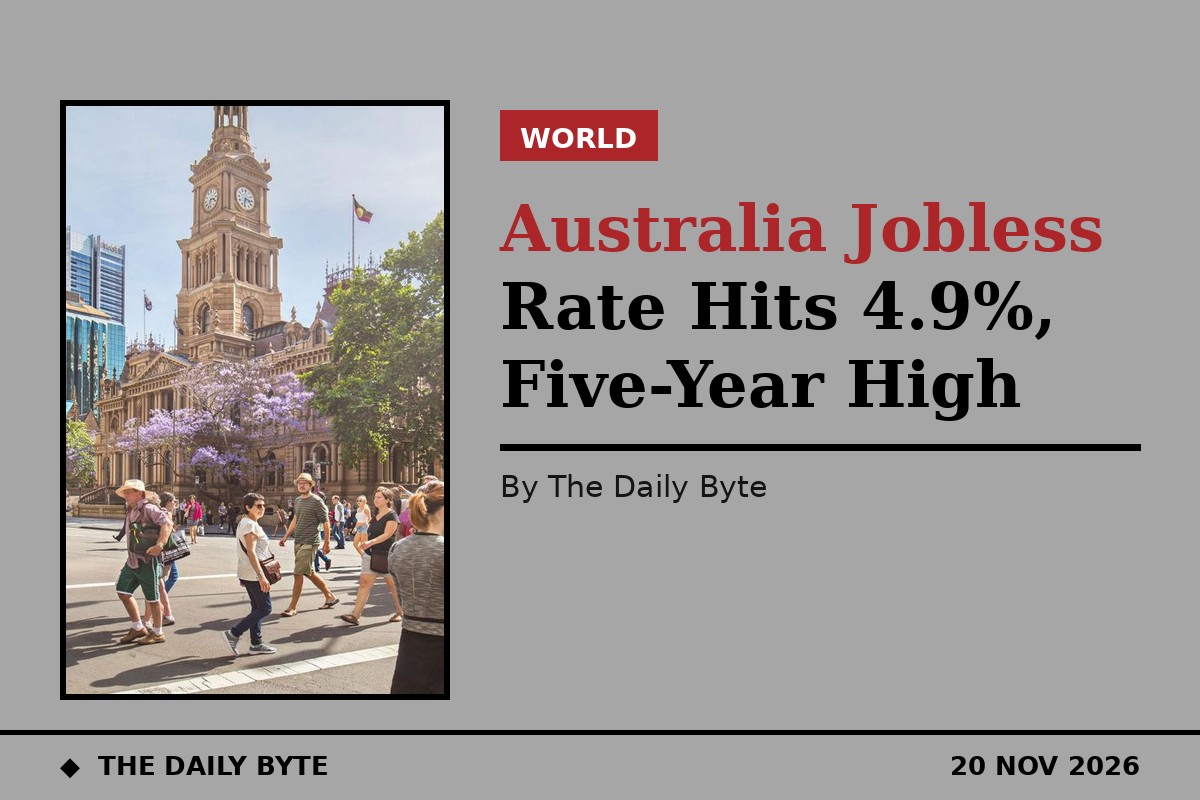
Australia's unemployment rate climbed to 4.9 per cent in October, its highest level in five years, as the labour market weakened faster than expected and markets scaled back bets on further interest rate rises.
The Australian Bureau of Statistics said on Thursday that the seasonally adjusted jobless rate rose from 4.7 per cent in September to 4.9 per cent in October, the highest since October 2021. It is a level the Reserve Bank of Australia had not expected to see until the end of next year.
Employment fell by 43,500 in October, following a revised fall of 36,400 in September, the biggest two-month total for job losses in five years. The result was far weaker than economists had forecast: analysts had expected employment to rise by about 25,000 and the jobless rate to hold steady at 4.7 per cent.
Jobs fell far short of forecasts
Sean Crick, the ABS head of labour statistics, said there were 44,000 fewer employed people and 18,000 more unemployed people in October. The fall in employment was driven mostly by losses in part-time jobs.
"Similar to last month, we had a higher proportion of people remaining unemployed than we would usually see in October in the post-Covid era," Crick said.
The employment-to-population ratio fell 0.3 percentage points to 63.3 per cent, and the participation rate fell 0.2 percentage points to 66.6 per cent. The number of hours worked fell 0.2 per cent in October, while the underemployment rate eased 0.1 percentage points to 6.2 per cent.
Young workers hit hardest
Youth unemployment rose to 11.3 per cent in October, up from 11.1 per cent in September, also the highest in five years. In the post-Covid period from May 2022 onwards, the youth unemployment rate has averaged 9.2 per cent.
The trend unemployment rate, which smooths out month-to-month volatility, rose to 4.8 per cent. Trend employment remained steady, meaning there was very little underlying growth in the number of employed people, and the number of unemployed people grew 13.3 per cent over the last 12 months in trend terms.
What it means for interest rates
The weak jobs figures have changed the outlook for interest rates. Markets have now unwound expectations for any further tightening by the Reserve Bank of Australia, after its five increases this year took the cash rate to an 18-year high of 4.85 per cent.
Investors are now expecting rates to be cut at least once in the second half of next year. UBS, Nomura, the Commonwealth Bank of Australia and the National Australia Bank are all tipping a rate cut in August next year, although stubbornly high inflation is likely to keep the Reserve Bank on hold in the months ahead.
The jobs data came a day after figures showed wages grew at their fastest pace since 2023 in the third quarter, underlining the mixed picture facing the central bank: a cooling labour market on one side, and persistent pay pressures on the other.
Sources: Australian Bureau of Statistics and Reuters.


