Austria demands deeper cuts to EU budget
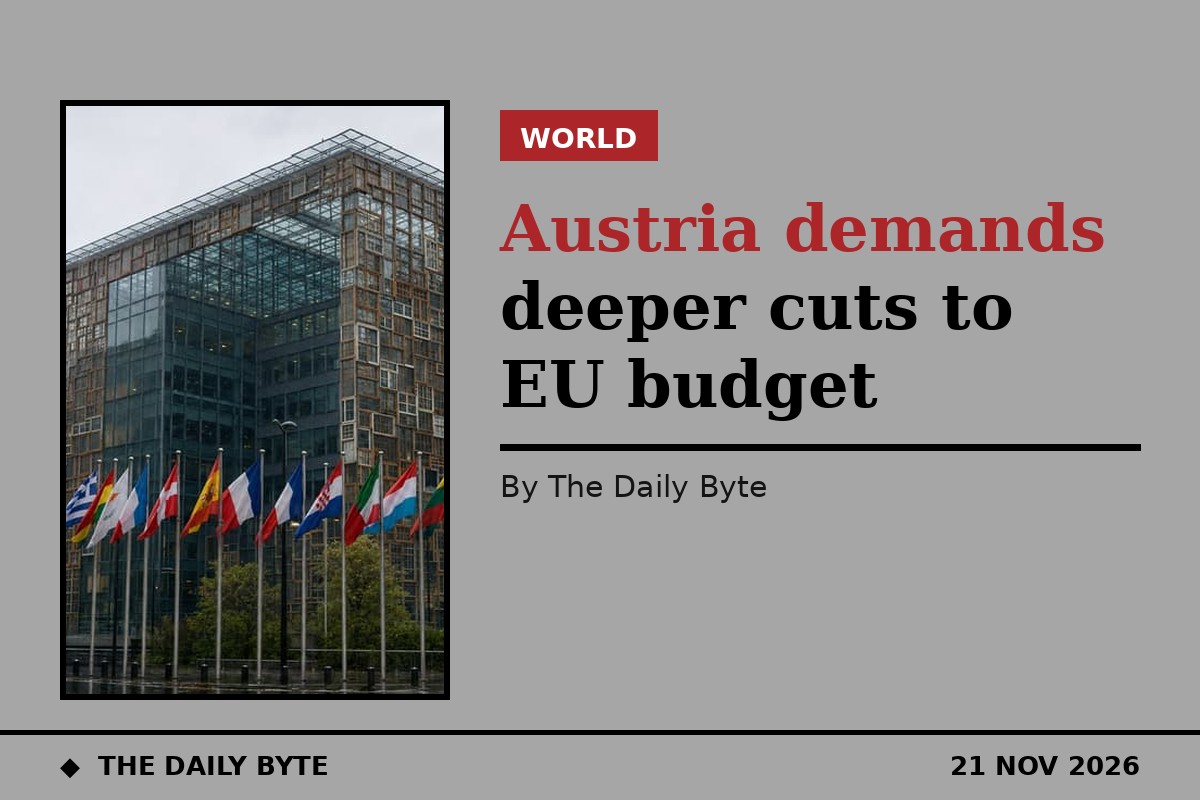
Austria has warned that it will not back a deal on the European Union's next long-term budget unless spending is cut far more deeply than proposed so far, a day before European Council President Antonio Costa presents his compromise plan.
Claudia Bauer, Austria's Europe minister, told Rapporteur that Costa must make drastic cuts to the bloc's 2028-2034 budget if Vienna is to accept a deal. "Setting priorities naturally also means making politically uncomfortable decisions," she said, adding that simply taking the existing budget and increasing spending to cover new areas was not going to fly.
"I stand by this: cuts of several hundred billion euros," Bauer said. Costa will present a new compromise negotiating box on Saturday 21 November, ahead of a special summit of the 27 national leaders on 26 and 27 November.
Two camps, hundreds of billions apart
The negotiations concern the Multiannual Financial Framework for 2028-2034, which will set the EU's main spending commitments for seven years. The European Commission's original proposal, presented in July 2025, envisaged spending of almost 2 trillion euros in current prices, equivalent to about 1.26 per cent of the EU's combined gross national income.
Agreement remains elusive. The European Parliament supports a budget of about 1.789 trillion euros, excluding repayments of debt taken on under the NextGenerationEU pandemic recovery programme, while the Irish presidency's proposal, discussed by leaders in October, amounted to 1.473 trillion euros on the same basis, a gap of more than 300 billion euros. Diplomats expect Costa's new box to propose cuts of roughly 210 billion euros compared with the Commission's proposal.
The Germany-led club of frugals, which includes Austria, is demanding major cuts, while a group of 17 countries, the Friends of Cohesion, rejects any cuts. Parliament's co-rapporteurs have warned that further spending cuts could put Parliament's approval at risk: any final deal needs Parliament's consent.
Protect farms and regions, cut elsewhere
Austria wants sufficient funding for agriculture and cohesion spending on less-developed regions, but it wants cuts elsewhere. Bauer said there was potential for efficiency gains in all areas, across all four proposed headings, as well as potential for savings in both administration expenses and development policy.
She welcomed the Irish proposal to trim administrative spending by around 10 billion euros, but argued that the administrative budget would still be set to grow by 29 per cent compared with the current budget. "So there is still room for more," she said.
Austria's position is sharper than that of some of its frugal allies, because it insists its own favoured spending pots remain protected while demanding cuts elsewhere. Chancellor Christian Stocker has previously raised the possibility of a veto over a budget that needs unanimous approval from all 27 capitals, and the net contributors, who account for 40 per cent of the EU budget, have said they do not want a deal by the end of the year at any cost.
New EU taxes will not close the gap
When asked whether new revenue streams, in the form of EU taxes and levies known as own resources, could help bridge the opposing demands, Bauer said they were not a cure-all. "Even if we agree on all the proposed new own resources, including those proposed by the European Parliament, they would by no means cover the proposed increases in the EU budget," she said, adding that Vienna was not fundamentally opposed to them.
The Commission estimates it could raise 66 billion euros a year through changes to existing revenue streams and new levies on uncollected e-waste, carbon emissions and large corporations. Parliament's proposals for a digital services tax and levies on online gambling and crypto assets, which are not officially on the table, could yield up to 13 billion euros a year, according to the EU executive.
Costa has taken over the negotiations from the rotating presidency and is aiming to secure a deal this month. His compromise will show whether the gap between the frugals, the cohesion group and the Parliament can be narrowed before leaders meet next week, or whether the budget talks will run into next year.


