Awá Tribe Emerges From Amazon Forest Seeking Food
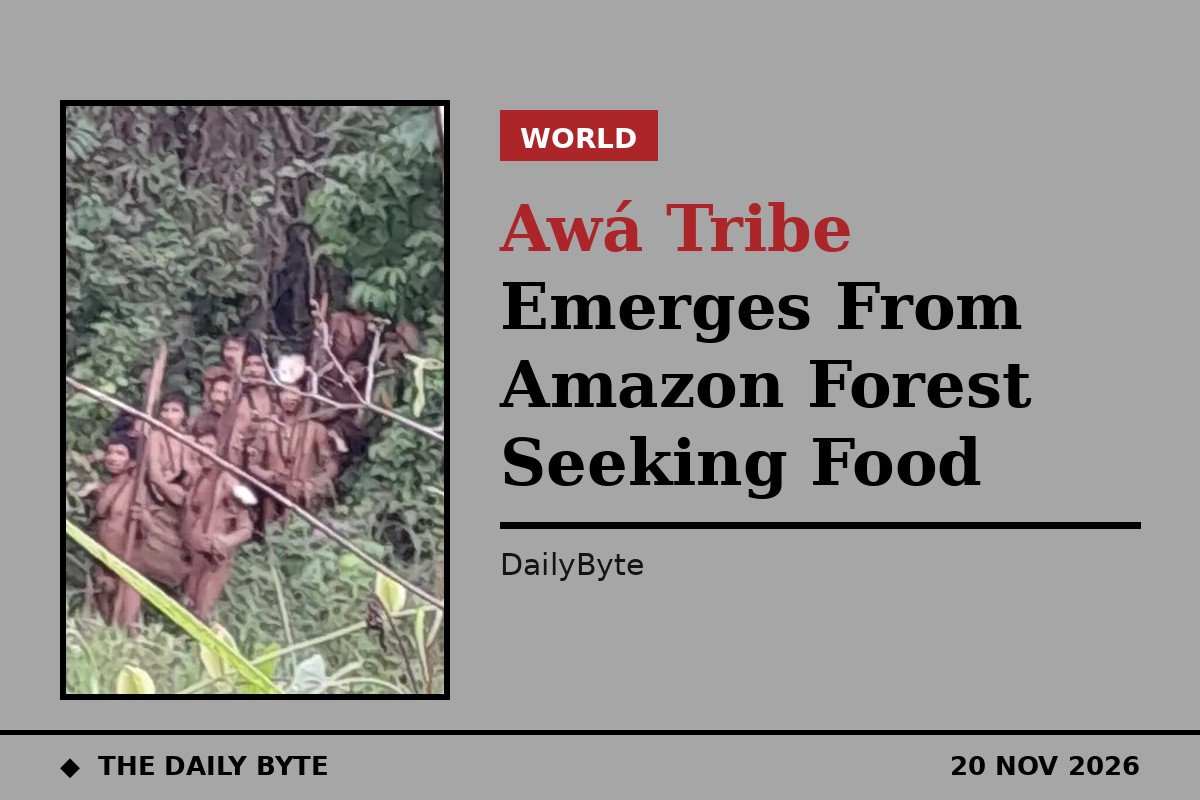
Around 20 members of Brazil's Awá Indigenous people have emerged from the Amazon rainforest and made contact with outsiders for the first time in decades, asking for food in an encounter that experts say is a warning sign about the destruction of their forest home.
The group, men, women and children, walked out of the forest on Monday 16 November in the Arariboia Indigenous Territory in the north-eastern state of Maranhão. They approached a government post and a neighbouring Guajajara village, where they were given yams, which they carried back into the forest.
Members of the Guajajara people, a larger Indigenous group that lives alongside the Awá, filmed the encounter, and the footage was shared by the London-based advocacy group Survival International. The interaction lasted several hours, although the two groups speak different languages and could barely communicate.
A worrying sign, not a celebration
Guajajara spokesperson Olimpio Santos Guajajara said the meeting should not be treated as a heartwarming story. "We were trying to avoid contact with them," he told Brazil's Globo television network. "Unfortunately, today they felt forced to come and make contact."
Since the late 1980s, Brazil has followed a no-contact policy for isolated tribes, allowing peoples such as the Awá to remain apart from modern society if they choose. Experts say the fact that this group sought help suggests the forest can no longer feed them. Sarah Shenker, head of Survival International's Brazil office, said the pressures of illegal deforestation, cattle ranching and hunting may have pushed the tribe to its limits.
"They've shown so clearly for so long that they don't want contact with outsiders," Shenker told the New York Times. "The fact that they've come out now does indicate they've probably felt forced to."
There were visible signs of hunger. Uirá Garcia, an anthropologist at the Federal University of São Paulo who has studied the isolated Awá for 20 years, told Globo that some members of the group looked "exceptionally thin" — particularly concerning because the encounter came in the middle of the Amazon's rainy season, normally a time of abundance in the forest.
An island of forest under pressure
The Awá are expert hunter-gatherers who live off the forest, hunting wild boar, deer, monkeys and fish and gathering fruit and honey. But their territory has been steadily carved away. In recent years, illegal loggers, hunters and cattle ranchers have closed in on Arariboia, and more than a third of one legally protected Awá reserve has been cut down.
Survival International says the Brazilian government has barely responded to the intrusions. In its place, a team of Guajajara people known as the Forest Guardians has defended the territory, and several of its members have been killed in conflicts with invaders. The Guardians said in a statement that climate change, fires, deforestation and land encroachment were having "a direct impact on their lands and the Awá way of life, which depends exclusively on hunting and gathering."
Past estimates put the total Awá population at roughly 450 people, of whom only around 100 still live in complete isolation, in a few small, mobile bands. They are among the world's last nomadic hunter-gatherer peoples, and one of the globe's last uncontacted tribes. Survival International counts at least 196 uncontacted tribes worldwide, with roughly 95 percent of them in the Amazon rainforest.
Health risks and an emergency response
Contact also carries serious health risks. The isolated Awá have received no vaccinations and have built up no immunity to common viruses such as influenza, measles and chickenpox, and introduced diseases are the leading killer of isolated tribal peoples.
Brazil's government agency for Indigenous peoples has enacted an emergency contingency plan, including restricting outsider access to the area where the group emerged. Caroline Pearce, director of Survival International, said the encounter showed how the invasion of uncontacted peoples' forests "puts otherwise self-sufficient Indigenous people in real danger" and called on the Brazilian government to commit the resources needed to protect Arariboia "from the loggers and ranchers who are razing it, in flagrant defiance of the law."
Estimates suggest nearly 20 percent of the Amazon has been destroyed since the 1970s. For the Awá, what remains is, in Pearce's words, "an ever-smaller island of Amazon rainforest, surrounded by destruction."


