B3 and Six Banks Plan Open BRL Stablecoin for 2027
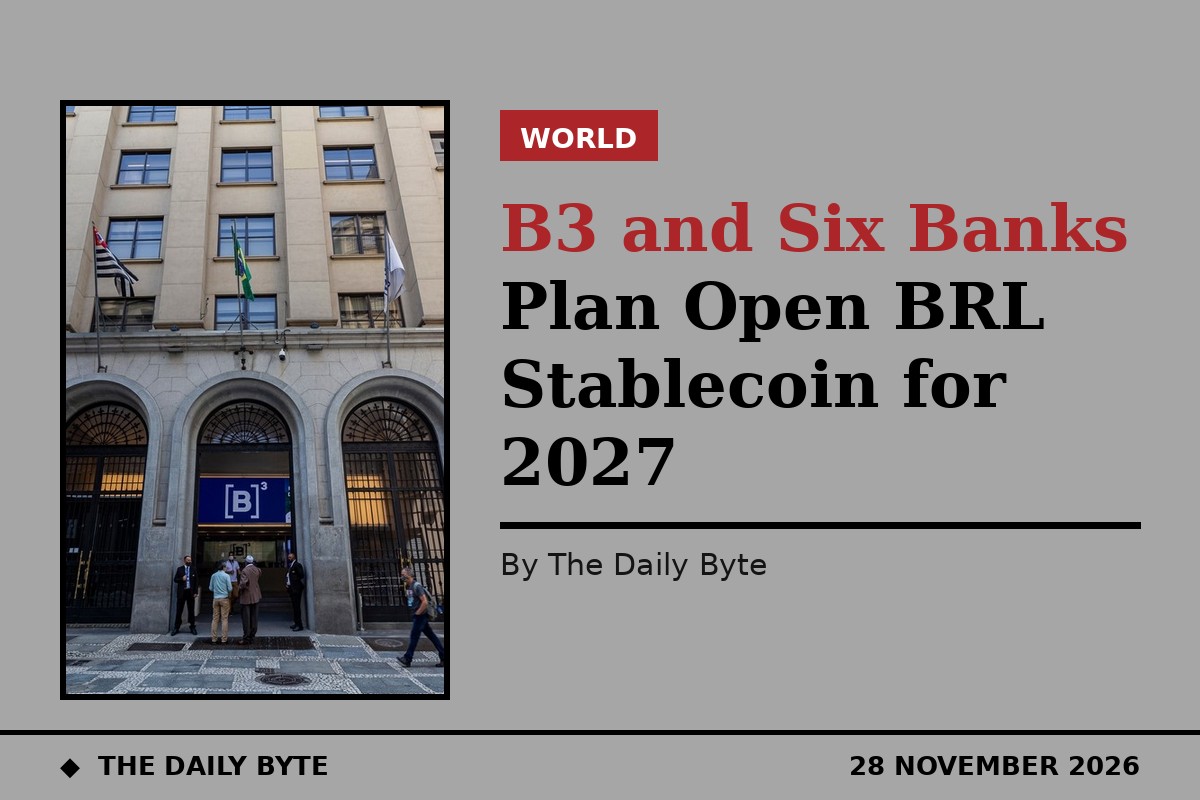
Brazil's stock exchange operator B3 and six of the country's biggest financial institutions are building a shared stablecoin pegged to the real, with operations expected to begin in the first quarter of 2027. The token, called Open BRL, was announced on Friday 27 November and is designed to give Brazil's banks a neutral way to move money between themselves on blockchain rails.
Each Open BRL token will be backed one-to-one by Brazilian reais and issued by Banco B3, the banking arm of the exchange group, which will also hold the reserves. Holders will be able to redeem the token for reais at any time. B3 will operate the underlying technology, while the six partner banks build integrations and test potential uses for the shared infrastructure.
Six banks behind one token
The partners are Bradesco, BTG Pactual, Itaú Unibanco, Safra, Santander and XP — six of the largest names in Brazilian finance. A steering committee will set the rules, technical standards and pricing for the network, and the partners have said the project could be spun off into an independent company if it grows. "Our goal is for this initiative to be open to the entire Brazilian financial market," Luiz Masagão, B3's vice-president of products and clients, told Valor Econômico.
The project grew out of a practical problem. Brazil's largest banks have spent years building their own digital tokens, but a token only works between banks if other banks will accept it — and rivals have been reluctant to take a token issued by a competitor. Open BRL is meant to solve that by sitting on neutral ground: the banks will keep their own tokens for internal use, while Open BRL carries money between them through B3. Two of Brazil's largest state-controlled lenders, Banco do Brasil and Caixa, are not on the partner list, and their participation would be a useful test of whether the coin really is neutral.
A second attempt at a real stablecoin
Open BRL is B3's second stablecoin plan in about a year. The exchange first disclosed plans for its own token in December 2025, with a launch targeted for 2026. As recently as July 2026 it was reportedly preparing a token called B3RL, backed by Brazilian reais and secured by government bonds, with testing scheduled for August and September. That launch never happened, and it remains unclear whether Open BRL replaces B3RL or will run alongside it. B3 has not answered a request for clarification, Cointelegraph reported.
A market still dominated by the dollar
Real-backed coins have a long way to go. Brazilians declared 404.8 billion reais in stablecoin trades in 2025, about 80 per cent of all reported crypto activity in the country, and Tether's USDT drove nearly 90 per cent of that volume, according to figures from the Receita Federal, Brazil's tax authority. Estimates of the real-backed market vary widely: consultancy Fintrender counted more than $140 million in supply across more than ten tokens in May, while data firm DIA verifies about $71 million on-chain across five publicly tracked coins.
Open BRL is not mainly a retail product, however. Its success will depend on how much bank-to-bank settlement it handles rather than on how large its market value becomes. B3 also plans to use the token to settle trades on the tokenized stock platform it is building, with trading of tokenized shares due to start in early 2027 through the same order book used for conventional equities.
Why not just use Pix?
Brazil already has instant payments through the central bank's Pix system, so a blockchain token has to offer something more. The difference is programmability: a wallet transfer can trigger smart contracts that automate trade settlement. Even so, those benefits may arrive slowly. Humberto Costa, a B3 digital assets executive, said in October that tokenized shares would keep two-day settlement at launch, and that round-the-clock trading would require regulatory changes.
Questions still open
For all its detail on who does what, the announcement leaves the questions that decide whether a stablecoin works unanswered. It names no blockchain, so it is unknown whether Open BRL will run on a public chain, a permissioned network operated by the exchange, or a hybrid. It promises continuous audit and backing mechanisms, but publishes no reserve composition, no custodian and no attestation schedule. Governance is still to be defined.
Brazil's central bank crypto rules took effect in February. They treat stablecoin trades as foreign exchange operations, but there are still no licensing rules for local issuers. B3 says it has briefed the central bank and that the CVM, Brazil's securities regulator, supports the project. The announcement of the partnership does not mean the stablecoin is available for transactions — and the first-quarter 2027 target may still change.


