Balkan Leaders Press EU on Membership at Ohrid
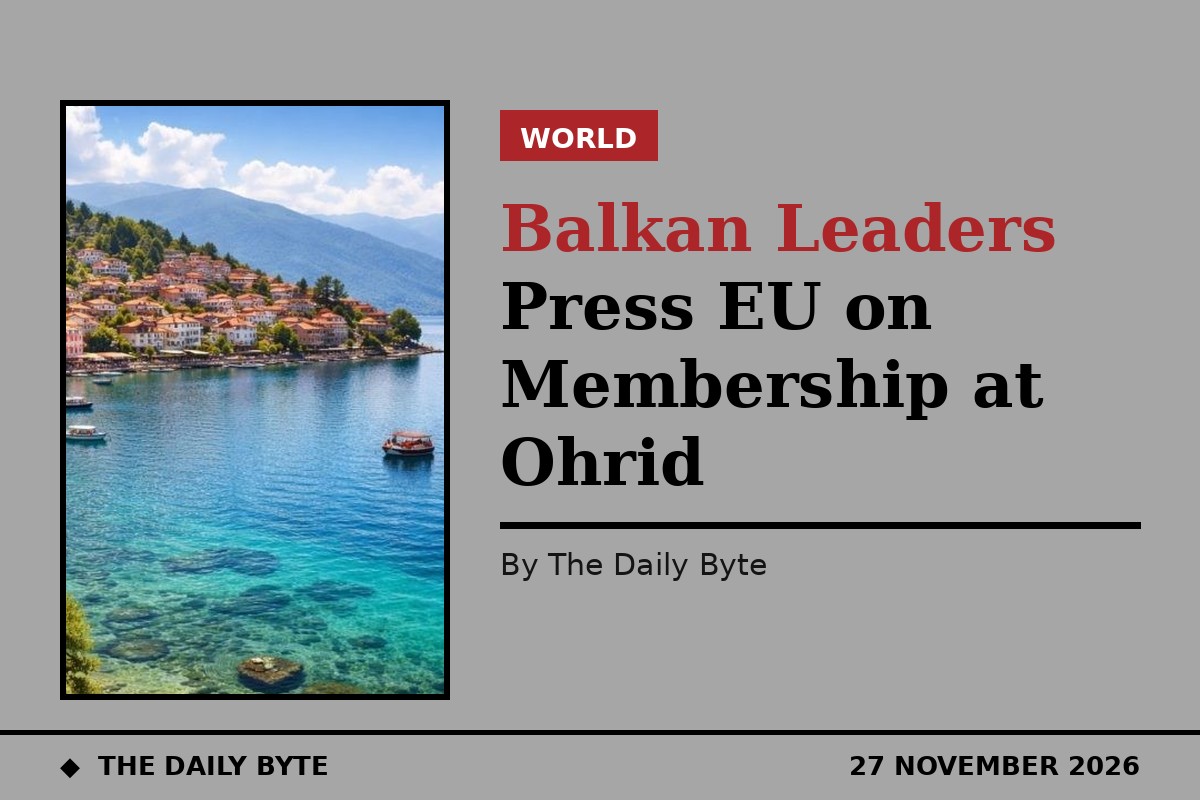
Leaders from across the Western Balkans have pressed the European Union to speed up membership for the region, warning that slow progress on enlargement is becoming a security risk as well as a political frustration.
The call came at the 15th summit of the Brdo-Brijuni Process in Ohrid, North Macedonia, on Friday, 27 November. The meeting was hosted by North Macedonia's President Gordana Siljanovska-Davkova and co-organised by Slovenia's President Natasa Pirc Musar and Croatia's President Zoran Milanovic.
Leaders from Albania, Bosnia and Herzegovina, Kosovo, Montenegro and Serbia joined the three hosts for the talks, whose central topic was the European perspective of the Western Balkan countries, with a focus on EU enlargement, reforms, regional cooperation and good-neighbourly relations.
At a joint press conference after the meeting, Siljanovska-Davkova described the integration of the Western Balkans into the EU as a security and geopolitical necessity. She said bilateral disputes, including identity-related issues involving Bulgaria, should not be allowed to block North Macedonia's accession path, and she urged stronger transport, energy and digital connections across the region.
Milanovic praised what he called the constructive atmosphere of the summit, while Pirc Musar said the EU must fulfil its responsibilities towards candidate countries and accelerate enlargement. She also stressed reforms, the rule of law and creating opportunities for young people so they are not driven to emigrate.
Montenegro's President Jakov Milatovic told the summit that his country, the most advanced of the candidate states, can finish its accession negotiations by the end of this year and become a full EU member in 2028. The European Commission has described completing Montenegro's negotiations by the end of 2026 as realistic, with an accession treaty possibly signed in 2027.
Milatovic also told fellow leaders that Montenegro's government is providing financial support for new airlines, presenting it as a concrete step towards closer regional cooperation.
Bosnia and Herzegovina was represented by all three members of its presidency, Zeljka Cvijanovic, Denis Becirovic and Darijana Filipovic. Becirovic said accelerating Bosnia's European path and improving economic relations in the region were among his key goals, while Filipovic said Croatia and Slovenia, as EU members, had clearly expressed readiness to keep supporting Bosnia on its European path.
“BiH does not lack a desire for the EU; it lacks a political capacity to accelerate that process,” Filipovic said. She added that the meeting had also addressed security challenges, with participants expressing concern about the regional and global security situation. She said she was optimistic that Bosnia and Herzegovina could host the next meeting of the process.
The Brdo-Brijuni Process was launched by Slovenia and Croatia in 2013 to support the European future of the Western Balkan countries and to promote stability through dialogue. It has no power to take binding decisions on enlargement, but it remains one of the few forums where leaders from across the region, including Kosovo and Serbia, sit down together.
The Ohrid meeting came a day after EU leaders in Brussels failed to agree on the bloc's next long-term budget or on a 45 billion euro loan for Ukraine, a deadlock that has added to doubts in candidate countries about how quickly the EU can act. For the Western Balkan leaders gathered in Ohrid, the message was that enlargement cannot wait for Brussels to settle its own arguments first.


