Bank of England's Bailey Says UK Labour Market Has Stopped Loosening
By The Daily Byte
·20 Nov 2026
·4 min read
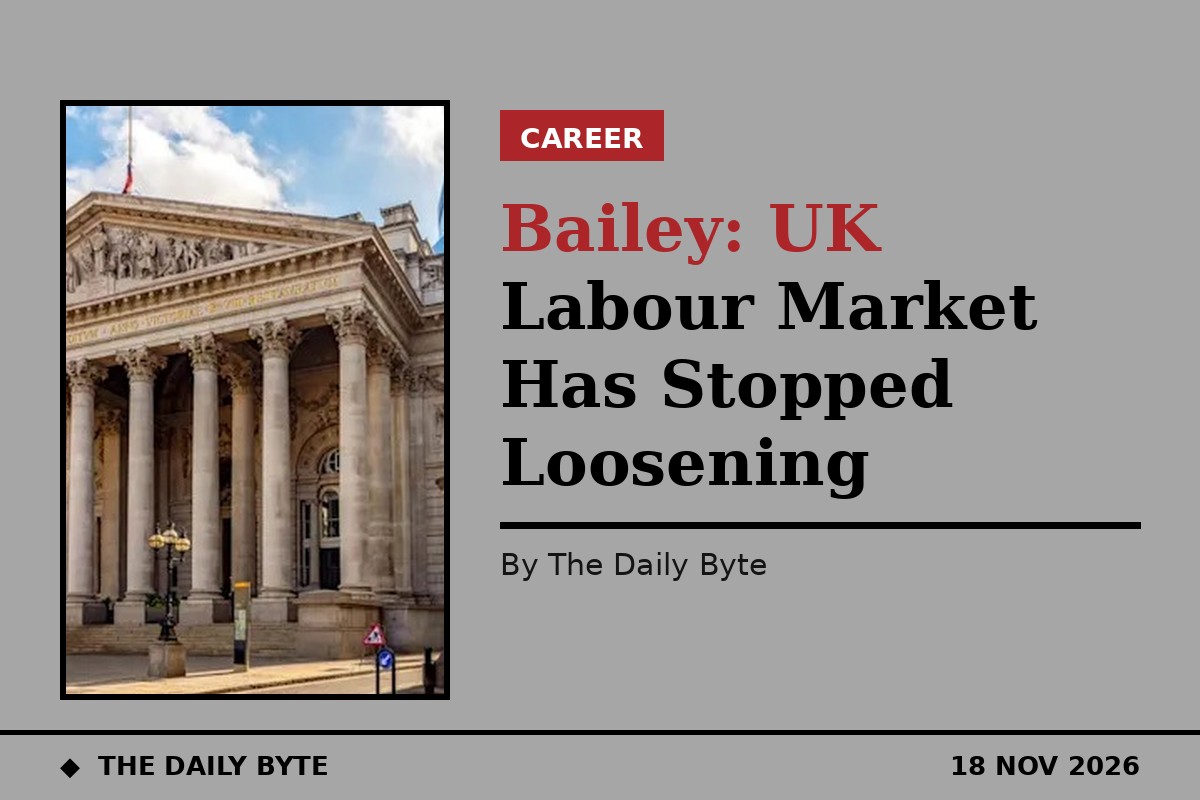
Bank of England Governor Andrew Bailey said on Wednesday 18 November that Britain's labour market no longer appears to be loosening, although some slack remains. It was his first public assessment of the jobs market since the Office for National Statistics (ONS) published its November labour market figures the day before.
Speaking at a conference hosted by the Institute of Economic Development in London, Bailey said: "(While) indicators point to spare capacity remaining in the labour market, the margin of slack has stabilised as activity growth has picked up." The remarks, reported by Reuters, suggest the Bank believes the recent weakening in hiring has levelled off rather than continuing to deepen.
## What the official figures showed
The ONS bulletin published on 17 November estimated the UK unemployment rate at 4.6% for July to September 2026, down by 0.3 percentage points on the previous quarter and on the year. The employment rate for people aged 16 to 64 was estimated at 75.4%, up 0.3 percentage points on the quarter.
The same release estimated 690,000 vacancies in August to October 2026, down 22,000 (3.0%) on the previous three months. The ONS said that was the largest quarterly fall since May to July 2025, and that outside the coronavirus pandemic, the last time there were 690,000 or fewer vacancies was July to September 2014, when there were 686,000.
Vacancies fell in 11 of the 18 industry sectors measured. Administrative and support services, construction, and transport and storage each recorded falls of 5,000. The sharpest fall by business size was among firms with one to nine employees, where vacancies dropped by 22,000 to 73,000 — the lowest for that size band outside the pandemic since April to June 2012. The ONS said feedback from its Vacancy Survey suggests smaller firms may not be recruiting because of labour costs and other economic conditions.
## Why Bailey's reading matters for jobseekers
Bailey's comments matter because the Bank watches the labour market closely when it sets interest rates. A loosening jobs market — fewer vacancies and slower pay growth — usually eases pressure on inflation, while a stabilising one suggests the economy is finding a floor.
The ONS figures themselves were mixed. While unemployment fell, the early estimate of payrolled employees for October 2026 decreased by 34,000 on the month and by 95,000 on the year, to 30.2 million. The ONS stressed that the October payroll figure is provisional and likely to be revised. The Claimant Count rose to an estimated 1.714 million in October.
Regular pay growth, excluding bonuses, slowed to 3.5% in July to September, down from 3.7% in the previous three-month period. Total pay growth, including bonuses, was 3.6%. The ONS also cautioned that the quarterly movements in employment and unemployment partly reflect the rotation of its Labour Force Survey sample, with the group leaving the survey having lower employment and higher unemployment than the group joining it.
## No preset path for interest rates
Bailey repeated that monetary policy is not on a preset path, saying the Bank would look carefully at the evidence that accumulates before its next meeting. The Bank raised Bank Rate by a quarter of a percentage point to 4% earlier this month.
On inflation, Bailey noted only that the annual rate of consumer price growth had increased to 3.6% in October. The next ONS labour market release is due on 15 December 2026.
## Frequently asked questions
**What did Andrew Bailey say about the UK labour market?**
He said on 18 November 2026 that Britain's labour market no longer appears to be loosening, but that some slack remains, and that the margin of slack has stabilised as activity growth has picked up.
**What is the UK unemployment rate?**
The ONS estimated unemployment at 4.6% for July to September 2026, down 0.3 percentage points on the quarter. The ONS cautioned that the move partly reflects changes in its survey sample.
**How many UK job vacancies are there?**
The ONS estimated 690,000 vacancies in August to October 2026, down 22,000 on the previous three months, with the fall concentrated among the smallest businesses.
Sources: Reuters reporting of Governor Bailey's remarks on 18 November 2026, carried by Global Banking and Finance (https://www.globalbankingandfinance.com/boes-bailey-sees-uk-labour-market-longer-loosening-slack/); Office for National Statistics, Labour market overview, UK: November 2026 (https://www.ons.gov.uk/employmentandlabourmarket/peopleinwork/employmentandemployeetypes/bulletins/uklabourmarket/november2026).
Source
Global Banking and Finance — https://www.globalbankingandfinance.com/boes-bailey-sees-uk-labour-market-longer-loosening-slack/