Bank of England boss warns AI bubble could burst
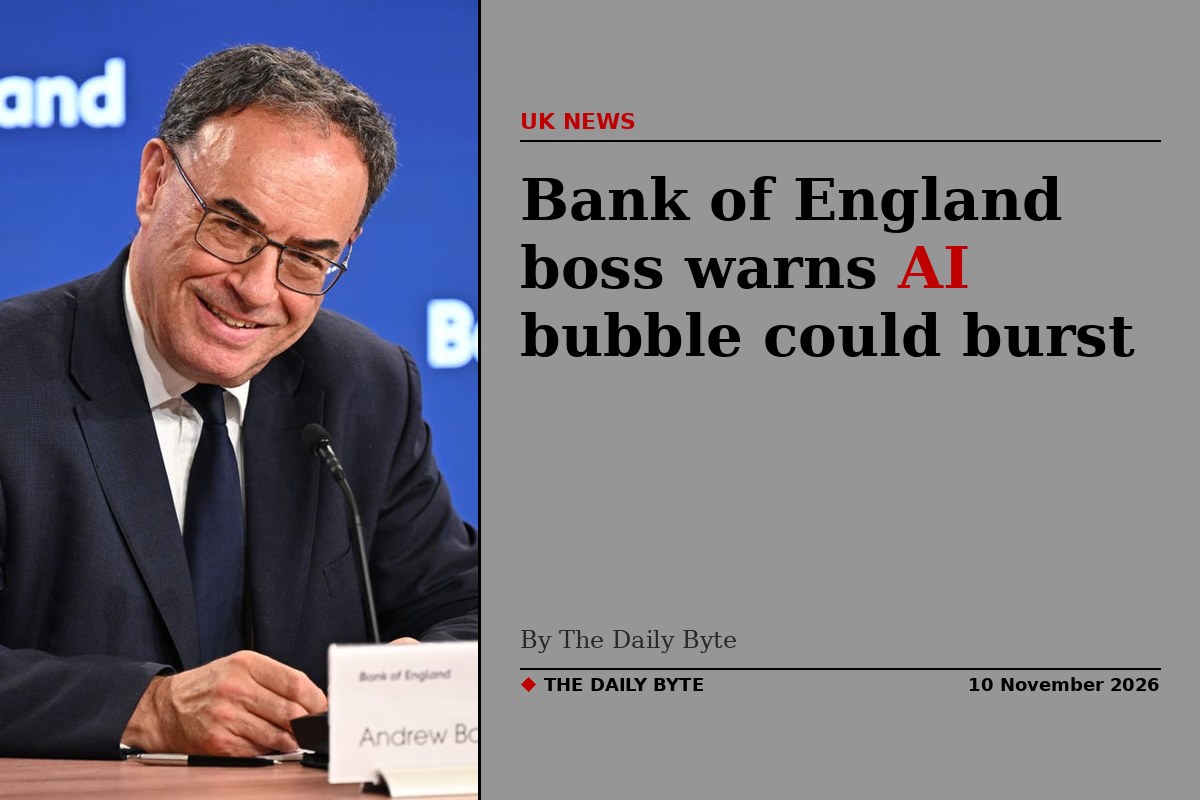
Bank of England governor Andrew Bailey has warned that artificial intelligence stocks may be overvalued and that a burst "asset price bubble" in AI could threaten the UK's financial stability. He made the warning in a speech in Zurich on Monday 9 November 2026, in which he also said frontier AI had increased the risk of cyber attacks.
Mr Bailey told the Swiss Institute of International Studies lecture series at the University of Zurich that investors may be overvaluing AI companies, or that the returns they expect from the technology may take longer to arrive than markets assume. "There are good reasons to believe that the world moves faster now, but still the timing may not live up to market expectations," he said, adding that either could be a reason why the bubble bursts.
AI is already lifting UK growth
The warning was not wholly gloomy. Mr Bailey said there were growing signs of the beginnings of a positive supply shock from AI and the investment it requires, and that UK economic activity was proving more resilient than expected, partly because of AI investment, particularly in business services. The Bank's November 2026 Monetary Policy Report found that AI-related activity had accounted for nearly one-fifth of UK GDP growth since early 2026.
He said AI, digital technology and probably robotics had the potential to lift sustainable growth rates by raising productivity. The annual boost from AI and digital technologies has been a modest 0.5% over the past three years, he said, and he expects it could rise to 0.9% a year over the next three years. Global AI-related debt issuance reached about $450 billion by early September, roughly double the 2025 level, underlining how much money is now riding on the technology.
Cyber risk and tougher testing
Mr Bailey also warned that frontier AI had raised the threat of cyber attacks on the financial system. "In our world, frontier AI has increased the risk from cyber-attacks - something that was already prominent," he said, adding that the resulting concerns "may call into question public trust in AI. This is critical." Last week the National Cyber Security Centre warned that Britain faces the prospect of AI-boosted attacks on critical national infrastructure within the next two years.
The governor called for "more extensive model testing" before and after AI models are released, and "better incident reporting, monitoring and follow up" for AI tools. He said the financial stability risks of the technology made it an issue of importance to central banks, even though he described himself as an optimist on AI.
Why central banks are watching
Mr Bailey has repeatedly described AI as the next general-purpose technology, the kind of innovation that spreads across almost every industry and lifts growth broadly. His argument on Monday was that the same scale is what makes the risks matter: if expected returns disappoint, or arrive late, asset valuations could correct sharply, with knock-on effects for banks, pension funds and the wider economy.
The speech, titled "Central Bank independence in today's world", ranged beyond AI to the case for independent and accountable central banks in a shock-prone world. But it was the AI warning that carried the sharpest message for markets: the Bank of England is watching valuations closely, and it believes the timing of AI's payoff, not just its size, will decide whether the boom ends in an orderly slowdown or a damaging correction.
Read the full speech on the Bank of England website. The Press Association's report of the speech is available via the Glasgow Times.