Bank of England Cuts Bank Capital Rules to Free £175bn
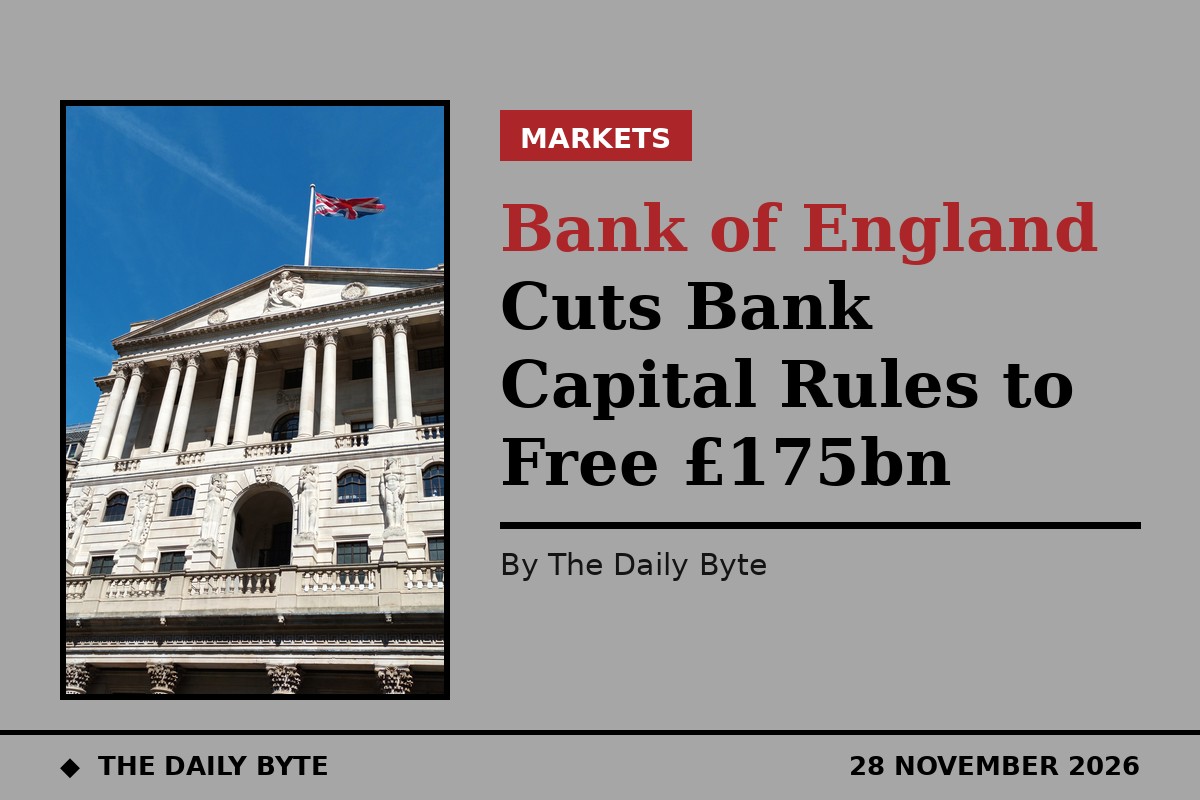
The Bank of England has moved to cut the amount of capital Britain's biggest banks must hold, in a package it says could free up about £175 billion of extra lending capacity for households and businesses.
The changes were announced on Thursday 26 November in the Bank's half-yearly Financial Stability Report, and mark the conclusion of a review of the bank capital framework by its Financial Policy Committee (FPC). The Prudential Regulation Authority (PRA), the Bank's supervisory arm, will now consult on lower minimum requirements linked to domestic lending.
Taken together with earlier changes to leverage rules, the reforms will cut Tier 1 capital requirements for major UK banks by an amount equivalent to around 50 basis points of risk-weighted assets in normal economic conditions, the Bank said. Across the major banks as a whole, system-wide Tier 1 requirements fall by 30 basis points to 12.8 per cent of risk-weighted assets, while domestically focused, systemically important banks get a deeper cut of about 60 basis points, from 13.6 per cent to 13.0 per cent.
After the reduction, system-wide requirements for the major banks will be consistent with the FPC's benchmark of around 13 per cent of risk-weighted assets, down from around 14 per cent before the committee cut the benchmark in December 2025.
Why domestic lenders gain most
The Bank said the existing rules had weighed more heavily on banks with greater exposure to domestic lending than on internationally diversified lenders. The final part of the review recalibrates the capital held against geographic credit concentration risk and recognises more fully the protection provided by the countercyclical capital buffer, which the FPC held at its neutral setting of 2 per cent.
Lloyds and NatWest, the two most domestically focused of the big UK lenders, are seen as the main beneficiaries, alongside other major banks including HSBC, Barclays and Standard Chartered. The extent of the benefit will vary with each bank's geographic mix and business model.
Governor Andrew Bailey said the changes made requirements more proportionate and better targeted, and therefore lower. But he drew a line under further easing. "Reducing capital requirements much further would risk financial instability," the committee said.
Risks still rising, the Bank warns
The report was not all good news for the sector. The FPC said risks in the global financial system had intensified in recent months, pointing to the conflict in the Middle East, heavy borrowing by governments and by the large technology companies building artificial intelligence infrastructure.
The Bank put the total potential exposure of the big AI "hyperscalers", including off-balance-sheet commitments, at just over $4 trillion, and warned that the financing of AI was tying markets together in ways that could spread a shock from one area to another.
It also warned that small and medium-sized businesses were under growing pressure from higher energy and borrowing costs, even as the banking system itself remained well capitalised and able to keep lending. Major UK banks' common equity Tier 1 capital ratio stood at 14.1 per cent in the third quarter, and gross lending to households and businesses was 9 per cent higher than a year earlier.
The FPC will consider the proposed changes when it sets the minimum capital thresholds for its 2027 Bank Capital Stress Test, due to launch in the first quarter of next year. Consultations on the leverage ratio changes are due in early 2027, with the Pillar 2A consultation following in the first half of 2027.
Major UK banks returned £9.2 billion to shareholders through dividends and share buybacks in the third quarter of 2026, according to the Bank's report, a reminder that looser capital rules could also feed payouts as well as lending.


