Bank of England December Rate Rise Priced at 88%
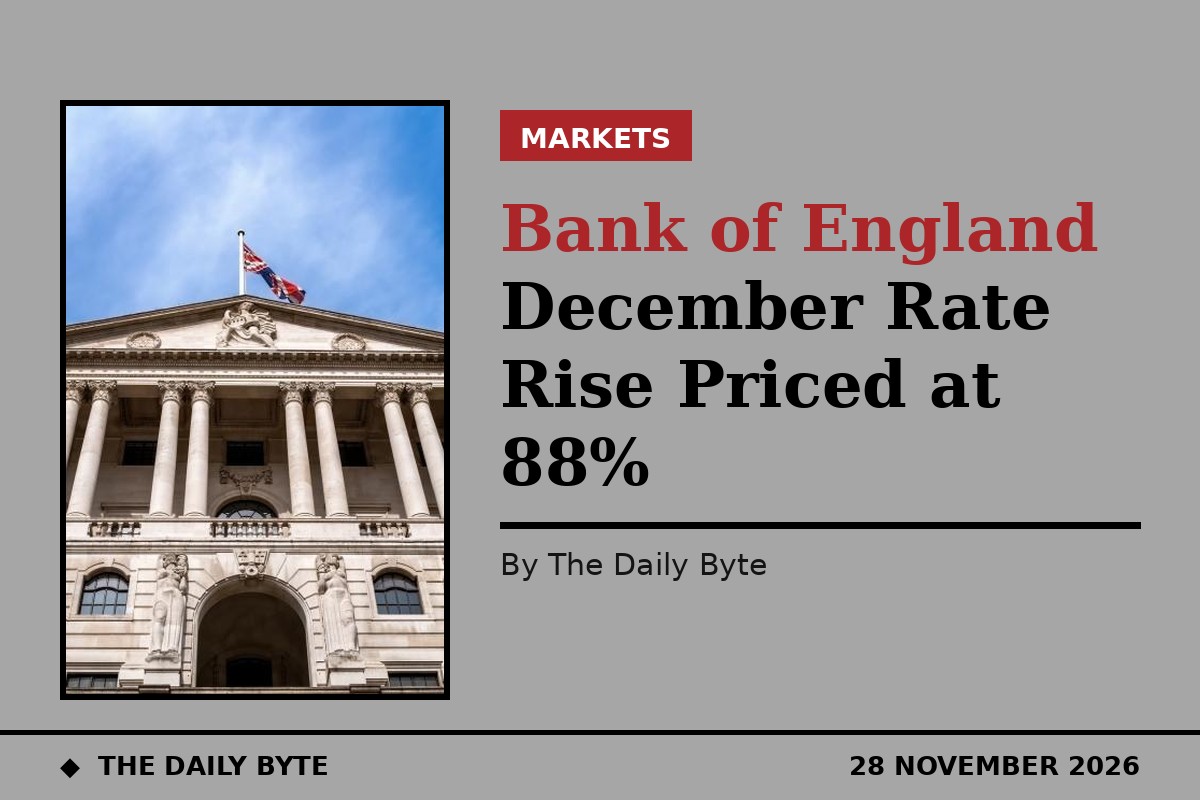
Financial markets now price an 88% chance that the Bank of England raises Bank Rate by a quarter of a percentage point to 4.25% at its next meeting on 17 December, according to market pricing reported on 27 November. The move would follow the Bank's decision on 5 November to lift Bank Rate from 3.75% to 4%, its first increase in more than three years. That decision was backed by eight of the nine members of the Monetary Policy Committee, with the ninth, Catherine Mann, voting for a larger half-point rise to 4.25%. Market pricing has firmed through the month. Pricing on 20 November implied an 80% chance of a December rise, and by 27 November that had moved to 88%. Not every reading agrees: Fidelity, writing on 26 November, put the chance at slightly above 50%. The gap shows how much the market's view is still moving with each new piece of data.
Markets and economists split
Economists are far less convinced than traders. In a Reuters poll conducted on 11 to 13 November, 64 of the 65 economists surveyed expected Bank Rate to stay at 4% in December, with most expecting the first further rise in February and a peak of 4.25%. The poll was taken before the October inflation figures and before the Bank's latest comments, so it may not reflect the newest evidence. Even so, the split is stark: markets see a December rise as the likely outcome, while economists see February as the more probable date. Both sides agree on the direction. Whether the rise comes in December or February, the peak is widely expected to be 4.25%, and further rises after that are not ruled out.
What Bank officials have said
Members of the Monetary Policy Committee have kept the door open without committing to a date. Governor Andrew Bailey said on 18 November that interest rates were not on a 'pre-set path' and that policymakers would watch how high energy prices feed into other prices and wages. Deputy Governor Clare Lombardelli said on 10 November that she would not rule December or February in or out, leaving the timing dependent on the evidence. Chief economist Huw Pill said on 14 November that further increases were likely to be needed, and described market pricing that implied rates approaching 5% next year as 'not outrageous'. Committee member Megan Greene said on 24 November that disinflation, the slowdown in inflation, had stalled, above all in wages, and pointed to pay growth running above the 3% mark she sees as consistent with the inflation target. The Bank's own staff forecast supports further rises: it expects consumer price inflation to reach about 5% in the second quarter of 2027, well above the 2% target.
Inflation data will decide it
The deciding evidence arrives in the two days before the meeting. Consumer price inflation rose to 3.6% in October, up from 3.5% in September, with higher petrol and diesel prices the biggest driver. Core inflation, which strips out energy, food, alcohol and tobacco, held at 2.8%, while services inflation stayed at 3.7%. The Bank will also watch pay data. Its Decision Maker Panel survey found firms' expectations for inflation over the coming year rose to 3.3% in the three months to October, up from 3.1%, while firms' own-price inflation expectations rose to 3.8%. The November inflation figures are published on 16 December, one day before the decision. Another rise in the headline rate would make a December increase close to certain; a fall back towards 3.5%, especially with services cooling further, would cut the odds and weigh on the pound. Growth has also been stronger than expected, with the economy expanding by 0.7% in the third quarter and by 0.2% in September, although some economists question whether that strength will last as higher energy bills squeeze households.
What it means for mortgages
A December rise would feed straight into tracker mortgages, which move in line with Bank Rate, and would keep upward pressure on fixed deals. Average two-year and five-year fixed mortgage rates stood at 5.99% and 6.00% on 25 November, according to Moneyfacts figures, while the best five-year fixed deal was 4.82%. The Bank's Financial Stability Report, published on 26 November, forecast a typical rise of £100 a month for homeowners coming off fixed deals over the next three years, with around 6.5 million households expected to see their payments rise by the end of 2029. Savers, by contrast, have seen returns climb: the best Cash ISA rate was 4.9%, although that rate includes a time-limited boost. For now, the market's message is clear: the Bank is expected to raise rates again, and the only real argument is whether it happens in December or February.


