Bank of England to wait until February to raise rates: poll
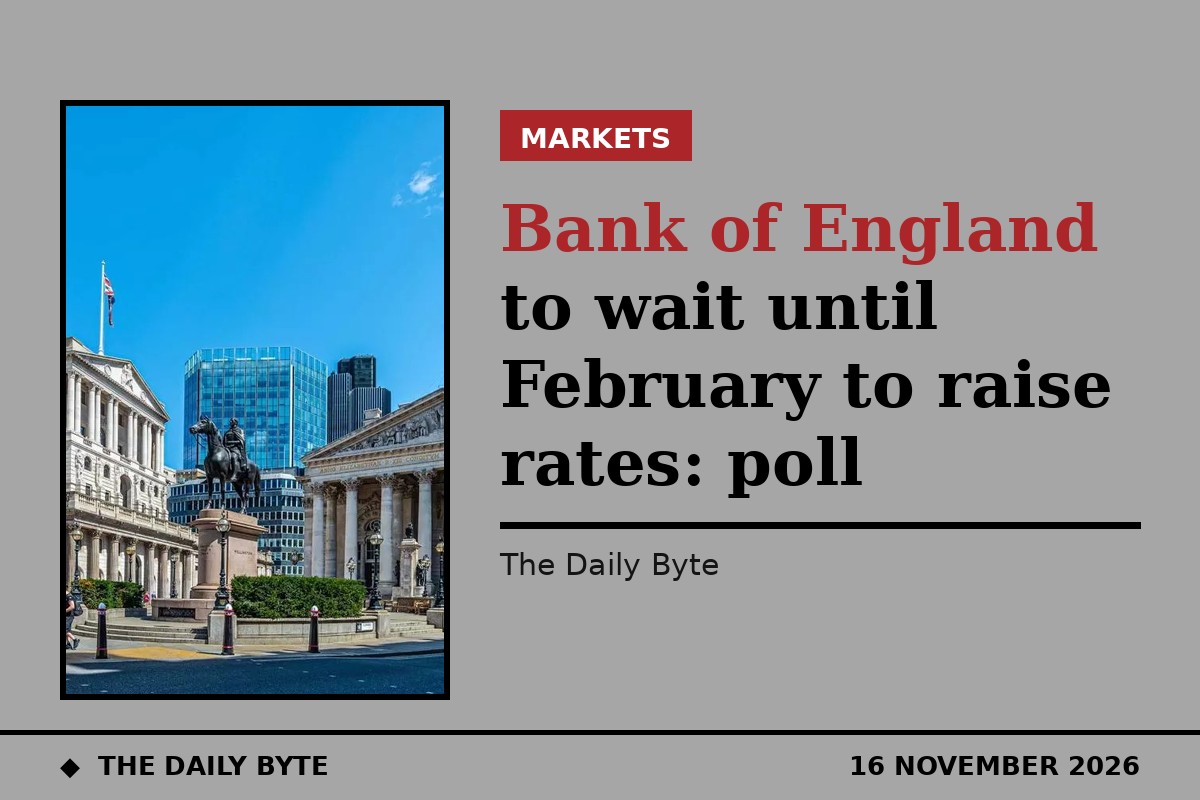
The Bank of England is likely to wait until February before raising interest rates again, according to economists polled by Reuters, even though financial markets are betting heavily on a move in December.
Sixty-four of the 65 economists surveyed by Reuters between 11 and 13 November said the Bank would leave Bank Rate at 4.00% when its Monetary Policy Committee meets in the week before Christmas. Only one expected a rise. The median forecast was for the next increase to come in February.
That puts the economists at odds with traders. Reuters reported that interest rate futures were almost completely pricing in a December hike, a split that leaves the Bank's next decision genuinely uncertain.
Lombardelli keeps December live
Bank of England Deputy Governor Clare Lombardelli has refused to close the door on December. Speaking on Tuesday 10 November, she said the conditions for persistent inflation in Britain were crystallising and that she would not rule a December increase in or out.
"I wouldn't rule December in or out, February in or out," she said, adding that each meeting was "live". Her vote, she said, would be shaped by the conflict in the Middle East, energy prices and the next rounds of price and labour market data.
Pricing has swung sharply in recent days. Lombardelli put the market chance of a December rise at about 50/50 in a Guardian interview on Tuesday, while Reuters reported on Friday that futures had moved to almost fully price a December move.
Pill warns of further rises
The Bank's chief economist, Huw Pill, has added to the hawkish tone. Speaking to the Financial Times, he warned that interest rates could rise further in December and during 2027 as policymakers try to contain inflation driven by higher energy costs and possible wage pressures.
Inflation remains well above the Bank's 2% target. Consumer price inflation stood at 3.5% in September, up from 3.1% in August, and the Bank's November Monetary Policy Report projected it could rise to about 5% by the second quarter of 2027. The Reuters poll was less alarmed: its median forecast was for inflation to peak at 4.3% early next year and slow to an average of 2.6% in the final quarter of 2027.
British fuel bills are likely to rise by around 20% in January, when the regulator next adjusts retail prices to wholesale costs, adding to the pressure on households.
What happens next
The Bank raised Bank Rate by a quarter point to 4.00% on 5 November, its first increase since August 2023, on an 8-1 vote. External member Catherine Mann dissented, preferring a half-point rise.
This week brings the last full read on prices and pay before the 17 December decision. The Office for National Statistics publishes labour market figures on Tuesday 17 November and October inflation data on Wednesday 18 November. The economy grew 0.7% in the third quarter, with output 1.9% higher than a year earlier, giving the Bank less reason to hold off if inflation stays hot.
The 10-year gilt yield held just above 5.2%, reflecting the same repricing seen in US Treasury yields. AIB's economics team notes that markets attach around a 50% probability to a December hike, have a rise fully priced in for February, and price about 75 basis points of further tightening by the end of next year. AIB itself expects just one more rise, in early 2027, taking Bank Rate to a peak of 4.25% against market expectations of 4.75%.
Whether December brings a second consecutive rise will depend in large part on how energy prices trade in the coming weeks and on what Tuesday's jobs figures and Wednesday's inflation print show. As one economist in the Reuters poll put it, a December hike is certainly on the table, and the view will be updated when the data arrive.
Sources: Reuters poll, 13 November 2026; Clare Lombardelli remarks, 10 November 2026; Huw Pill warning, 14 November 2026.