Bank of Israel Holds Rate at 3.25% Amid Uncertainty
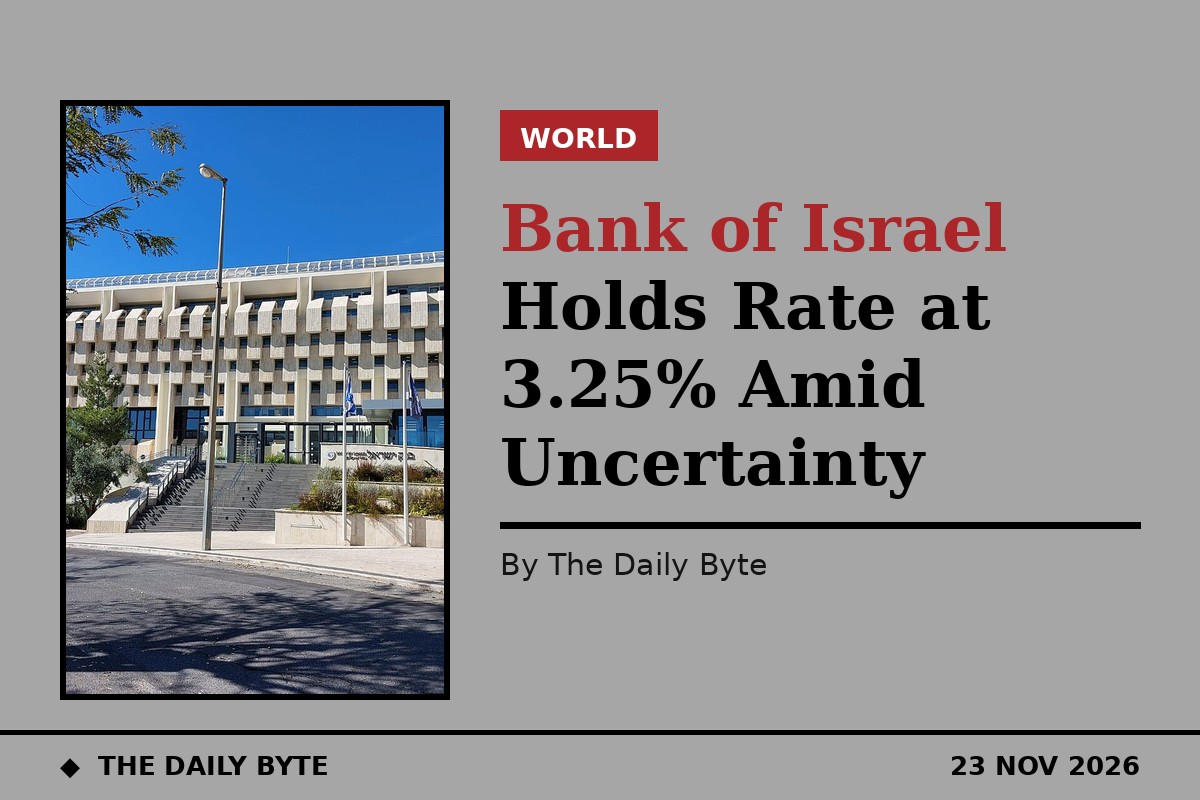
The Bank of Israel held its benchmark interest rate at 3.25 percent on Monday, 23 November, leaving borrowing costs unchanged for a second month in a row in its final policy decision of 2026. The central bank pointed to domestic and global uncertainty, continued geopolitical tensions and a weaker shekel, even though inflation has fallen well inside its target range. Twelve of the 14 economists polled by Reuters had expected no change.
Inflation is low, but the shekel ties the bank's hands
Annual inflation eased to 1.1 percent in October, down from 1.6 percent in September, and remains well within the official target range of 1 to 3 percent. On that measure alone, the case for another cut looked strong. The Bank of Israel, headed by Governor Amir Yaron, nevertheless chose to wait. In its statement, the bank warned that domestic and global uncertainty remains high in view of continued geopolitical tensions, and it said the inflation rate should move above 2 percent in the coming year. The shekel has weakened by nearly 8 percent against the dollar since the previous policy decision on 21 October, reaching 3.35 shekels to the dollar. The currency firmed by 1.8 percent to 3.29 after Monday's decision. The bank is concerned that a weaker currency could push up the price of imported goods and feed through into inflation, and analysts believed the shekel's slide had tied the Monetary Committee's hands when it would otherwise have liked to cut again.
Growth is strong while politics stays deadlocked
The decision also reflects an economy that is still expanding. The economy grew by an annual 8 percent in the third quarter, or by 4 percent once the production of Israeli firms abroad is stripped out, a measure the Bank of Israel described as a more relevant reflection of domestic economic activity. At the same time, Israel remains without a new government nearly a month after an inconclusive election on 27 October. Neither Prime Minister Benjamin Netanyahu's bloc of right-wing and religious parties nor the opposition led by former military chief Gadi Eisenkot won enough seats to form a governing coalition. Eisenkot has been given the first opportunity to try to form a government, but it is unclear whether he, or Netanyahu if Eisenkot fails, will be able to assemble a viable coalition in the coming weeks. Economists believe policymakers are worried about both the prospect of a return to conflict with Iran and the uncertain political environment. Officials had previously said the key rate could fall to 3 percent if inflation remained contained. The central bank also noted that interest rates priced into markets for the United States Federal Reserve and the European Central Bank reflect expectations of continued tightening of monetary policy.
From rate cuts to a long pause
Monday's hold extends a cautious turn that began more than a year ago. The Bank of Israel cut rates last November and in January, then paused as the conflict with Iran raised fears of a spike in supply-driven inflation. It resumed cutting in May, July and September, before holding rates in late October, a week before the election. The bank said the inflation environment will be greatly influenced by geopolitical developments and their effects on economic activity and on energy prices, by the risk premium and the exchange rate, by the development of demand alongside supply constraints, and by fiscal developments. For households and businesses, the decision means borrowing costs stay where they are until the next decision in early January 2027. What happens next will depend largely on the shekel, on whether a government can be formed, and on whether the region stays calm. Reuters reported the decision, and Globes confirmed that the rate was kept unchanged despite inflation falling to 1.1 percent.


