Bank of Korea Expands Deposit Token Trials
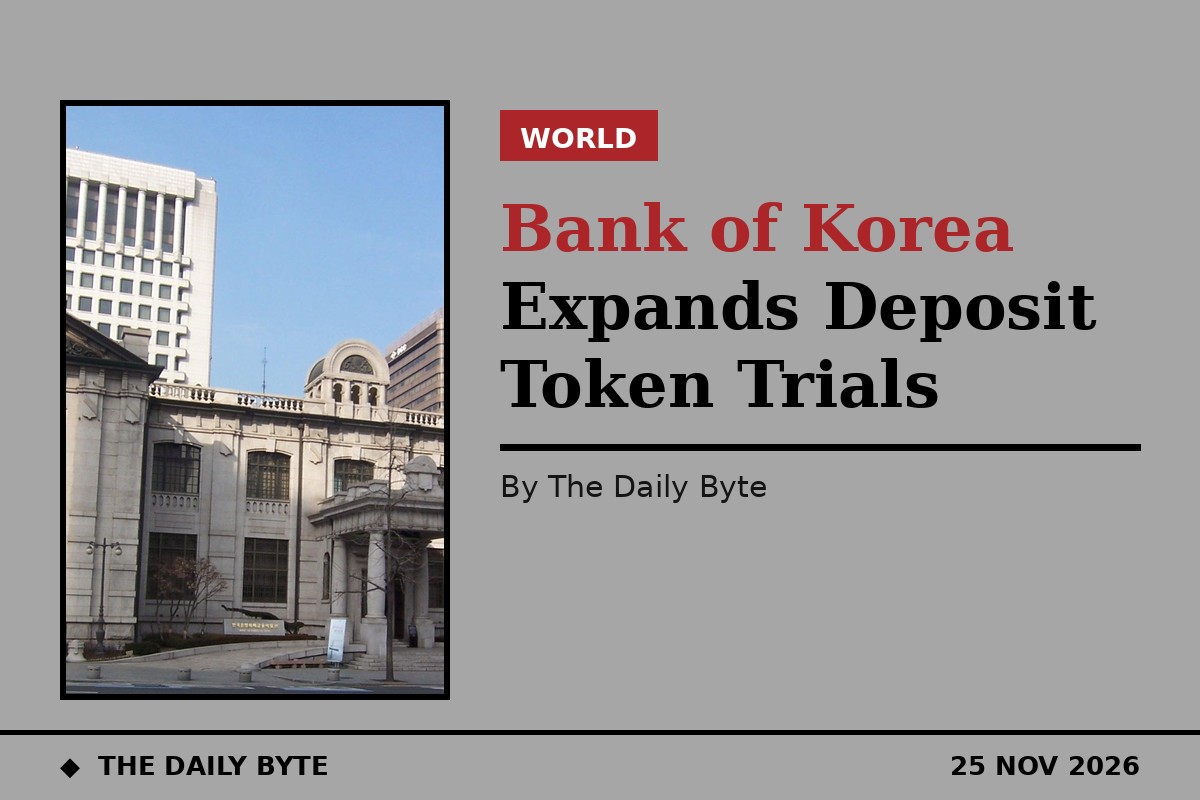
South Korea's central bank is expanding its deposit token trials and preparing a government bond tokenization pilot for 2027, the Bank of Korea disclosed on Tuesday, 25 November, at a session during 2026 Blockchain Week in Seoul. Under the second phase of its Project Hangang digital currency programme, the bank will test using deposit tokens to pay subsidies for electric vehicle charging facilities and for business promotion expenses, moving the experiment from technical proof towards real government payments.
The disclosure was made by Sung Joon, head of the Digital Currency Infrastructure Team in the bank's Digital Currency Office, at a session titled "Project Hangang 2.0: Expansion and Future of Deposit Token Infrastructure" at COEX in Seoul. The plan extends Project Hangang, the bank's central bank digital currency proof-of-concept, into a fuller payment infrastructure aimed at settlement stability and legal finality for large transactions between financial institutions.
What the second phase will test
The bank is preparing a second round of live transaction testing under Project Hangang. The number of participating banks will rise from seven to nine, with Kyongnam Bank and iM Bank joining, and the ceiling on eligible participants will grow fivefold, from 100,000 to 500,000 people. The bank also plans to widen the places where deposit tokens can be used, including convenience stores. "We intend to lay the groundwork for commercializing the deposit token system during next year," Yoon Sung-kwan, head of the bank's Digital Currency Office, said, adding that the bank will clarify the legal nature of deposit tokens and resolve technical questions such as security, backup centre operations and node configuration.
A separate test will distribute 30 billion won in subsidies for electric vehicle charging infrastructure in deposit tokens, testing whether government grants can be paid and settled efficiently in token form. The budget for Project Hangang has risen 61.8 percent this year, to 12.52 billion won from 7.74 billion won a year earlier.
The 2027 bond tokenization pilot
Alongside the deposit token work, the bank is pursuing a 2027 pilot that would tokenize government bonds and use them as settlement assets for large transactions between institutions, with wholesale central bank digital currency as the settlement asset rather than privately issued stablecoins. The bank has said it is not currently considering private stablecoins as a settlement asset for the pilot, because central bank money reduces the risk that one side of a trade fails to deliver and ensures settlement finality.
Yoon drew a line against issuing bond tokens directly on a public blockchain, speaking at the Toss Insight Forum the previous day. "Issuing government bonds on a public blockchain is not appropriate," he said, pointing to cyber risks and other security and operational risks. The likely approach is to link bond tokenization with Project Agora, the cross-border payments initiative, embedding the bond functions within the jurisdictional ledgers that central banks are building rather than on an open chain.
Project Agora and the wider plan
Project Agora aims beyond a technical proof-of-concept towards building actual financial infrastructure. More than 40 private banks and over 600 people are taking part, and in 2027 the plan is to discuss the platform operator's governance and additional functions, then select a private operator and build out the system.
The bond pilot idea was first outlined publicly on 1 July by Bank of Korea Governor Shin Hyun-song, speaking at the European Central Bank Forum on Central Banking, where he described government bonds as the "big prize" for tokenization and proposed bringing tokenized bonds, wholesale central bank money and tokenized commercial bank deposits onto a unified ledger. The government then put a 2027 date on the pilot in its economic growth strategy for the second half of 2026, and in August the bank set up a dedicated asset tokenization team within its Digital Currency Office.
What is still undecided
For all the detail, much remains open. The concrete connection between Project Hangang and the tokenized bond pilot has not yet been finalised, and no operating schedule, settlement performance target or market-wide rollout date has been announced for the pilot. The pilot is expected to coincide with the rollout of South Korea's regulated token securities market, with amendments recognising distributed ledgers as valid securities registries scheduled to take effect in February 2027. Whether the 2027 pilot becomes a working market, rather than another experiment, will depend on those legal and governance decisions landing in time.


